
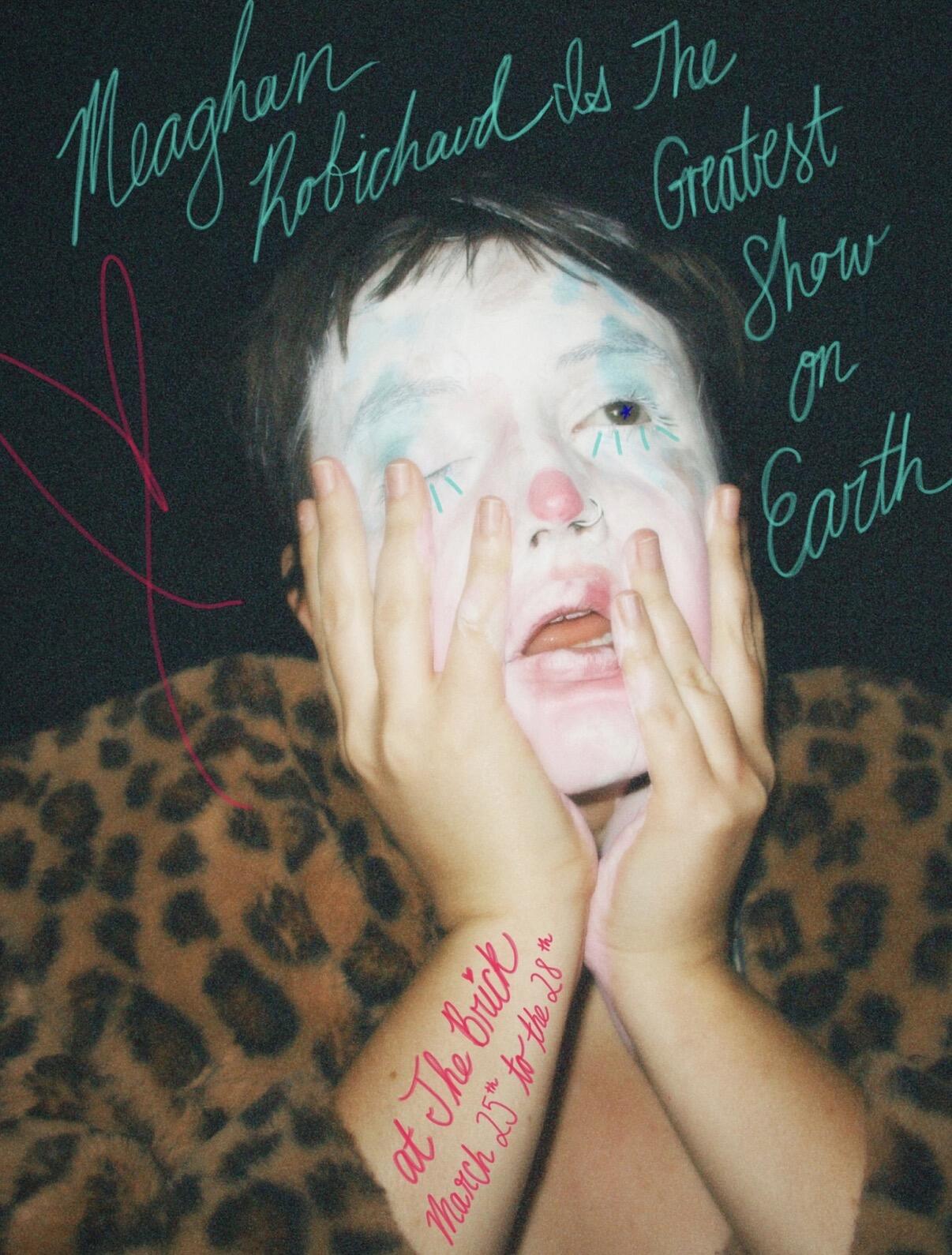

It was supposed to be a variety show, something our grandparents might have enjoyed alongside our parents in lead-painted houses bought for five whole American dollars.
The Human Cannonball (Ring Yang) opens Meaghan Robichaud Is The Greatest Show on Earth. They wear tights and a giant inflatable ball in which they attempt to roll and spin, though they never do. The ball—what sociologists spend years of studying to learn to call a child’s toy—turns on the Human Cannonball. Failure comes back to kill. The Cannonball becomes a body under assault by that which defines and protects them. But the Cannonball triumphs by knife, becomes a ball conqueror, and makes a beanbag chair of the ball that tried to make them into a David Vetter bubble boy, suffocated forever and ever. Atop it, they eat jerky.
What comes next is probably the show that lost Meaghan Robichaud’s Spunky T. their job. Though mentioned only once, the show’s framing device is that it occurs within the memory of Spunky as they die in a Reno motel and reminisce over their old circus show back in San Antonio.
They’re joined by Cheetah Man (Matt Gerkin), who provides accompaniment on guitar. He plays “Stairway to Heaven,” “Wild Thing,” “Entrance of the Gladiators,” and other songs that reminded me of Joe Pass and Chet Atkins. Gerkin’s guitar work is not background for a musical; it remains subordinate to Robichaud’s spectacle.
Often, in clown and puppetry (both having a theatrical moment right now), there’s an urge to leverage genres and props for their nostalgia. Robichaud does not do that, and the audience is left better off by it. So, the variety show never happens (though each night of its run at The Brick has a different guest, including Live Animals and World’s Biggest Head).
The body of the American people is fundamentally unserious. Twain, Kennedy Toole, DFW, Patricia Lockwood: some of our greatest authors prove that, most of the time, the national condition is not at all receptive to introspection if it doesn’t come with a knock-knock joke. We need sugar with all of our medicine. Venturi in Vegas, or every Substack writer in Brooklyn: we seek playgrounds to justify our critical attempts. Peak American art would be a touring rodeo backed by a slideshow of historical facts regularly cited by Frantz Fanon before it all ends with someone getting pie-faced.
It’s a constant struggle to determine if Spunky or Robichaud is fooling around on stage. Spunky reminds the audience of the show’s name, though their actor’s name is in it. The barrier between the two is porous. Spunky was on the stage, but Robichaud was the one reaching out beyond the barriers we pretend are there, reaching out even to me.
I was singled out as one of three Glasses Guys and told to shut up (deserved: I was trying to have a whole conversation with Robichaud). Later, Robichaud calls on an attendee to join them on stage. The attendee demonstrates a somersault, something Spunky could never do. They’re with one another among all the joys in attempting. Together, they tugged a rope, which collapsed the fabric that hung over the stage like a canopy over a child’s bed. Together, they imagine the present as being worthy of memory, finally some nostalgia for Spunky as they die in that motel room. Any given moment of joy or struggle is the lament of a dying clown. Even in their final moments, they remember their struggle.
It’s witnessing a life of mistakes, a life deserving of acceptance. Life is lived by a human body in all its grease and spasticity. Robichaud’s makeup smears as the show goes on, and their clothes keep slipping off. That, with the hazy air and bottle of lube, produced a smell that wasn’t really there, like old clothes pseudo-renewed by two weeks at the bottom of a hamper, now drafted for dutiful reuse.
Robichaud acts out a radical display of a normal body, a body beyond critique. At first, a clown in a curly rainbow merkin with breasts slipping out of their overalls appears as parody. But clowns with tummies are also entitled to be revered, to be consenting figures of desire. In darkness, Robichaud unclenches their stomach, tightens their core in light. People with guts deserve to love themselves, too.
Spunky fails to juggle bowling pins, fails to ride a unicycle, but successfully rides a toy car (and aids a German attendee in doing the same). Hitachi wands lie on the ground (never used: a pre-show illusion of sexual repression) and Americana objects, like a moonshine jug that Robichaud exalts. Their world is a body of objects.
Those objects take on an American abstraction. Spunky glorifies drunk driving (an extreme sport in Wisconsin, akin to dirt-biking) and an ex-wife’s bloody underwear. Miserable solo acts that show an urge to be held that only grows in the absence of another, even when love feels like too big of an ask. Far gone since the start, always rolling downhill, accumulating mass and sticky dirt and crud atop open wounds along the way: Robichaud/Spunky and the country they represent appear too fast to die. And we’re here in it with them, wanting to be frumpy bodies, supplicant and accepted.
But someone’s got to leave, so it’ll be the clown, who must die or go away in some way. A second clown (Matt Gerkin again) appears with a knife, as if a specter ready to finally put Spunky out of their misery. Instead of ending their misery, they shepherd Spunky (at least part way) through it, like they caught their angel of death on a good day. They hold each other, and sing Sondheim’s “Send In the Clowns:” “But where are the clowns? / … / Don’t bother, they’re here.” But we’re Americans, and decades of sugar have made us resistant to ending sweetly, so it ends with a pie in Robichaud’s face.
Leave a Reply to Kat LCancel reply