
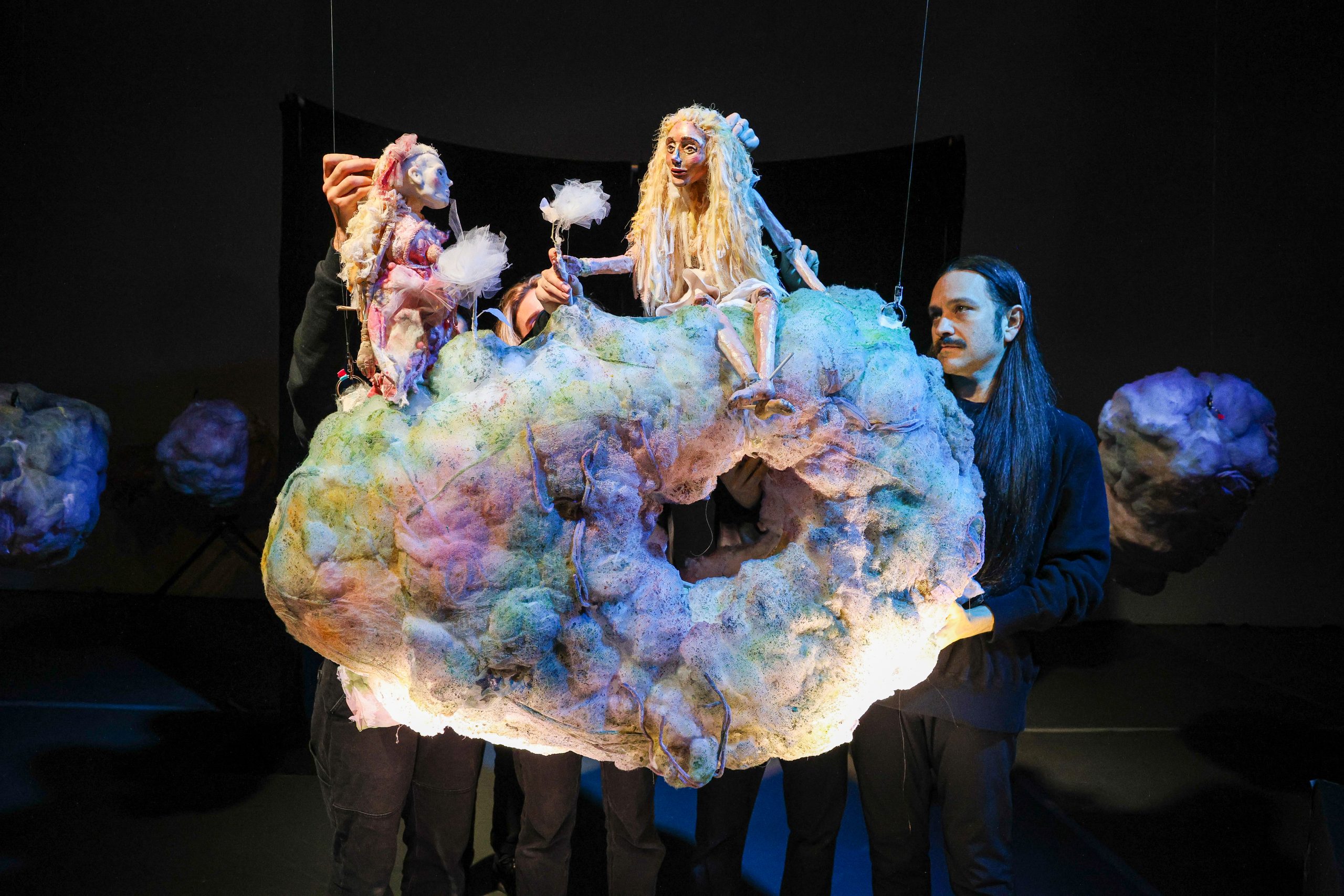
How do you find agency in free fall? How do you assert identity and transformation in circumstances outside of your control? These were the questions at the front of Emily Batsford’s mind when they began work on Cumulo, a whimsical and harrowing puppet journey inspired by a recurring nightmare. Cumulo follows its protagonist, Plum, on a free-fall descent through sentient clouds and encounters with violent sky creatures as Plum seeks wholeness, autonomy, and a soft place to land.
Though the piece’s origins are specific and personal—rooted in Batsford’ experiences during the early days of COVID-19 and their lifelong quest for embodiment—the story is universal. A human figure falls. A human figure longs for home. There is something innately accessible in nonverbal puppetry. Unconstrained by text, the audience has room to interpret the broader language of gesture. That openness informs the show’s intricate sensory landscape, including floating cotton candy propelled by a custom wind machine. We all know the feeling of falling. We all know the desire to touch. Drawing on years of work with people with disabilities, Batsford treats Cumulo as an invitation to connect building access tools into the audience experience. You can touch the props, enter the world, and meet Plum’s story where you are.
I spoke with Emily Batsford in March via Zoom. We discussed accessibility, the language of puppetry, and the transformative power of skydiving.
This interview has been edited for both length and clarity.
Annie Rasiel: Usually I read the script before interviewing artists about new work, but this is a nonverbal piece. What can you tell me about the show?
Emily Batsford: Cumulo is a nonverbal puppet piece. We follow the protagonist Plum in free fall. We never see where they come from, and we don’t see the ground. The main question of the show is how we claim autonomy when the circumstances of our life send us into free fall. This story is about what happens to our protagonist, Plum, in the fall, in between here and there. The show is gestural, and there is a narrative, but we’re also really interested in creating a high fantasy atmosphere and building a world. Things in the sky are sentient; they have interests and needs. The show uses cotton candy, and the set is embedded with fans, so we can create wind and a sense of drag as we’re falling. It’s an immersive experience; we pull people into this world.
AR: That sounds beautiful. The clouds, the cotton candy– are those elements all around the space or contained on stage?
EB: The set is designed to be a void. We want Plum to feel like they are existentially alone in certain moments of the show, and then we’re really deliberate about when we bring in other elements for them to react to and interact with. We give the audience the chance to interact with components of the show ahead of time. We give them cotton candy, and there’s a touch table with objects and some artifacts from the show. Then during the show, we’re very strategic about how we introduce these elements. As the audience comes out of the show, those same things will be available for them, hopefully with some new meaning and significance.
AR: Who is the audience for this show?
EB: When this show was first beginning, it was really personal. It was based on experiences and sense memories and questions that I had about my identity as a queer person. We were coming out of lockdown, and there was this sensory craving. I was exploring what my body needed in order to feel like it was in equilibrium. As we settled the narrative and started to move past these first inciting bits, it became about a universal feeling. Everyone has felt in between, like they don’t belong, like life is moving too fast.
It’s for fans of whimsy, for fans of suspense, for anybody who believes in the magic of imagination. It’s based heavily on the worlds that I grew up loving, like the Dark Crystal and stop motion animation. We’re taking inspiration from many different forms. There’s dance and obviously the technological element. I think it’s for the weirdos and the dreamers and the people who feel like they’re fighting for a life society doesn’t want them to believe in. We’re telling an adult story, but the aesthetic of the show is appealing to everybody. That’s part of why I love puppetry so much. It’s wonderful for young minds. This is a story about self transformation, and I think anybody who’s gone through any kind of personal metamorphosis is going to find something to connect with in this show.
AR: Can you talk about how you created the puppets?
EB: The initial inspiration for the main puppet for Plum came from a recurring dream I started to have during the pandemic of a figure jumping off of a cliff, off of a mountainside, and dissolving into vapor on the way down. It started as conversation I would have with people I knew were fabricators or creators. It was a party trick; I’d ask, “If you were to stage this moment [the jumping, falling, dissolving figure], how would you do it?” The more I talked to people, the more I realized that it was something I needed to create.
I had worked with Yuliya Tsukerman, who created all of our objects, on a number of projects and had fallen in love with her aesthetic. It’s beautiful and delicate, but also kind of strange and fantastical. The initial puppet that she created for this piece felt too small, and the expression was a bit distant—though that original puppet is still in the show in a different role. Because so much of the impetus for the show was personal, Yulia made the decision to base the facial design of the puppet on my facial structure. As we have developed the show, it has felt profound to watch this version of me go through this harrowing story.
As a puppeteer, I’ve experienced rehearsal rooms where we’re meant to be as invisible as possible, and I’ve experienced rooms where the director has asked us to be more present and live the experience of the puppet emotionally. In my own work, I prefer the puppeteers to be invisible, unless there’s a reason to step forward and comment on what’s happening. But it’s almost impossible for me to be 100% invisible in this show, because that connection is there. It’s terrifying for me, and also kind of extraordinary, because it challenges me to honor what I’ve created—and it challenges the audience to recognize the story in a more tangible way as well. There’s a human figure on stage who is reflecting back that story to them. That facet of the show has been a surprise to me. I really thought it wouldn’t matter if the puppet looked like me, but of course it does.
AR: Do you see the puppet as a stand-in for you?
EB: I am learning about myself through these puppets. They aren’t always a direct allegory for what I’m going through or who I am, but I talk about them in therapy a lot. I think when you make any kind of story, especially one that’s devised, facets of yourself are going to show up. I feel really lucky, because my collaborators are incredible puppeteers, creators, fabricators—just incredible dramaturgical minds. I feel really lucky to have the team that I have around me. And it’s fascinating to be in a room where everybody is talking about themes that feel very personal to you, and to trust them to carry those ideas with empathy and care and love. Fortunately, that’s what has happened. Sometimes there’s a little distance there—like any performance, you are being seen, which is so vulnerable, and you’re on display in some way, but you’re also hiding in a character.
AR: Can you talk a little bit more about your collaborators?
EB: They’re amazing. My puppeteer team for the April run is Camille Cooper, Gaby FeBland, Justin Otaki Perkins, and Takemi Kitamura, and they’re such incredible puppeteers. Their attention to detail and empathy for the puppets is so high. I’m a pretty exacting choreographer, and I knew that I wanted people who were meticulous in movement. Working on puppets, especially in a nonverbal piece, the gesture has to be just so to convey the emotional quality of the moment. They’ve been very patient with me and my need for specificity. Yulia has made all of the objects. Joe Silovsky created a DMX-controlled mobile of floating cloud set pieces that we call the cloud machine. David Leon composed all of our music, and the score is this wonderful, complex creation of its own that helps transport us to the world of this show. Emily Bruner is my dramaturg. Allison Costa did the lighting design. Veronica Johnson is the costume designer. Pat Maliwat, Ash Winkfield, Ben Eling, Darren Brown. Frankie Alicea is our line producer. Publicity from Emily Owens and web/media support from Emma Gabel. There are so many people working on this piece.
AR: You’ve been developing this piece for a few years. Can you tell me about that journey?
EB: The initial impetus for this piece started during the pandemic. I found puppetry pretty late in my career. I was having some success as a stage and film actor, but there was something about the collaboration that felt isolating. I didn’t feel like I had found my community. Sam Jay Gold, who’s a dear friend and my puppet mentor, brought me to New Vic [The New Victory Theater] for a theater work development, and I remember being in that room and thinking, “Oh. Here it is.” It was a room where everyone spoke a language that I understood. It was this moment of, this is what I’ve been looking for. That was in 2018, and puppetry is all I’ve done since.
I was falling in love with puppetry, developing my skills and vocabulary, and finding my people—and then lockdown. The thing that I had just fallen in love with was taken away. And so, of course, my body was fixating on it. Suddenly everything was a puppet. How can I touch more things? How can I see more puppet shows? How can I still be part of this thing that I know I am meant to do? There were other things going on during that time, too. I was starting to look at my own identity. I grew up in an incredibly supportive family that was also incredibly normative socially. There were questions brewing in me about who I was, who I wanted to be, who I was attracted to, all of that, and I didn’t have an opportunity to ask them. During lockdown, the distractions went away, and those questions bubbled to the surface. There was the craving for this thing I love, the recurring dream of jumping and dissolving, and this new identity exploration—trying out new pronouns and having those conversations with myself about who I was. It was all the beginning of this show.
In September 2021, just as things were opening up, I went skydiving. That solidified it for me. I was expecting it to feel scary in the way that a roller coaster feels scary: your brain is doing the thing, but you know it’s safe. And then you finish, and you’re like, that was cool. But it wasn’t like that at all. The actual experience of skydiving was so profound. I had absolutely no nerve, up until the moment we jumped. I was strapped to a guide, so I felt secure. I had somebody to lead me. And then we jumped out of the plane and that sensory experience—the wind was so loud, and I couldn’t breathe because we were moving so fast. Time stopped, and I remember just thinking, “Oh, this is full embodiment, and it is terrible.” I loved it. I loved the experience. I think about it all the time, this realization that, as someone who is so sensory-seeking, who wants to be in their body—and I think puppetry in itself is a form of embodiment—to realize that the thing that I had been craving actually felt so bad was a powerful moment of catharsis. It also posed questions that we try to answer in this show. What happens when you’re in a situation where nothing is consistent, where you’re constantly in free fall, where the experience of being in your own body feels profoundly and permanently difficult? How do you find stability? How do you seek anchors outside of yourself? How do you find a grounding in your own soul? Those questions were the thematic inspiration for Cumulo.
We started to devise, and in the summer of 2024 Amanda Card and I got into my backyard with a couple of fans and some fabric and a shitty puppet made out of paper and just asked, “What do these do together?” That November was the first work in progress showing of Cumulo at Concrete Boom Volume Three, which was a puppet slam. We showed a second version of that work in progress at Special Effects Festival at The Wild Project that next January. Then I received the Culture Lab Emerging Artist Grant, which came with nine months of free space. We devised most of the show during those nine months. We had a five performance run in November that we treated as a workshop. We did all of the technical elements. We did a draft of the piece, with the goal of hearing audience feedback and collecting impressions, feelings, questions, and confusions. The show has received some really generous support from places like NYSCA, the Jim Henson Foundation, the Green Feather Foundation, and PATCH [Puppetry at the Carriage House] residency. Concrete Temple Theater is co-producing and has been an advocate of the show since the beginning. MITU580, where we’ll be performing, has provided us support through their Artists at Home program. I think it’s resonating with people. People are excited to see what this show is—and so am I!—and I think we’ve finally reached the point in the process where we’re ready to have this extended run, to invite audiences in and tell a really clear story.
AR: You said earlier that it’s been profound to watch yourself, the puppet you, go through this journey. How does that feel in the moment? How do you manage those feelings?
EB: I think this puppet has a particular resilience that I also have. The journey that this puppet goes through is harrowing and difficult, and there isn’t a lot of breath. As an artist, I really crave structure and work. I’m capable of a lot, but I find the idea of rest alien. I think there are tendrils of capitalism in me. To watch this puppet go through a really abstracted version of that and to watch their resilience and the toll that it takes on them is so heartbreaking and also incredibly affirming. It allows me to see the things that give me strength and the things that make me unique and powerful and capable and autonomous—and simultaneously all I want is for that puppet to stop falling, to find a place that feels like home. We’re all searching forever for a home. I am closer than I’ve ever been. I don’t know if I’ll ever find it completely. I think that’s part of my artist journey. This is a way to talk about it.
AR: Joel Coen once said every movie is an attempt to remake The Wizard of Oz. I feel that way about theater too.
EB: It’s all of those classic stories. Alice in Wonderland too. They’re seeking stories. I found a lot of inspiration in those narratives.
AR: And in Alice in Wonderland she spends so much time falling! Given that you’re the director and the lead puppeteer, whom do you turn to for feedback? Where do you find other voices?
EB: I trust my team. I trust their opinions, and often they are my mirrors. We also record rehearsals constantly. It has been so deeply collaborative. Part of what I love about devised work and about puppetry is that it has to be that way. It’s much more difficult than being on the outside, but it feels that much more rewarding. And the puppetry community is really tight knit, so there are people that I invite into the room for feedback. Everyone’s excited to support each other, so it doesn’t feel like I have to rely on any one voice, including my own. The entire community has really stepped up to support this piece.
AR: Earlier you mentioned that when you discovered puppetry it felt like finding a language in which you were already fluent. Can you talk about what that language is and what it is about puppetry that created this feeling of belonging for you?
EB: This is not by any means universal, but I think the physics of puppetry is really satisfying for me. There is a moment when something works—when the world is correct, the rules of the world are correct, and the character is really living presently—that feels like a click inside my body instrument. There’s a timing. It’s like comedy. You’re on the same page with all the puppeteers that are on this puppet. You breathe together. It feels like an instant flow state. I love the problem solving of it, the causality of puppet movement and what a gesture suggests emotionally, how we indicate big ideas through literal and sculptural movement. I also love that we get to communicate nonverbally as puppeteers, feeling each other’s movement. I like feeling in my body. I’m a big fitness junky, so it’s nice to be able to feel the strength and power behind an intention in my own instrument and share that with other people.
Puppets have incredible potential for catharsis. As an actor, I can only tell a story through my own physical appearance. I can put on makeup or I can add a wig, but the audience is always going to meet me here at what I am, and there’s not much I can do about that. With a puppet, we have infinite space in which to meet. There’s so much room for imagination.
AR: Have you been tempted at any point to add any text?
EB: It’s funny, we’ve had to create quite a bit of text around the show, actually, for things like marketing and access materials. Some people really need outlines of what is happening in a scene. It’s been a delicate balance. I have not felt tempted to add text to the actual events of the show, but the framework around the show does have text. We’re trying to provide enough context for people to feel like they are welcome, but not so much context that we’re taking away their permission to interpret. In any devising process, you develop in language—names for puppets, characters, objects—and as we’ve moved towards an external presentation of the show, we’ve had to change a lot of the words we use to make sure that they accurately represent the function of these puppets and objects and not to give too much away.
AR: You mentioned access materials, and I noticed that your bio opens with “their artistry prioritizes inclusion and accessibility.” Can you talk about what those terms mean to you?
EB: I come from an access background, meaning that I work with folks who need special accommodations. Access to me also means financial access, cultural access, physical access. We’ve built access pillars for our audience like a social narrative and the touch tour. We’ve built the pre- and post-show experience so people are able to have that up close experience. For folks who appreciate detailed information, that is provided. We’ve implemented tiered ticket pricing. As a working artist, I can’t afford to see most art. If someone can’t afford the ticket prices as they exist right now, I hope they reach out. We want to make sure that people can see the show if they want to. I also think that access can mean taking away language. Part of the point of a nonverbal story is meeting people where they are, in terms of processing time, in terms of interpretation, in terms of identity. I want this presentation to be as universal as possible.
We’ve worked really carefully with MITU580 to make sure that it’s a welcoming space. I do want to say that the venue is not ADA compliant because the restrooms don’t fit a power chair. When we were thinking about venues, we had a really long conversation about what that means and whether we were honoring accessibility. We’ve built out other physical pillars to make sure that those folks feel included in other ways. We’re making sure that there’s ramp access everywhere and paying attention to things like points of egress. We’re being as thoughtful as we can within the parameters of our show. I also think access means being open to feedback. We tried to make that a priority from the beginning. We’re thinking about how to meet each audience where they are and opening up opportunities for people to share what they want from the experience. We want feedback! It’s an ongoing dialogue.
AR: Do you have any dreams of what might be next for Plum and for this show?
EB: I have so many dreams. My dream for this premier run is to have a diverse, excited audience share in this journey with us. Transparently, we are running twenty-one performances because I think the puppetry is extraordinary and want folks who are on nominating committees to see it. The people on my team are amazing creators, and I want them to get their flowers and audiences and critics. I think this show is being designed to tour. I would love to expose all people in all places to this form of puppetry, to our love of the art form, to Plum’s story.
AR: Would you go skydiving again?
EB: I’ve thought about this a lot. For many months after it happened, I said, “No, absolutely not. I’ve done it once, and I remember what that feels like, and that’s enough.” The further I get from it, the more I think, maybe. I would love to take the team of Cumulo skydiving. That would be a really powerful experience for everybody working on the show, and in that instance I would definitely go again.
AR: It just has to be a community effort!
EB: Exactly. I know what it meant for me, but let’s do it together and find out what it means for us.
Photography by Ken Pao Studio.
Leave a Reply