
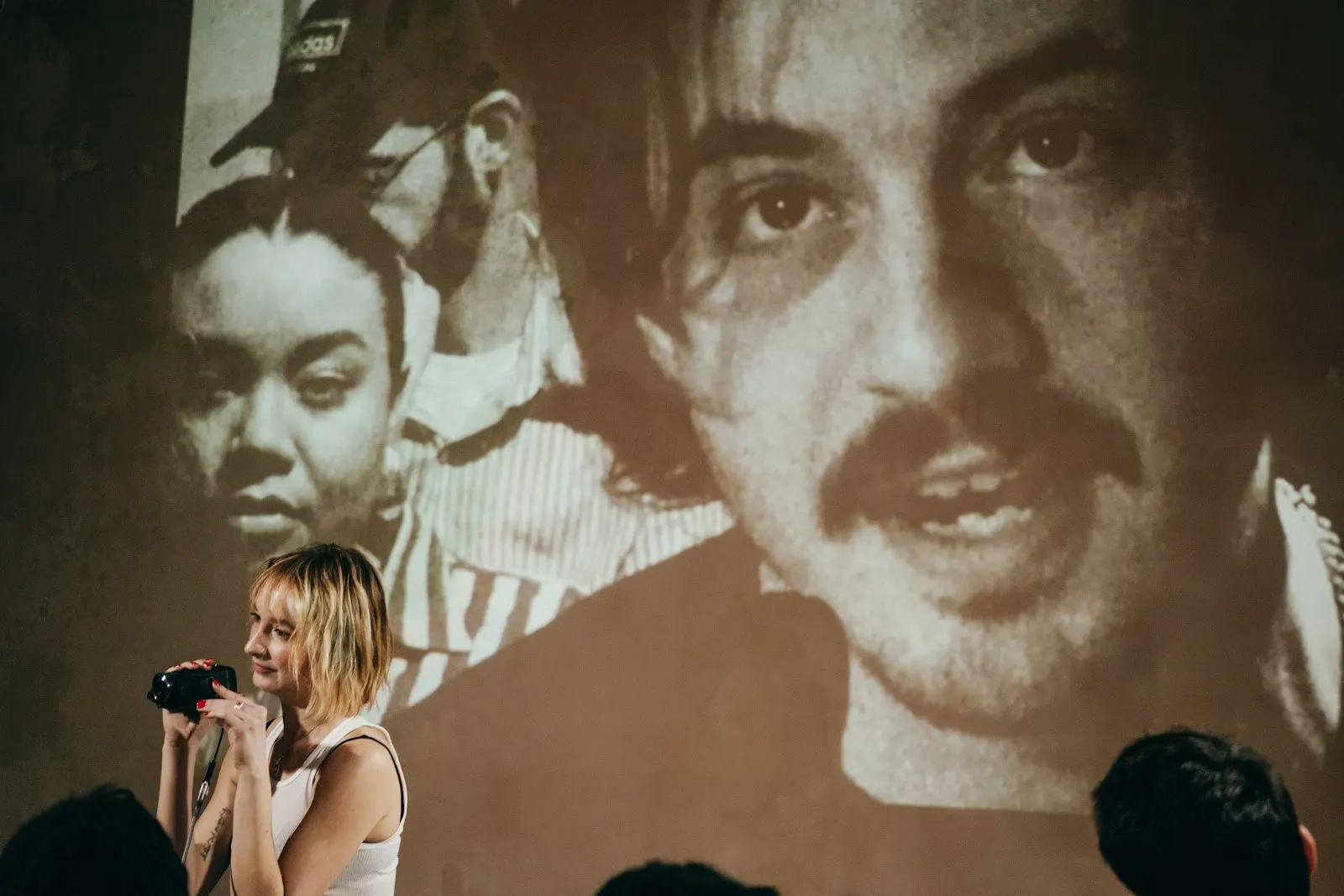
A willing or unwilling audience. A camcorder. A projector. A script. One ebullient actress. These are the ingredients for intimacy; or, rather, these are the ‘conditions’ that make intimacy possible in playwright Sophie Dushko’s Verité. Verité, which debuted two years ago, enjoyed a two-week run in early March at a loft space in East Williamsburg. After one mistaken venture into a loftspace hosting a ‘sip and clay’ pottery night, I found my way to the second-floor event space. I am handed a paper cup of boxed-wine upon entry (très chic!). People are milling about and exchanging niceties.
The setup in the loft is straight-forward: four rows of metal chairs face a blank wall. A lone barstool occupies center stage. A stack of paper, presumably the script, sits heavily at the foot of the barstool. I imagine that many of the audience members are friends or collaborators of Sophie’s. And yet, when Sophie enters the space, I sense that the people seated around me, people who likely know Sophie in a greater capacity than myself, are also wondering to what degree the play has begun. Can the piece’s start occur beyond an instant?
Sophie’s entrance into the space has the casual air of someone re-entering a conversation they got whisked away from. She is jovial, almost elusively so— or, if not elusive, I at least want to be let in on her secret, on the reason for her good mood. Not five minutes into the piece, Sophie reaches for the camcorder resting expectantly between me and my friend. A projector is switched on and Sophie laughs as she swings the camera around to face the audience. She scans us carefully, singling out, from time to time, one audience member in particular, zooming in on their hands or face. People seem variously bemused and uncomfortable. Others seem utterly indifferent to seeing themselves projected onto the back wall. They seem to be thinking I’ll wait patiently until this part of your experiment is over. A man in the front row has a particularly theatrical response. On camera, his face is striking. Maybe he knows this. Through gestures that convey coyness or flirtation (he smirks and hides his face in his hands), he displays an unwilling wantingness to be filmed. I think maybe he is Sophie’s partner, but he is not. Sophie points the camera at him, and asks, can you help me with something? He, predictably, says, no. His “no” is a catalyst for the rest of the play, which unfolds with the help of the man sitting next to me and, unexpectedly, myself.
We are cast as quarreling lovers. Have you ever broken up with someone on a park bench, Sophie queries, it’s kind of like that. But the point of the Verité is neither its characters nor its plot; both aspects of the play are nebulous and ungraspable. Rather scene-reading is the vehicle through which the playwright Sophie explores questions of intimacy and vulnerability.
Early on in the play, Sophie directs me to film my scene partner; she hands me the camcorder. I understand I’m supposed to be impish. It is early in the morning and we are in bed. He, my conscripted lover, is exasperated; do you have to film me right now? I, the audience-member-me, was timid at first, not totally sure how to use a camcorder. My camerawork, which was being projected in real time onto the back wall, was static and uninspired. That is until I realized that I was doing horribly at my assigned task; a lover wouldn’t just hold a camera. Out of curiosity and unthinking admiration they would find a most flattering angel or zoom in on an especially beloved freckle. I reset. I zoom in on his jaw line, his smile, the small of his ear. I am performing the task and it feels honest and suddenly I am laughing! This scene cuts to the core of Verité as ‘an experiment in intimacy’– through acting out intimate scenes, two strangers become less strange to one another. A few days after the performance, I sat down with Sophie to talk about how Verité came to be.
This conversation has been edited for both length and clarity.
SF: I’m curious to know why Verité had to feature you?
SD: The text is very personal, even while being very distanced. A lot of my writing, even in my more narrative plays, has that sort of unsaid thing going on.
SF: There’s a lot of inferring going on…
SD: In Verité… I think I was exploring…I had a few relationships with people who were collaborators… romantic relationships with other artists and I was trying to process what it means to be a young woman artist who is not a filmmaker but using the metaphor of a camera to talk about what it means to be a writer and what it means to be a director. Someone in charge of the narrative coming from the perspective of someone often objectified in a work, often the object of a work. People were asking for a solo play and I said fuck it, let’s do this… the doing of it is so much of the work– it’s also something that can’t really be rehearsed.
SF: Did you go into writing it knowing you would be filming people? You had the camcorder projection idea?
SD: The image started from a conversation I had two years ago. I often work from image, and I had an image of a young woman filming the audience and talking about her process, and the idea for that to go into different scenes with other people involved in the process. Initially those people were other actors she would be filming and then I got the invitation to do it solo, and I leaned into this idea of doing it with the audience…
The reason I love theater, and it was the reason I loved ballet and dance, is that relationship to the audience, and the fact that we all decided to be in a room together and that it doesn’t happen without each other and that it lives and dies on that connection. I think the voyeurism of that is really interesting and this piece exposes that in a lot of ways. As out of control as I feel about it, I am very in control of what is seen but I’m not in control of what is felt.
SF: The piece is really about creating the conditions for intimacy, it poses the question of how we might do this more often. Sitting, watching the show, I was thinking about how we’re only a couple of interactions away from real intimacy with anyone we encounter. I was wondering how much you mean it to be a commentary on social isolation?
SD: It was sort of unintentional, I was thinking about it more in terms of the artist-muse relationship, but doing it the first time I noticed each night the guys that I was using sort of latched on to me in this way that was very intimate… and they would come up to me at intermission and be like “that was sort of real though…” and it made me think about how starved we are for intimacy. There was this little latch happening, men like attention more than they would care to admit.
SF: Did getting those responses change how you played the role?
SD: I don’t think so, I actually tried to exploit it, I suppose a more sane person wouldn’t make this piece. Everything about me that is in the piece is the same thing that would exploit these men who think they have chemistry with me. I think the person who wouldn’t exploit this wouldn’t make this piece.
SF: I love this question you’re posing of “when does projection slip into something real and how can we know that” — you’re approaching a question of authenticity.
SD: For better or worse, I want art, the making of it and the receiving of it, to consume me, not to where it doesn’t feel real, but to where it takes over. As much as I love creating art and directing and writing and plays being fake, there’s still a thing inside me that’s like…. “There’s a little bit that’s real.”
There’s a part of me that wants that fantasy of the showman … and this piece lets me kind of dip a toe into playing with that, playing with fire, with real intimacy, which is combustible…which is why it’s not safe to do in repeatable acting. The cast of a play shouldn’t be playing with that fire all the way because that’s not safe, but in this situation… They’re total strangers.
SF: There’s a container–
SD: We have a container. We’re not touching. I don’t know you, you don’t know me. We kind of dip our toes into that thing that is kind of sexy and exciting for all of us in art…. We want to believe that the characters on screen are really in love with each other.
It shows how fake it is and how real it is at the same time…. You wouldn’t know the audience-actor next to you, but if you look at it on the screen you, in these little, tiny contextless scenes, you see chemistry, you see history… even though you’re barely looking at each other or touching each other, it’s kind of magic. It’s felt in the air, I think.
SF: Totally. When I was filming him [other audience-actor] and we were “in bed together”, it’s a sexy little “film me don’t film me” moment and it prompted genuine laughter from me— the doing it… the acting out of the scene… cut to the core of what you were getting at… acting out intimacy slipped into a moment of genuine ‘closeness.’
SD: That scene is so… I think there’s obviously a lot of flirting between me and the guy in the first two scenes… but it’s distant and it warms up a lot… and then it gives in a bit and then it goes right into a hyper-vulnerable scene… it is funny, it is flirty, it gets you out of your comfort zone.
The play keeps changing the circumstances on you and forcing the audience-actors and the audience into this new level of intimacy… and yeah the response to that is laughter….. when you’re really seen, when you’re vulnerable, it’s a beautiful thing and also like it makes you wanna laugh, it makes you wanna hide or go into whatever your mask is… which is then blown up onto a projector [laughter]
SF: When I was doing it I didn’t see myself [on screen] at all because I was so in it. As a dancer– it’s very ironic, I’m not always in touch with my body— I sometimes feel overly analytical. I had my little notebook out to take notes and then you put me in the play, I was so in it I almost had a hard time keeping up. I’m so present I feel scattered, I’m not even processing…
SD: I relate so much to what you’re saying. I was thinking about this piece in terms of control and lack of control. I think I love control. I think that comes from ballet.
SF: Very relatable. I can feel that in the piece- you’re very much in control.
SD: Except I can’t be…. I create enough of a container but I also never know what’s going to happen. I don’t know who is going to be there, how they’re going to respond, what their energy is gonna be… I think when I was making it I didn’t realize how scary it was going to be. When I’m making art I really love, when I feel really good about my work, and the thing I’m always searching for is surrender, is true presence.
I know I’m doing good acting when the words are moving through my body, my body is moving through space, but I’m present– this piece really forces this out of not only me but out of everyone in the room. It was really interesting filming it. At the last performance I didn’t know anyone in the audience… people’s response to being filmed is crazy.
SF: What’s the craziest response you’ve ever gotten?
SD: There was a woman in the front row who was so uncomfortable she just kept laughing…And she was sooo…. her laugh and her discomfort was so uncomfortable that it threw me off the text. It was the first time that I ever lost my place in one of the monologues because I was like, “I’m so sorry”…
SF: That was your response? You felt guilty?
SD: I felt guilty, and it wasn’t serving her and it wasn’t serving the piece… maybe if it was the last show I would have felt more comfortable but it being the first show… yeah, I am objectifying everyone, it can suck… it doesn’t feel great doing it all the time. It’s vulnerable for me to objectify people.
SF: There’s something, at least how I took it and maybe it’s because I also enjoy performing, but to put it back on the audience…. there’s something thrilling about thinking “oh, I’m going to see someone perform” only to find out that you’re included in the performance. Maybe it makes some people laugh or feel uncomfortable. I know you’re going for an objectifying sort of thing, but there’s also something about it that’s inclusive and welcoming. There’s that both/and of you’re included in this and I see you and maybe you don’t what to see yourself. But I see you and I don’t… you’re not judging…. SD: I’m not judging…
SF: No you’re not. It felt very, “aw look here we all are”… that’s sort of the tone you set.
SD: That’s really important to me… My least favorite thing when I go to see theater is not feeling acknowledged.
SF: Are there performances that have stood out to you in terms of not feeling acknowledged?
SD: I think most plays are on Broadway… I talk to my friends about sitcom plays or plays that feel like they could be a tv show or a movie… I think theater, to me, truly fails to get people when it feels like it could just happen over and over again. It doesn’t matter who’s there when it happens, it doesn’t matter that it’s live at all. And when I see that, especially now, especially when we could watch anything on the screen at any time… and not just like the advent of film killed in the theater… like, we can watch something in the shower… And so live art has to be inclusive, it has to honor the fact that we all decided to put our screens away, to sit down to watch, to witness, to be present.
SF: How would you describe the theater scene right now, how do you locate yourself in what you imagine to be the current landscape?
SD: I think if I see one more adaptation of classic literature by a British actor who’s been in a prestige tv show I’m gonna be really upset… [laughs]. In terms of big money theater, money is going to star-casting so we’re not paying money for sets, everything is minimalist production….
SF: Are you saying we don’t need Keanu Reeves?
SD: That’s just something I’m seeing… minimalists sets and production. On the other side, in the downtown scene I’m seeing a lot of work that is really exciting intellectually and very image-forward, but I walk away not feeling a whole lot… and then there’s the indie landscape, like living room scenes that I think are commendable but it’s not what I make … so where I’m fitting in right now– I feel torn between I want to make a play with a capital P and then there’s this other part of me that wants to keep going down this train that is almost performance art, like little experiments.
SF: Verité definitely falls into performance art.
SD: It does, I call it an experiment in intimacy and an experiment in performance. It’s very different from my other work. Because making theater is so expensive and New York is so expensive and theater has been dying for centuries…it just gets worse and worse and bleaker and bleaker… I haven’t stopped doing it and I don’t think I ever will. I think the magic of a transformative, live experience is one of the most impactful things that a person can have in our society right now. True catharsis feels so inaccessible right now and we’re so in need of it. I don’t think Verité is asking for true catharsis, but I think seeing and being seen in a real way…
SF: It [Verité] sort of prompted me to think about where in my life intimacy is lacking…
SD: It makes me think about that in my own life… I’m seeing people from a very specific vantage point. And seeing the people who came holding hands, and zooming in on that, or the people who came closed off and shut down.
SF: I’m curious to know, if you can articulate it, what is intimacy to you?
SD: I think intimacy is presence. I think you can’t have intimacy without presence. I think it’s honesty. I think it’s almost as simple as seeing and being seen and that is actually way harder than it sounds.
SF: It’s so hard. I remember in my early 20s my therapist said, “you need to work on being vulnerable” and I thought about it for a second and I said “what’s being vulnerable? I don’t know what that actually means.”
SD: What is it to you?
SF: I guess I landed on vulnerability is a willingness to be seen despite negative aspects of self.
SD: I remember when I was 20, 21 years old we would do 3 hours of Meisner training a day, and one day my teacher was upset with me…she said you’re not letting yourself be seen, and she said I want you to come into the rest of class with no makeup on. That was hard for me because it was scary. I think Verité, the arc of it, is very concerned with my own relationship to being seen…. this person who is able to be so charismatic and flirtatious and create this idea of intimacy but she also doesn’t let anyone see her. As artists and as creators and performers, too, we can know what it is and perform it…
SF: On an intellectual level…
SD: But can we actually do it? Can we do it in reality? I love to be looked at, but do I love to be seen?
SF: It’s a great distinction to make.
SD: I think that’s one of the real seeds of what Verité is actually about… what it is to be looked at versus what it is to be seen.
SD: It’s funny because I’m super vain.
SF: Aren’t we all?
SD: I think growing up in ballet and looking at myself in the mirror for long periods of time my entire life, I think I love doing the show. I love making people look beautiful, I’m zooming in and blowing you up because you look beautiful. ….
SF: I think Verité is charging us with this task, to find what’s beautiful in someone else. The conditions you’ve created are asking us to do something specific, and it’s not necessarily to objectify another but..
SD: There’s a negative connotation attached to “objectification” which is really real and valid and I feel it all the time…
SF: To be sure, I feel it all the time… [laughs]
SD: But I also love being an object sometimes. I love being looked at. With this piece it’s more about objects as muse, as things of beauty… I’ve always been interested in that… When you go to a piece of theater, the person on stage is often the object that is the work of art… what happens if we’re all included in the art and there’s no subject really. Or, subjectivity is coming from me and it erodes throughout the piece which is why it’s important that the piece ends with me on camera
SF: I love that inclusion.
SD: I’ve been looked at by everyone but I haven’t let myself be seen and that’s the only way for me to close the play…
Leave a Reply