
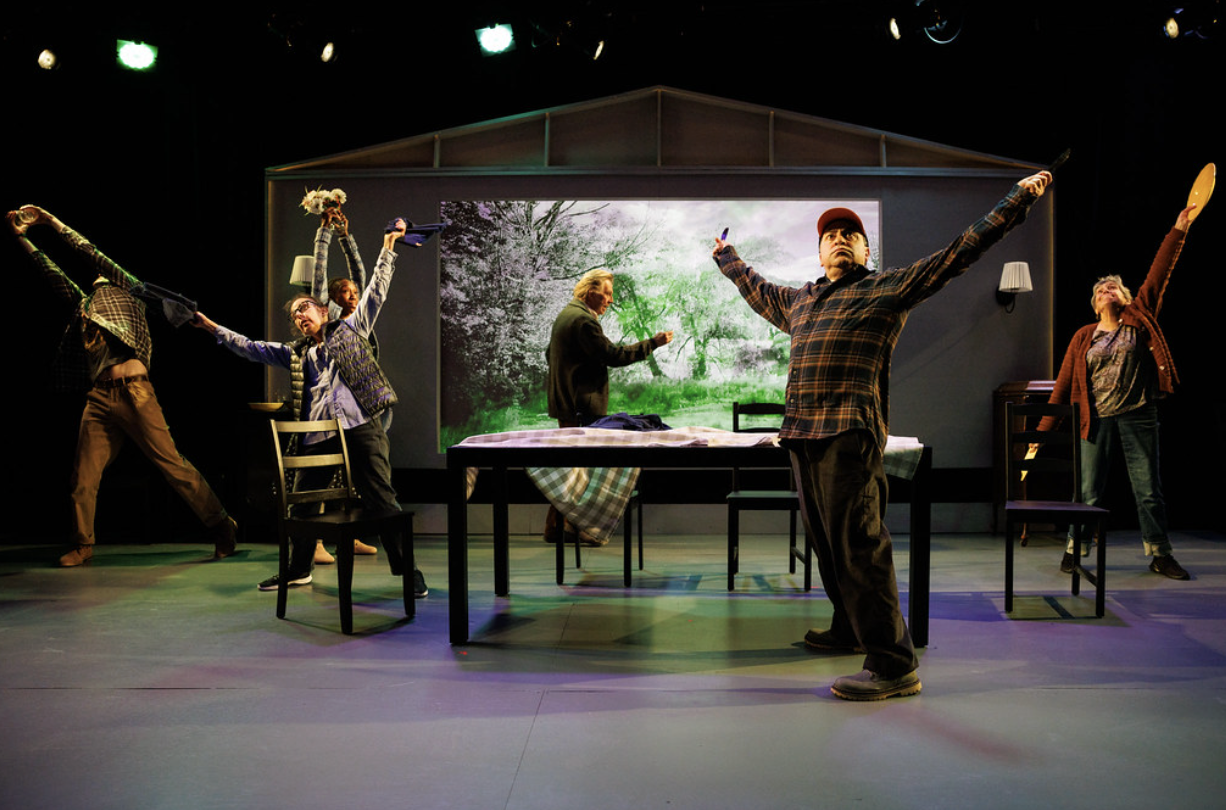
Under the cobalt blue ceiling of La Mama’s Great Jones rehearsal studios, the team behind The Door Slams, A Glass Trembles– the most recent offering from the venerable experimental theater company Talking Band– prepped for an early runthrough. On one side of the room, a lush assortment of costumes strain a set of rolling racks. On the other, a well-stocked table sags under the weight of full place-settings and myriad of other props. In between these two poles, a refreshingly intergenerational ensemble flitted back and forth in preparation. Notes are given. Blocking is marked. Lines are looked over. Amongst all this happy chaos, a small black dog named Ava roamed contentedly. It’s scenes like this that, despite every bit of better sense, draw and keep people coming back to a life in the theater. At the center of this revving engine sat the writer and director of The Door Slams: Paul Zimet.
Along with Ellen Maddow and Tina Shepard (both of whom appear in the piece), Zimet founded Talking Band over fifty years, hedging out even contemporaries like the Wooster Group in terms of downtown longevity. Even rarer still, Talking Band continues to produce work at a clip that might fatigue even the most eager of undergraduates. As part of their golden anniversary season in 2024, they produced not one, not two, but three original productions with collaborators such as Anne Bogart and fellow husband-and-wife duo 600 Highwaymen. Throughout all of this, Talking Band maintains a commitment to highlighting the simmering humanity and layered connections that knit us all together, especially in a city like New York. Chased, of course, with a propensity towards uncut theatricality.
Running until May 10th at La Mama proper, The Door Slams takes as its source material Thomas Mann’s celebrated 1924 novel The Magic Mountain. While the book takes as its setting a sanatorium in the swiss alps, Zimet’s take centers a group of upstate transplants seeking reprieve in an unnamed rural alcove. That is, until Mann’s mountain retreat bleeds into their world. Time warps and winds, stretching and contracting in ways that succinctly capture the feelings of lag and acceleration fueling the anxieties of our age. In capturing this sensation, Zimet and his cast (which includes Patrick Dunning, Delaney Feener, Amara Granderson, Jesse Koehler, Lizzie Olesker, Steven Rattazzi, and Jack Wetherall) present a potent combination of presence and precision that props up a powerful sense of ensemble.
I recently sat down with both Zimet and Maddow in their SoHo loft to discuss everything from the company’s origins to the art of listening to Zimet’s other half-century obsession: aikido.
This conversation has been edited for both length and clarity.
Patrick Denney: Talking Band has been making theater in New York since the early 1970s. What’s something that, fifty years ago, would never have been a part of your theatermaking process?
Paul Zimet: I think one of the differences then was that we had an ensemble employed all the time. It would be nice to keep that model, but economically, that isn’t possible. So, we learned how to spread it out over time and work on multiple projects at the same time. When we started, we had this ensemble that stayed together, that changed over the years. So of the core group, it’s just Tina, myself, and Ellen, that remained. But we keep bringing new people, and we do that intentionally.
Ellen Maddow: After the Open theater was over– where there was a kind of suspicion of language– we became really interested in poetry, and also music, and where those two things rub up against each other.
PZ: The first actual theater piece which we did was the Kalevala, which Liz Swados wrote the music for. It was based on this Finnish epic poem, kind of like the Iliad of Finland. They used to have two singers holding hands, sitting on a log, swinging back and forth, one person finishing the line of the person one before. That was kind of a starting point. But it was very spare and as we continued work, we worked more and more with designers. Design collaborators are a really important part of the process, and they’re in there early. We have this team of designers who have worked on the last three shows together and that’s really great, because they really have a language they share, an understanding.
PD: Something that feels rarer and rarer in American theater these days is the clip at which you all are producing work. It seems like it’s at least one to two shows a year regularly. Would you say that’s accurate?
PZ: Yeah, I mean, I think we’ve increased the amount we’ve been doing. It’s partly because we have several shows in the pipeline. When we did our fiftieth anniversary year, there were three new shows. That was really something for us. But one of the pieces, the 600 Highwayman piece, we had been developing for 4 years–
EM: It’s probably because of the pandemic, too.
PZ: Shimmer and Herringbone was also developed over a long period during the pandemic, when we really started working on Zoom a lot because people were in different places. That’s another thing we do: we commission different people to become the lead artist. In that case, Olivera [Gajic] who’s done costumes for this, was the lead artist. So we started with costumes for that piece. She went through the boxes of costumes to people in the different cities and they sort of created characters based on those costumes, and Ellen and I wrote a play based on the characters. And then Existentialism, which we did with Anne Bogart, we put together every quick, because that’s the way Anne works. She has a very different rhythm to it.
PD: It’s almost remarkable in its mundanity, to be consistently putting out genuine new work at the rate you all are.
PZ: I think it’s a number of things, but partly it’s our age, you know, how much time we have?
EM: How much time do we still have?
PZ: But I think we’ve also kind of developed a skill over the years of doing it.
PD: What’s the muscles you work in crafting that skill?
PZ: Well, we sort of get a head start, ’cause Ellen and I are married, we live together. So we’ve done a lot of kind of the envisioning the thing in our heads, even before we get into any room with people. It’s not like a being left to some last moment kind of thing. We’re thinking that through from an early stage.
EM: Also, the designers have actually all mostly worked with all the performers in various ways. So they kind of know who everybody is already, and feel comfortable. Everybody puts in their ideas.
PD: a true sense of ensemble there seems to be a really important jumping off point for the process.
EM: Yeah. The process is kind of already moving along, and they can sort of get on the train. Also, we’re willing to take a certain amount of risk. Isn’t that true? Yeah. Like, this is the way we’d like it to be, and we don’t have to make sure that our subscription audience is gonna like it.
PD: Where does the courage to take those risks come from?
PZ: I don’t know, if it’s courage, it’s a combination of “this is what we like to do” and stubbornness. We have this idea, we want to do it, let’s just do it.
EM: That’s always really harder than you think.
PZ: Yeah, it’s always a tremendous amount of work.
EM: We forget how hard it is every time, right?
PZ: Yeah. But then it’s a great delight when you actually see it come together, as you imagine.
PD: We’ve been talking a little bit about the timelines of other shows. How long has [The Door Slams, A Glass Trembles] been in the works here?
PZ: I started writing it two summers ago. Then we did a workshop at Mercury Store, and then we learned a lot from that. Then we did it, then I started writing it two summers ago. And Ellen was writing a lot of music, and we got a commission for Anna [Kirlay] last year– to do sets and projections– so she’s been on board for at least a year. Then we did another workshop this fall at Mercury Store, then another week this February, and, yeah, it’s been about two years, basically.
PD: I feel like you don’t get a lot of people talking about Thomas Mann these days. Why did the Magic Mountain resonate with you as a jumping off point?
PZ: Well, it’s because there was a new-ish translation of it, by James E. Woods. I had read it, as the character says in the play, when I was a young man on this freighter, going across the ocean for fourteen days.
PD: That’s a true story? Very Eugene O’Neill.
PZ: Yeah, and when I read this new translation– I was very affected by it then– but so much new popped out at me. The way that [Mann] dealt with time in the novel was really interesting. As a reader of that novel, you’re feeling the way the characters are experiencing the movement of time and how it keeps shifting. So I wanted to see if we can have the audience experience that, too.
PD: Mann is writing in a moment of such temporal change. I wonder if you see parallels between that moment and this?
PZ: Definitely. The whole background noise that’s surrounding these people is what’s happening now. There’s so much shit going on in the world, and in this country particularly. It’s always tricky to find that kind of balance in the material without the backstory. Yeah. You know? As I wrote it, things kept changing so much, getting worse and worse, actually. I actually kept putting some things a little bit more forefront than I had imagined originally, ’cause it just felt like it was necessary to do that.
PD: I never felt beaten over the head by anything, it seeped in in an organic way, almost miasmically. One of the lines that really stood out to me was this reframing of past and future. Instead of the past being behind you, it’s in front of you. Is that coming from you or Mann?
PZ: Actually, that wasn’t coming from either of us. It was an essay I read about time. In that essay, they mentioned these people who live in the Andes, an indigenous tribe, where they refer to the past as in front of them and the future behind them. Apparently, it’s true of some other cultures as well. It does make a lot of sense because as something you can see, these events that happened, they’re in front of you. You can’t see the future, so that’s behind you. That’s still coming.
PD: I imagine as you get older, there is a relief in the sense that the past is not gone, that it’s something you still can see?
PZ: The past becomes more and more important, It keeps coming up. I’ve just been telling [Ellen], I’ve been having these dreams of my father the past few weeks,which I usually don’t. My father died, you know, when?
EM: In 1990, maybe?
PZ: No, no, It wasn’t that long. It was right around the…
EM: Oh, your mother died first.
PZ: Yeah that’s right. Yeah, it was, like, 20 years ago, but suddenly… There he is very present in these dreams. So I think somehow the play is bringing it up.
EM: It must be. Because where are they coming?
PZ: That’s true. You have many stories that you accumulate.
EM: Yeah, you start to have a lot of things that happened.
PD: That makes me think, what does it mean to exist in a legacy, but also in the present? That you’re in the theater history textbook, but out still making new work in 2026.
PZ: I really don’t think much about legacy. I’m pretty interested in the present, you know, especially in the work. That’s where my excitement is. I think for us, that’s always the challenge and the excitement of it, how not to repeat yourself. How to make it new. You know, there are certain common threads in our work, but I feel like this piece is different from anything I’ve done before. I felt Triplicity was different from anything Ellen’s done before. That’s where the excitement is for me.
PD: I believe it was [Ellen’s] character who said that people open up to her “because they know I’m Listening.” I think there’s a lovely degree of listening in the play. Is listening a dead or a dying art?
EM: That line was taken from some truth in me. People tell me things, which is really great as a playwright. I just meet people in the dog park or something and, all of a sudden, they tell you a lot of things that are going on with them. People are full of things they have to say and stories and some of them are very surprising. I know with the internet and people’s attention spans, that is what people say– that people can’t listen for very long. Sometimes in the street, you feel like people are not in the present. They’re somewhere else. But I don’t feel like that’s true with people I know, though. Do you?
PZ: No, but I think another thing that helped us in being listeners is that Ellen and I worked as volunteer mediators for the last thirteen or fourteen years with the New York Peace Institute. We do all kinds of mediations: criminal court, civil court, family court. The main skill you learn as a mediator is to listen. So much is about listening, you know, because…
EM: Because part of what happens is a lot of people don’t feel heard when there is a conflict between two people about something. Nobody’s listening to each other. So if you can be a kind of neutral thing that the story that they’re telling passes through, then they can hear each other better. If you really learn– and it took me a long time to get good at it– you repeat back to people what they said, not what you think they said, not what you think they should do, or anything like that. Just really hear what they’re saying.
PD; And when you do that, you know, there they go “Oh, yes. Yeah, that’s exactly what I said!”
EM: I’m just transparent. I’m saying back what you said, you know?
PZ: But that’s also because you sort of make an instant judgment about a person when you see them, or how they’re talking, and stuff like that. To learn how to put that aside a bit, because you find, as they go on, that this person is not who you thought they were when you first met them. They reveal a lot. It’s a real skill you work on.
EM: There’s so many different kinds of people in this city, and so many different ways that people interact economically, that are underneath, whatever the regular thing is.
PZ: We meet so many people from so many different classes and races. And it’s a privileged peek into all these worlds that you might only superficially come into contact with. Another thing about listening. A very important part of my life has been practicing aikido, which I’ve practiced for 55 years, and I teach it as well. It’s a martial art all about receiving an attack. There’s a real listening in that, a kind of listening with your body. You’re sort of receiving the person’s energy as it comes to you, rather than some idea of what their energy’s gonna be. I think that’s helped, too.
PD: How did you start practicing aikido?
When I was in the Open Theater, Joe Chaikin used to invite all these different kinds of people to teach us all kinds of things. We had opera singers, ballet people, and Sufis, and he invited these aikido people. I just thought that was really interesting, so I just went to the Dojo, where they came from, and…
EM: Tina [Shepard], too.
PZ: Yeah, Tina too. Yeah. I just started doing it, and it’s been an important part of my life.
PD: Are there any other lessons from aikido that feed into your theater practice, or are they pretty inseparable at this point?
PZ: I think as a performer, it’s kind of a way not to panic. How to feel more centered in the moment. I think that’s helped. And just keeping me in shape, keeping me healthy, keeping me moving. All that, as well. It’s also about interacting with this wide range of people, ’cause they’re all kinds of people who do it, you know? From artists, to cops, to construction workers, all kinds of people. A lot of people are kind of like, “Oh, wow. That’s what you do. That’s what you do when you’re not in your gi.”
PD: Getting back to the theme of presence. As one moves up in age, is it harder or easier to be present?
PZ: I don’t know if it’s easier or harder. I think you’re more aware of wanting to be present, trying to be present. Maybe that means one is more present, but I’m not sure that it comes naturally. There’s still a whole lot of distractions.
PD: What’s distracting you these days?
PZ: I mean, there’s so much. The news, things going on within your friends or your family, just the myriad distractions that everybody has. I think it’s particularly hard to turn off now, because it’s so available just by checking your phone or…
EM: Keeps growing, dinging. It’s like “Oh, God, what happened now?”
PZ: Yeah. But I think one thing I love about theater is that both the performers and the audience really have to be present. It’s a moment demanding you to be present. The thing I really like about directing is that I am there in the room with the actors really looking at them, finding what will help people. Which actually is similar to what in teaching Aikido. When I’m teaching Aikido, I’m looking at what everybody’s doing and just saying, “what you let your hip lead the action rather than your shoulders” or something like that. Just all these little adjustments that demand a lot of being present.
Tickets for The Door Slams, A Glass Trembles can be purchased here.
Feature Photo by Maria Baranova.
Leave a Reply