
A good repertory company provides opportunity. Through the diversity of its programming, dancers can showcase the breadth of their skill, and audiences, during a single evening, can enjoy seeing them wrestle with an array of choreographic languages. The New York Theatre Ballet aims beyond good. Founded in 1978 and currently under the Artistic Direction of Antonia Franceschi, NYTB provides dancers the chance to study and perform roles drawn from ballet’s vast tradition, while also granting the chance to engage with works with modern and contemporary sensibilities.
In their recent Legends & Visionaries program at Judson Memorial Church, classical sensibilities mingled alongside their experimental counterpoints. In a robust programme including two premieres alongside a pair by 20th century pioneers, NYTB offered a glimpse into how dance traditions are often inspired by and in dialogue with one another.
Judson, an historical site steeped in post-modernism “downtown” scene, continues to showcase emerging and experimental dance artists. The space provides audiences members with the rare pleasure of witnessing performance up close: seated in the front row for NYTB’s performance, the dancers must’ve been less than 10 yards away from me. Legends & Visionaries is an exciting vehicle underscoring the virtuosity of ballet’s next generation. How often do audiences get to see classical dance in such close proximity?
The program opened with the premiere of “All the Flowers Are Behind Us”, choreographed by Julian Donahue, who danced with NYTB from 2018-2024. Previously, I had only seen his solo work “With Violets in Her Lap.” I was excited to see what he would do with this group of seven. Celebrating the vocabulary of classical ballet, “Flowers” revels in the use of space: Donahue creates a dizzy geometry of entrances and exits here as dancers burst onstage for a brief interlude before vanishing to start new sequences. Swift exchanges of tense drama between the dancers are glimpsed before a new moving image takes their place. What is lost, Donahue asks, when wildness is severed from the earth? While a solidly ensemble work, Mitchell Welsh shines in “Flowers” with his execution of perfect pirouettes, and Sarah Fernanda Stafford never makes a sound whenever she lands from one of her gravity-defying leaps. Julius Eastman’s solo piano score couches the choreography in cascading continuity, the music occasionally hinting at something more modern and minimalistic. Donahue achieves something similar with his dance vision: “Flowers” is steeped in balletic tradition yet also mines deeper themes. Throughout the piece, large artificial tulips constructed by Lily Guerin transform from hand-held bouquets to extensions of the costumes (designed by Carmella Lauer).
“Noi-Tar-Gim,” another new work, shows NYTB operating in a completely different mood. At first, choreographer Kevin Iega Jeff has his eight dancers assemble static somatic images, reminding me of Pilobolus. These living landscapes slowly smoulder into our minds before patiently shifting into a new one. Darryl J. Hoffman´s music is almost ambient, blending ocean waves with children’s laughter and a haunting chorus of “ooohs”. Sydney Gallas has designed colorful scarves, hats, and transparent raincoats to adorn the dancers´ bodies, giving “Noi-Tar-Gim” a more earthy, comfortable feel. But then, when the music shifts into a much more driving pulse, the dance vocabulary unfurls and becomes much more physically lush and sinuous, and almost feline. Iega allows NYTB to show off their individual abilities during this section, especially the talented Kristina Shaw and Sarah Simon Wolff. The movement language of the piece freely pulls from multiple sources, widening the lens of ballet to encompass a global perspective of dance references, suggesting new blends of ways to move. Following on the heels of Donahue´s more balletic expression, “Noi-Tar-Gim” travels across time, tradition, and style. Iega´s work with NYTB was a personal highlight for me.

Antony Tudor’s 1953 duet “Little Improvisations,” featuring live accompaniment by pianist Renee Ong, followed a brief intermission. Welsh charms as he dances fluidly alongside the beautiful Giana Parlin, the two sprinting through a choreography illustrating the lifespan of a young couple in love, from their first “meet-cute” to having a baby. Both delight in Tudo’s sweet and tender pas de deux, staged by Diana Byer. Parlin is particularly expert in conveying each thought and emotion in her face as this delicate story unfolds across a multitude of key moments between her and her beloved.
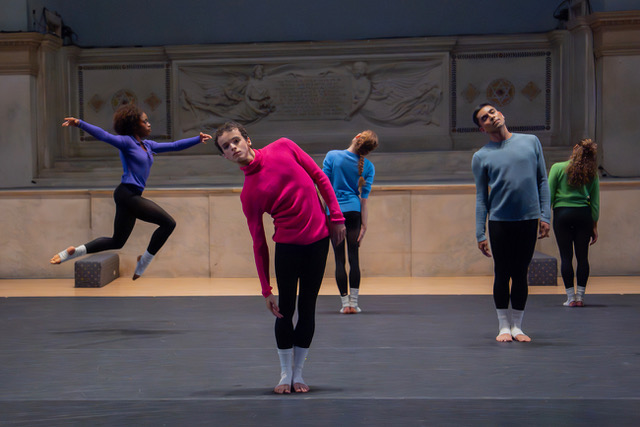
Legends & Visionaries concludes with Merce Cunningham’s “How to Pass, Kick, Fall and Run” (1965), staged by Jennifer Goggans. Instead of traditional musical instruments, John Cage’s “Stories from Indeterminacy” score is composed of stories, musings, and jokes. The scripts are read by veteran actors Paul Lazar and Peter Francis James, who laconically sit at a table in the corner (while drinking champagne?), while the NYTB dancers execute Cunningham’s formalistic choreography. Their alternating soliloquies are brief–containing everything from thoughts on the Sutras to learning to play bridge in a mental institution, and how Aunt Marge holds more affection for her washing machine than she does for Uncle Walter. Their voices overlay our perception of the dancers executing their various movement tasks. Spontaneous and accidental relationships emerge between what we hear and what we see: the actors’ voices become instruments, their words music. “How to Kick, Fall and Run” frequently tickles the brain with unplanned amusements, mixing up what we see the dancers doing while listening to Lazaer or James speak a Cagean koan. But this “chance operation,” a hallmark of Cunningham/Cage’s collaborations over decades, also creates moments of shared discovery between the artists and the audience which are quite moving. Watching NYTB perform “How to Pass, Kick, Fall and Run” is tranquil and curious, like watching one´s thoughts float by during meditation. A fine finish to a tasty array of work by this creative and talented group.
Feature Photo features a scene from How to Pass, Kick, Fall and Run. Photo by Hisae Aihara.
Leave a Reply