
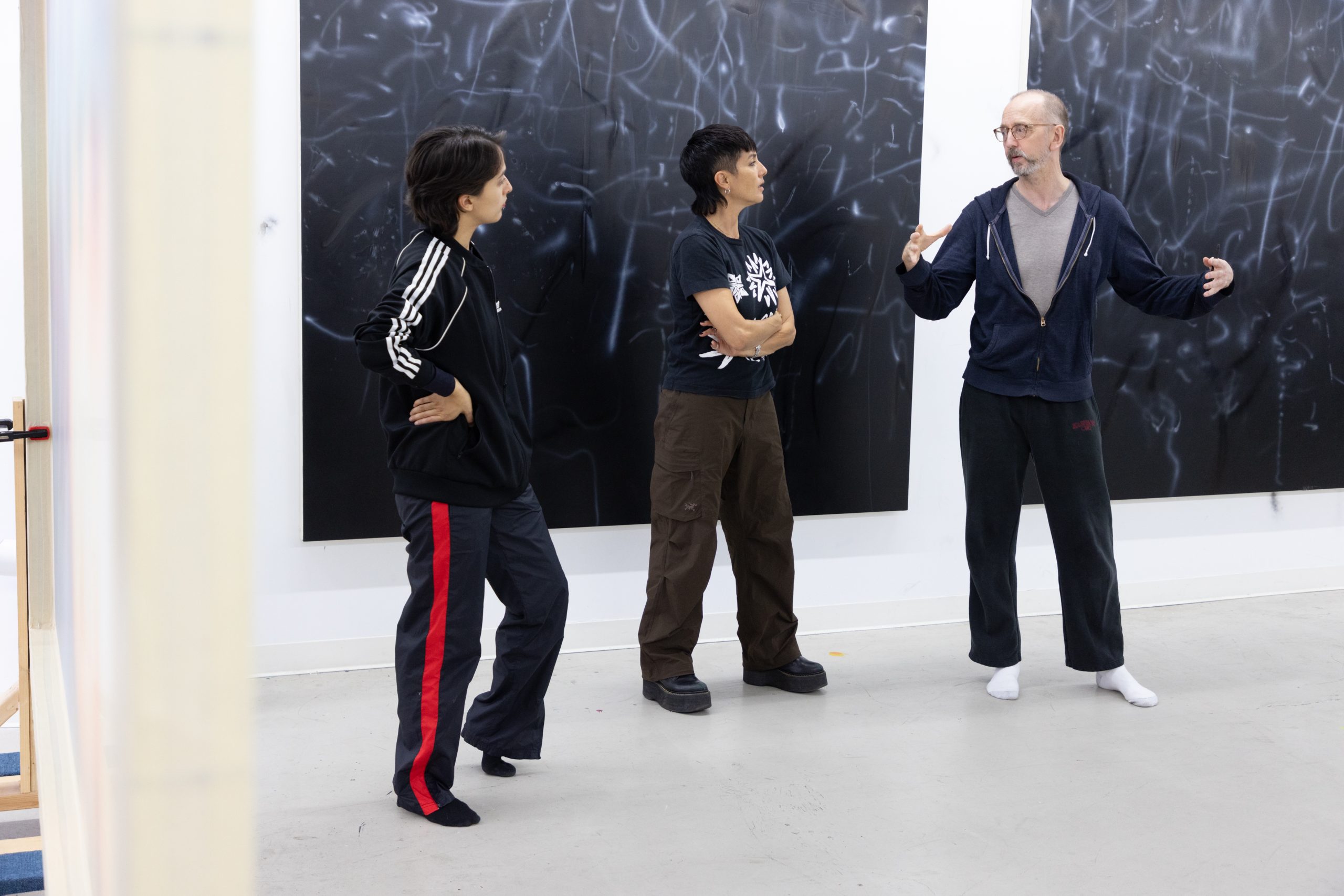
In late August of 2025, I interviewed choreographer John Jasperse at home in his studio in the historic Westbeth Artists Housing in the West Village, New York City. We discussed movement geometries and sound, the Venn Diagram of artistic process, and Jasperse’s contributions to dance as an evasive particulate.
This interview is being published in advance of Jasperse’s premiere of Wandering, a collaboration with painter Julie Mehretu to be presented from May 20th to 23rd at The Marian Goodman Gallery.
This interview has been edited for both length and clarity.
JS: In my research I found writing about the lucidity of your movement, your sense of irony and tone, and your influences. But I want to start a bit further back. Can you tell me about where you grew up?
JJ: I grew up in Rockville, Maryland. My mother, who had never done any arts, felt we should all learn piano. I started that very young, and played for many years. Though a yet-to-be cognizantly queer kid, I had been craving social connection. I started to do things like choir in junior high, then plays, then musical theatre. And I thought, “Oh, I guess I have to learn how to dance,” and I immediately enrolled in a Graham class, as if that was going to further my path to Broadway performance. I was clueless really. I didn’t fully understand what all of that meant.
Classical piano is still there [in me]. Though most people don’t associate my work with musicality, I do. It came incredibly naturally to me, although I had no discipline to do the kind of scales and exercises that set up foundational patterns. I’m not being a traditionalist when I say that technical systems are colonizing the self– not just the body, but also the self. It all comes to you before you understand why you’re doing it, why they did it. I have a lot of questions about that inside of classical piano. That foundation doesn’t really go away. I feel that it’s innate, but it’s not. It’s learned.
JS: Let’s put a pin in this and take one step back. How is your work musical?
JJ: I think I experience movement through energy and time. I find myself almost hearing it. It’s not pulsed, all of the time, but it’s not that it doesn’t have a relationship to meter, time, ever. Dancing is not just a series of positions that have no energetic definition. Learning material without reference to counts is an essential part of ensemble work. So much of this has to do with the momentum and mechanics of gravity.
That was one of the things that was so exciting about Trisha [Brown]. Her contrapuntal structures were super. The rhythms gave me goosebumps. She had an affinity to a softer, momentum-based body, the idea that forces were acting upon you, that you were riding a wave in the dancing. The approach felt very natural to me, even if I was a gangly wave.
This sense of energy and time is also one of the great things about Hahn (Rowe), who created the sound for Tides [a Jasperse piece which premiered in April at the 2025 La Mama Moves! Festival]. Hahn has a real ability to read energy and to provide something that doesn’t necessarily mimic it, but supports it, or that the performers can push against. Symbiosis is most exciting to me. It’s a kind of intuitive relationship.
JS: I’m thinking about a few directions we could take the conversation. When you imagine or conceive of the phrase of movement it’s not just steps, it’s energetic as well. It’s rhythmic, maybe it comes as sound. How would you describe the conception of a phrase?
JJ: I see it as an unfolding embodied set of geometries. Where did we just come from? Where can we go? A lot of times, that doesn’t happen through doing. That happens through me trying to feel and imagine where it might go, in a meeting space between my current body, sensation, memory, imagination, and other people’s embodied experience in the room who are more or less limited than I. Where does it go? Is it translatable, or doable? What else can it be?
I admit that this pushes against the notion of musicality; it may be that the contour through form is the first layer, the initial layer. But there’s no way for it to exist in the room without some sense of what it could possibly be. Forms without rhythm? It’s the meeting of those two things for me.
JS: What is formalism?
JJ: Doesn’t everything have form? In the case of most dances with human beings, you have humans and the identities we invariably project onto them– who we understand them to be. There are all sorts of questions about the politics and power of that. I’m currently working on a project with a visual artist who really resists a relationship to representation. Whereas, just by me stepping into the space– a 61-year-old, cis-gendered, balding white guy– there’s a package of association that comes in. And as a 61-year-old, cis-gendered, balding white guy, as a maker, I’m still the ghost in the room, even when I’m not the performer. We’re stuck with this. It’s lovely, but we’re stuck. To say that’s formalism is a mistake, I think.
I still see potential in relationships: in the way that a circle has a different feel than a spiral, a zig-zag, or a squiggly line. They all feel different. The density of movement is different, and the effect is different. I trust that affect. And so in making those things and fixing them in performance, I stand as accused. In that way, my work is anachronistic to this time, or rather, it looks like it’s of its time. Impossible to hide, why bother trying? This idea, that the perceptibility of time or context within a work is somehow bad… It’s ageist.
Though at the same time the work is constantly changing. If we accept the thing as it is without altering it, we’re just regurgitating. If I’m not changing something about it, defamiliarizing in some way, it’s not really art work.
JS: This makes me think of the essay “Art as Device” by Russian-Soviet writer, critic, and theorist Viktor Shklovsky, in Theory of Prose (1917). He writes, “And so this thing we call art exists in order to restore the sensation of life, in order to make us feel things, in order to make a stone stony…”
JJ: If I understand him. His big thing was that we need that to incentivize or mandate perception. If I know what an object is, I don’t have to pay attention to it. I can elide the experience because I know it’s a coffee cup. In performance, it doesn’t mean that everything has to be genre-bending, and breaking, and transgressive, and yet…it does. Even with the most classical text, there’s a constant need to reshape, reinvent, or twist it enough to activate that space.
JS: Otherwise, perception is automated. “Automatization eats away at things, clothes, furniture, your wife, your fear of war,” also Shklovsky.
JJ: Exactly.
JS: On another note, in my research I watched a video of your piece Becky, Jodi, John (2007), performed by yourself, Becky Hilton, and Jodi Melnick. It was so witty, vulnerable, and apt. It also deals with these questions of anachronism.
JJ: We were creating a project just to be in the room with people; that’s always true to a degree, but that one was really particular.
JS: There’s a moment in the piece when a cloud of smoke emerges from your shirt. At first it’s funny, but then becomes sort of sublime. Can you tell me about that moment?
JJ: We have these three very big personalities and I just feel like there should be a weather system that follows each of us. My depressive personality, Jodi’s windswept thing, and Becky as sunlight. I didn’t really know where that idea would go. And I thought, maybe I was just in a cloud. So I’m like burning up, smoldering, and there’s this ridiculousness, and beauty, but it’s also really sad. It’s a sort of self-immolation.
There’s something else about that, which is dissolution of self into the environment. Sort of abstracted like, my particulate is literally filling the room. When it fills the room, there will be nothing left. And that feels very much like dancing. Well, in life in general. Although the feeling is acute in dance because our work lives in other people’s memories and bodies. It lives in action.
Jodi (Melnick) was your teacher, and so she’s in you. And something of Jodi is still there and something of Jodi is also Sarah (Rudner). And at some point, all of those names will have long been gone. But the particulate is still there. And the sum total of your actions will be dispersed into the world. The question is not how do I ensure or avoid it? You can’t. The question is, what am I sending out? How do I try to make part of something that I want to see? How do we let go of the notion that it’s going to have my name on it? The ahistorical nature of dance is shocking. It just shows you that the ego thing is a big sandcastle.
JS: History— this last minute through the beyond, on a personal or grand scale—is what helped me to feel a sense of place inside of my dancing. I don’t think that I really understood why any of this was happening without that historical perspective. I’m starting to understand my life in dance as a series of meaningful lineages and accidents. It’s helped me to care about dance in a way that I haven’t before. It became less about Faustian striving and more about the people.
JJ: Dancing is made of continuums, though we’re stuck with this patriarchal notion of genius and ascribing it to one person. I don’t belittle the power of someone who can synthesize and bring an idea into focus, but people working “alone” in the studio are never “alone”.
JS: My last question is, is there anything you’re thinking about these days?
JJ: I’ve been thinking about this sort of Venn Diagram of artistic process: in one circle is me/us, in another circle is place, and another circle is time. In between the me/us and place is community. Between place and time there’s a sense of history. All of these things overlap in various ways, and where all three overlap together is where the work comes from. To me it’s like trying to use the work to process what it means to be alive in a particular place and at a particular time.
And what a time we’re alive in! And a place! Let’s just say it’s very full. I will admit that before we did Tides, as we got closer to April, I was like, what the fuck are we doing? Who cares about whatever this (dance) is? Our time feels like the end of civilization. It feels like everything is on fire. And yet, colleagues came and asked, “Great. So why does this matter?” When we do something that we are committed to, it gives us a way to process.
Though I’m suspicious of dance’s ability to hold up to overt context. I’m not casting aspersions on whole categories of work– this is personal. I felt this during the AIDS crisis; the thing was too big to make work about. The pain of the AIDS crisis was so concrete and massive that it was very rare that artists were able to take on that subject and make something that actually had power. You couldn’t see the work! Because the other thing, the tragedy, was too loud.
This was one of the brilliant things about Neil Greenberg’s Not About AIDS Dance (1994). It was a very dark moment– the release of protease inhibitors, which revolutionized HIV treatment and drastically improved survival rates. Time felt burdened by the accumulation of death. At that time the crisis had gone on for 10, 12 years, and so many people had died. Not About AIDS Dance was obviously about AIDS, but it was really about the performers’ relationship to dancing. The piece was kind of able to pierce the thing by skimming it, and remaining tangential to it. That tangential relationship is the only way we could touch it.
JS: It was of that time and that place. It was in the Venn diagram.
JJ: Exactly! There are references from that decade that are wrenching. But those images never go straight into the fire. So what’s interesting to me is not to compare that moment and this moment, but to go back to the artwork-ness of it… to get back to questioning.
To me it’s classic Shklovsky– not that we really know what this time is. But, we all have powerful relationships to it. And we can’t really be in the space of not knowing, because you want to crush your phone each time you open it. There’s real power here, but it’s difficult to harness it if you go straight in. I can’t wax poetic that my perspective is for everyone; those tenets of 20th-century modernism have collapsed for good reason. Yet, distance has a purpose– to place you in a questioning and contemplative space. The shimmer of not-knowing!
I can’t speak about art globally, but that space I know. To invite a relationship to the world in that way, a kind of wonder, that’s what is interesting to me. That’s the experience of poetics. I know that this is a resistant proposal. It’s counterpoint.
Tickets for Wanderings can be purchased here.
Pictured: Dancer Andrea Soto, dramaturg/producer Ariel Osterweis, and choreographer John Jasperse. Photo by Whitney Browne.
Leave a Reply