
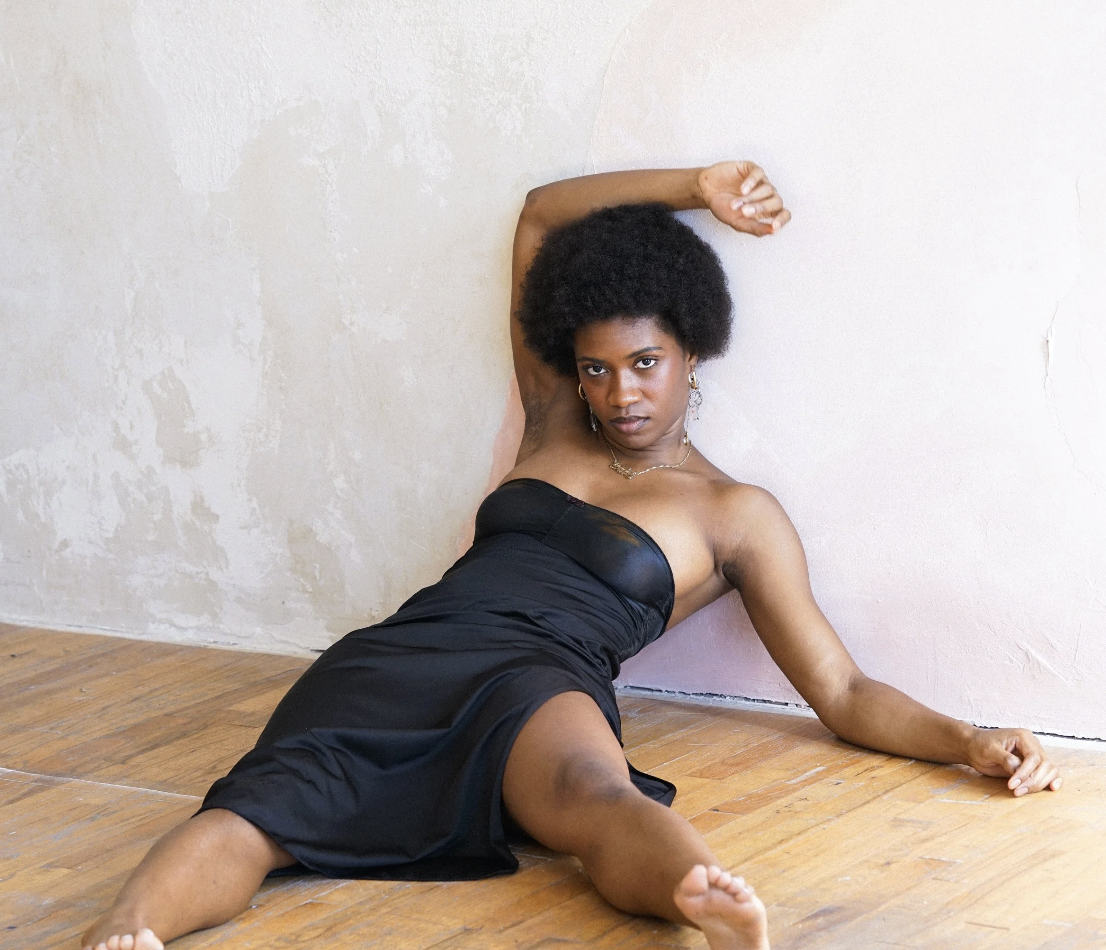
Reflections on choreographer Dorchel Haqq’s 2025 work, swallow, as they prepare for two upcoming works at Triskelion Arts (April 30th-May 2nd) and New York Live Arts Fresh Tracks (May 15th & 16th).
Against Battery City Park’s sterile skyline, a dancer appears, limbs astride. I see shapes against the setting sun: a black dress and a black garbage bag. She swings the bag in circles until the bag lifts off of the stage and careens through orbits, across planes, under horizons. The dancer shows us that the bag has weight, that it is an extension of the body. I witness the fiction of centrifugal force, and imagine the bag is cosmic. I think about Blackness. I think about vortexes, about being swallowed. I am watching the radical geometries of Dorchel Haqq. Haqq’s work, swallow, premiered at Battery Park Dance Festival in August of 2025 featuring dancers Christine Shepard, Ny Opong, Indigo Sparks, Nailah Murray and Angel Glasby.
“I tried to capture the moon once. You won’t be able to capture this dance,” Haqq begins, reading a piece of paper resting inside of the bag. I consider the word “capture”, its etymological relatives– 17th century English caption, a warrant for arrest, or the 18th century meaning, document or accompanying wording– and my own task of writing laid here.
swallow is smartly packed with personal memories and cultural references that connect self with Black lexicons. In her opening solo, Haqq is joined onstage by Angel Glasby, in a baroque oversized church hat, who acts as a docent, observing and supporting. They are accompanied by a sound score she mixed herself: loops of the NYC atmosphere, Lil’ Kim songs, recordings of their own voice, and her mother’s and aunt’s voicemails. Dancers Christine Shepard, Ny Opong, Indigo Sparks, Nailah Murray, emerge from the far ends of the field wearing bulbous black and white tops by Dauan Jacari, a longtime collaborator of Haqq. The dancers carry white chairs on their heads, (according to Haqq, a reference to the Montgomery Riverfront Brawl and the Ciara Chair Challenge), and each hold small purses in different colorways. I spy the Brandon Blackwood End Systemic Racism Bag, a Louis Vuitton– given to Haqq by a church member who sponsored her training at Dance Theatre of Harlem– and a tiny Telfar: personal details forming a genealogy of how Haqq moves through the world, and what she carries– literally and symbolically– along her way.
For Haqq, pleasure and sustainability of work is not an afterthought, but a driving force. Now onstage, the dancers adjust their hair, apply lip gloss, and take photos with toy cameras. They start to warm up, jog, do squats, pushups, and stretches: a dramaturgical tool and the efforts of preparing the body to work. Haqq’s insistence on sustainability, pleasure, and play as building blocks make me think of the Audre Lorde essay, Uses of the Erotic: The Erotic as Power: “Within the celebration of the erotic… my work becomes a conscious decision, a longed-for bed which I enter gratefully… and rise up empowered.”
swallow intertwines gesture and rhythm to create distinctly Black geometries. The dancers fall, run, hop and shift athletically in tight and loose swarms, sometimes colliding into one another. Their darting is peppered with Black dialectic gestures: playful hand games, fists of solidarity, hands-heavy arguments. There’s a sense of shared grammar between the dancers. Support. Flick. Toss. Snatch. I also see an obsession with centrifugal force, a particle’s apparent relationship to and movement around from a central force. Haqq’s gestures are often spinning. Ny Opong, alluring and defiant, whips in and out of fluid arabesques and hand-stands. Shepherd dances her solo with a velocity that makes me feel she’s been catapulted onto the stage. By quoting gestures and objects of Black dialects and setting them in circular motion, Haqq extends geometry beyond the physical body, flirting with the cosmic.
At the end of the piece the dancers lift the white chairs over their heads and spin. They toss the chairs over the upstage edge, again nodding to the Montgomery Brawl. The dancers stand still, hand in hand, facing away from the audience and towards the quiet Hudson. In that still moment, the dancers created a kind of seal around their work, quieting those spinning forces, closing the piece for themselves before it ends for the audience. It made the sharing of gestures and personal artifacts feel more intimate. I am reminded again of Haqq’s promise, almost warning: “You won’t be able to capture this dance.” I turn to my notebook to document, a task that feels both rich and dizzying.
Post-performance, I ask Dorchel questions urgently: did you ever capture that moon? Haqq tells about her attempt to photograph the Sturgeon Moon that rose over the Statue of Liberty weeks prior. This impossible task became a movement prompt in the piece. As we chat, I imagine the blushing moon that crowned Liberty Island. I picture Earth’s Moon and the far side that faces away from us, like Haqq and her cast faced upstage before bowing. I think about what it means to caption, to provide accompanying wording. I jot a few notes. I am trying to capture, perhaps also the moon.
Tickets for vol.1/DND/ a study on perspective at New York Live Arts Fresh Tracks can be purchased here.
Photo by Amy Gardner
Leave a Reply