
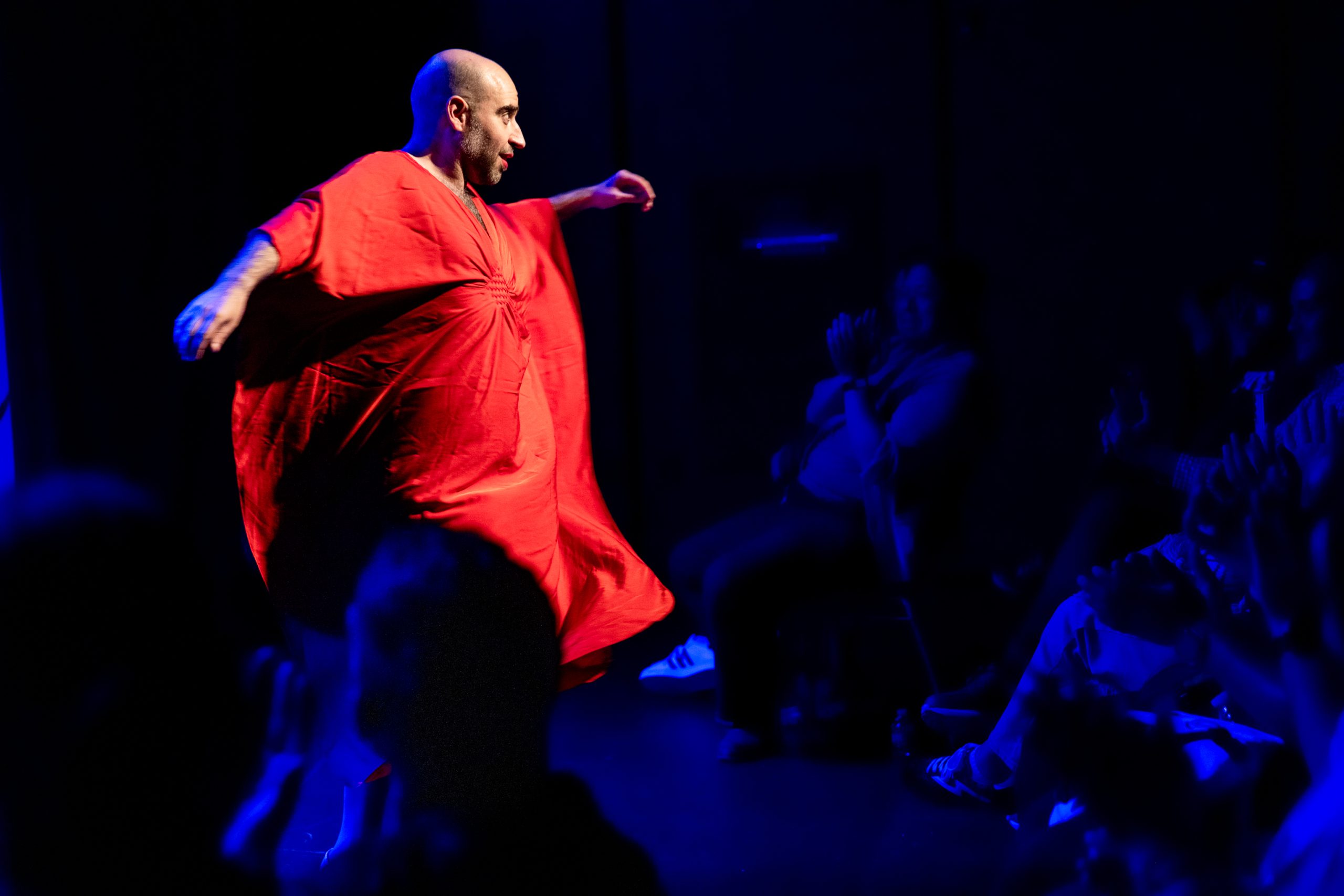
There is no fourth wall in Lipstick. When latecomers slip in to find seats (I’m embarrassed to admit I was one), performer Edu Diaz handles the disturbance graciously. He jokes that not all of us have clocks, acknowledges the audience already present, and then moves on with ease. He wears a slip and a black silk bathrobe, his head shaved, standing in the center of a black box theater. Later, someone sneezes—“bless you.” Someone shifts in their seat—he notices and responds, folding it into the world onstage. “I know,” he says, or, “just wait, there’s more.” He asks audience members how to say “hide and seek” in their own languages. We are not watching Diaz from a distance; we are in the room with him.
A one man show based on Labial, a short story from the book El libro de los enigmas by Linda Morales Caballero, Lipstick is an emotional and intimate story, told through the physical, theatrical, and musical lens of a master blending magical realism with drag humour. Outside of the Drag persona of our protagonist, this is a story about finding hope, and allowing some questions in life to go unanswered.
Diaz’ character reflects on his life, especially his childhood, when he felt invisible and fixated on the transformative power of his mother’s lipstick, the way it changed her demeanor and seemed to give her power. He tells us plainly that his mother, due to desires of sensuality and glamour, didn’t want to be a mother. She didn’t want him. From there–with the help of theme songs played live on a keyboard by musical director Ángelho Díaz–the actor slips on a wig, becoming this woman, this mother. She sings and performs for us, constantly swatting away emotions, and saying “maestro, la musica.” Diaz’s character shifts again when he puts on glasses becoming his enthusiastic, although largely unhelpful, therapist. And then he returns as the voice of the work, shifting back into the soft and easygoing tone.
The characters in Lipstick speak about what it means to be alive, to be seen, to be yourself—and remain your own mystery. Diaz approaches this virtuosic performance with grace, addressing us directly before lifting us into moments of spectacle. The illusions slip in and out so seamlessly that we believe all the characters he becomes. We believe the story, and his insistence on hope.
We learn how our protagonist grew up, how he felt in school, how his mother descended into madness. We see how therapy overlooked essential truths about him. Through three distinct characters’ perspectives, Lipstick reveals a life in fragments, shifting expertly between them before finally letting them fall away revealing the power the main character has found in his drag persona.
“I want to be unrepeatable. I don’t want to know. I want to marvel. I want to remain a mystery.”
And now Diaz transforms before our eyes: no wig this time, that belongs to his mother. Tossing the robe aside he dons a flowing red gown, heels, a necklace—yes, the lipstick. He speaks of transformation through the power of the lip, the stage, and of the feminine. He adds earrings and sings the last of many songs threaded throughout the piece. And we still believe him—every version of him.
Why do we believe him?
Because every gesture, every beat, every pause, every eruption, every aside—every breath—is controlled, practiced, nuanced, and exactly what each moment requires. Diaz is a master of physical theater, both subtle and grand. He moves effortlessly between pain and humor, carrying us from held breath to laughter, from silence to applause.
I have seen a lot of autobiographical theater. Most suffer from the author being too close to the material, too bound by the physicality of the real life experience they are trying to unpack. One reason Diaz is able to make such precise, critical choices for this theatrical adaptation of this short story (co-authored with Caballaro) is because the source material isn’t his own. There’s a necessary distance. Diaz isn’t re-living his own pain; he’s inhabiting a character, one that demands intention, craft, and structure. Diaz, in performing the story of another drag queen, examines its topics with more rigor.
Lipstick concludes with Diaz singing “I Will Survive” first in Spanish and then in English. In Diaz’s hands, the short story has become about a life filled with gesture, breath, surprise, pain, and triumphant. A heartwarming, heartbreaking, laugh-out-loud evening of theatrical magic, this is storytelling at its finest.
Photo of Diaz by Krystal Pagán.
Leave a Reply