
These days I avoid the news. It’s devastating and terrifying and—from my New York bubble—remote. Everything bad is happening somewhere else, I tell myself. This is untrue, of course, but denial can be so comforting.
In Jerome, John J. Caswell Jr.’s new play at Playwrights Horizons, avoidance is a matter of survival. Set in rural Arizona in 1993, the play follows Con and Doane, a long-term gay couple who have built a secluded life together in the shadow of the AIDS epidemic. Grappling with aging, illness, and monotony, the couple opens their relationship to Bruin, who has fled a traumatized San Francisco.
Con and Doane live in Jerome, a ghost town where the once-booming mines have become mining museums. There are phantom explosions no one can explain, long-dead miners still tinkering at night. The three men prefer to keep their pasts quiet. Con and Doane don’t talk about the war. Bruin won’t reveal who he calls at night. They can’t quite face the future either, though: Con is getting sicker. Tethered to the past and terrified of the future, the characters reach for each other in the present. Intimacy persists, even in the darkest moments and the strangest places.
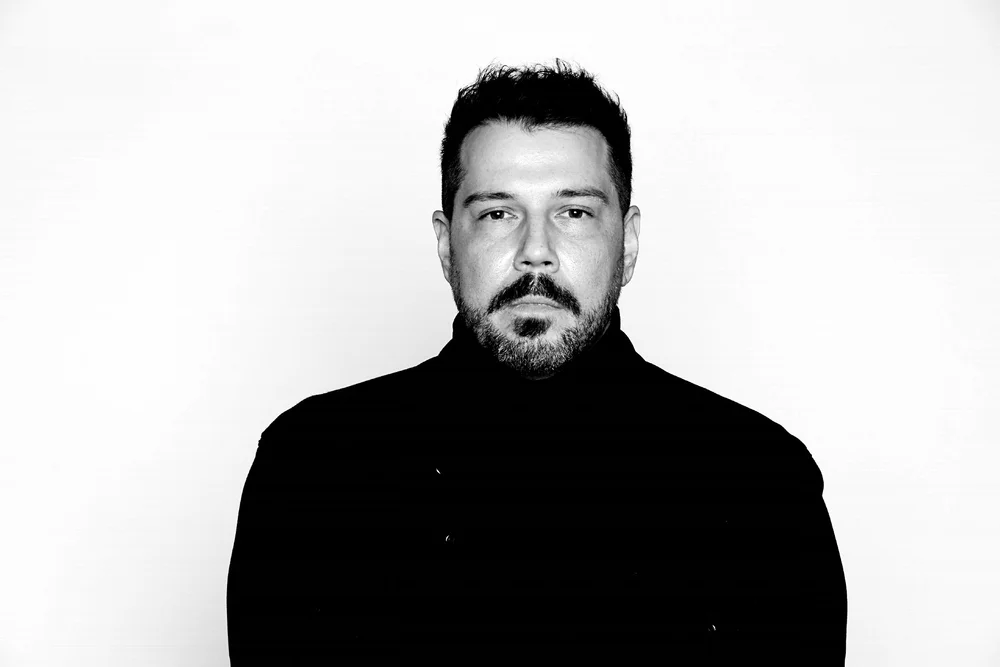
John Caswell—whom I first met when I took his wonderful playwriting workshop last fall—and I spoke via Zoom in early May. We discussed his childhood in Arizona, the fading historical memory of the AIDS epidemic, writing towards what scares us, and a retreat he once attended where tiny plants grew from stone.
This interview has been edited for both length and clarity.
Annie Rasiel: I love reading the play. I read it in one sitting. I was really enchanted by the setting. What can you tell me about Jerome, Arizona?
John Caswell Jr: Jerome was founded on copper mining, went bust in the 50s, and since then has become this tourist ghost town. There’s a line in the play that says, “Our story is industry, and now our industry is story.” So the town has become a place of lore and legend. It’s a fascinating place. I haven’t been there in probably ten years, and from what I hear, it’s become quite bougie and hipstery. It’s becoming a place that a lot of people like to go.
AR: Can you tell me a little bit more about what inspires you or what first struck you about Jerome?
JC: Jerome was a place that I visited often as a child. My great grandmother grew up in the Verde Valley region, which is where Jerome is located. She lived in a little town in a double wide on top of a hill called Camp Verde, and we would go and visit her often and take day trips to other towns nearby, like Sedona, Cottonwood, Prescott, Rome, Flagstaff. That area always felt like a second home. And I remember thinking as a child just how extremely weird it was. You can stand in vortexes and absorb energy from the earth. You can choose psychic mediums from a menu off the wall of a crystal shop in Sedona. The landscape itself feels like Mars with the red sandstone rock features. As a kid, it felt like a place that was weirder than I was. And so when I was there, I felt like I could really exist in my own skin, because the place that surrounded me, was one-upping the queerness that I contained and that I wasn’t telling anybody about. It was a place where I really felt at home and like myself.
AR: A place that’s weirder than I am!
JC: As a kid who feels really weird, it’s exciting to go somewhere with strange stuff happening all around you.
AR: And then you have these characters who feel like really fully formed people with histories and full lives. How did you find these characters?
JC: Aside from Jerome, the play was inspired by a former convent turned writing retreat outside of Spoleto, Italy, where I wrote a very early draft. At this retreat, we worked in a rehearsal room that was built up against the side of a rock face. One entire wall of the room was completely stone, and the room was very dark. There was very little light. But somehow, from the stone, grew small, unhealthy plants. Despite there being no visible source of water, life was persisting in this dark space. I started thinking a lot about love in times of darkness. I was going through family problems and thinking about what it takes to keep that love alive. Then I started thinking about the space I was in, specifically this crazy room with the rock wall. I started to imagine, if this were a place of residence, who might live here? That’s when the characters started speaking.
AR: That’s such an incredible image. Though, the neurotic Jew in me is immediately concerned about mold. It sounds damp!
JC: It was really beautiful.
AR: I’m also interested in the choice to write them as veterans of the Korean War.
JC: Choosing the Korean War as the place in which Con and Doane served was mostly an issue of practicality: when I wanted to set the play, and knowing how old I wanted them to be. The Korean War is a blight on this country—as so many conflicts that we’ve been involved with are—so the idea of these two finding something positive amidst the darkness of war was really appealing to me.
AR: For the first time in my life, I’m writing a play in which a central character is significantly older than I am, and I’m kind of anxious about it—about whether her voice is authentic, whether I’m able to imbue this character with the wisdom of someone who has lived much longer than I have. Did you have that experience writing Con and Doane? What was it like writing a play in which all the characters are older than you?
JC: I’ve done it before with Scene Partners, and I’m doing it now with Jerome. I would say that the process for me is initially writing the character as best as I am able to channel them. Then once I have a collaborator in the actor playing that particular role, I do a lot of talking to them and listening and trying to understand that perspective. Since childhood, I’ve gravitated towards people who are older than I am. Maybe I feel older than I am. I definitely feel an affinity of some sort with people who are older.
AR: Speaking of age, I think this is my favorite sex scene I’ve ever read in a play. All the talk about logistics feels so joyful and real. Can you talk about that?
JC: I knew that I wanted to write a play about queer people in a rural environment, and I knew that I wanted them to be characters that I haven’t seen on stage, which is older, rural queer men. I wanted to honor their romance and their sexuality, to really put it front and center. We are able to love and to fuck at any stage of life. I didn’t want to shy away from that.
AR: There’s something abject about the body as it’s breaking down, something we want to look away from. I found it exciting that you didn’t do that. I’m also curious about the role of AIDS in the play. The characters never actually say the word AIDS.
JC: I’m writing a play that I wanted to see: a play about gay men existing in the shadow of the AIDS crisis in rural America, and a play that explores not only the impact that AIDS has on bodies, but also the impact that it had on relationships and intimacies and aging, specifically in those who survived the epidemic. The play was also inspired by my own fears surrounding illness and death. When I was growing up in the 80s and 90s as a closeted gay kid in Arizona, all I knew of AIDS was what I was told by adults, which is that it would kill anyone who, “chose” to be gay. So for me, love and sex were built on a foundation of extreme fear. I wrote this play as a way of unpacking the stunted relationships that I have to love and sex as an adult as a result of that trauma growing up.
AR: Did you talk to any older queer people who were adults at the time about that experience?
JC: I tried to talk to my drama teacher. I went to school in a place called Gilbert, Arizona, which is a farming suburb in the Phoenix metro area, way on the outskirts. It was a very conservative place, and I knew that this teacher was queer—not because she publicly acknowledged it, but because I was just able to tell somehow. I tried to talk to her about my feelings, but she just couldn’t engage with it. She could have lost her job. I just remember looking in her eyes and seeing the pain and the conflict that she was experiencing internally about wanting to help, but not being able to, because of the potential ramifications. And now it feels like we’re headed back into that “Don’t Ask, Don’t Tell” dynamic in schools, which is frightening.
AR: And there have been hundreds of thousands of deaths from HIV because of USAID cuts.
JC: It’s horrible. We’re sliding into the past. It’s hard to think about.
AR: There’s a certain level of removal in the play. Con and Doan are isolated. They have their own little world, this cave that they live in, and when they let a third person in, it’s a really big deal. It made me think about the line between peace and avoidance, the ways that, though I am inundated with terrible news all day, I’m ultimately cloistered in New York City in this little bubble. There’s such privilege in tuning out the news, and there’s also risk. It can be dangerous not knowing what’s happening in the world, but it’s also dangerous to get lost in it.
JC: Tuning out can be a mechanism of survival and it can be a mechanism of self destruction. I have a hard time not tuning out. I have to make a conscious effort to check in with the realities of the world, because it is so much to handle. Especially when you’re trying to live in a creative space, there needs to be a balance between knowing what’s going on in the world and also enough space and peace internally in order to process those things and make art about it. My biggest struggle as an artist is finding that balance between engaging with the reality of being human at this crazy time and wanting to turn it all off and live in fantasy.
AR: Your work is a testament to the fact that it’s not either/or, that there’s a third way, because your writing engages so much with the present political moment. Even though the play is set in the past, the AIDS epidemic is still raging.
JC: I think a lot of people are forgetting. I think that there is a huge disremembering of AIDS. I worked at a hotel last year as a part time job—because playwrights don’t make a lot of money—and I was working alongside a young queer woman who was about to graduate high school. I was reading How to Survive a Plague, which is an excellent book about the epidemic. She picked up the book and read the back of it, and asked me, “When was there an AIDS epidemic?” That really shook me. I started thinking about how much time has passed and how much is going on in the world now. It’s easy to miss things when you’re growing up. But it reinforced to me that we aren’t talking about AIDS the way we once did. AIDS is still a huge problem. I think a lot of that has to do with the pain associated with it. For Bruin, the pain and the fear and the paranoia is so intense that he puts his head in the sand. He shuts it all out.
AR: It’s hard to find the balance between remembering and letting it in and letting it inform how you move through the world while also not falling into despair. Were you ever worried, because you don’t explicitly say the word AIDS, that someone might not get it?
JC: I’m not worried about it. If they don’t fully get it, hopefully they will leave and be interested enough to do some research. The play is not about AIDS. It’s not written to educate or to inform. It’s a slice-of-life view of people who are experiencing the epidemic indirectly.
There’s a terrible agitprop version of plays like this, that try to teach us a lesson, but I feel like there are plenty of resources to learn about AIDS. I’m more interested in how people survive in the midst of something so devastating
AR: And that could apply to how people survive as veterans or how queer people survive in rural Arizona in the 90s—
JC: How people just survived Covid! I don’t think a vast majority of the population really understood the terror that queer people felt during AIDS, how it felt when a disease came for you, until Covid came for everyone. And the response was massive. The response unified the world. When AIDS broke, people ignored it for so long. It only affected people whom they viewed as second class citizens, who perhaps deserved what they were getting. Covid was a wake up call for a lot of people, and also, I’m sure, traumatic to a lot of people who had survived the 80s and the 90s.
AR: While none of the characters has AIDS, Con is dying, or at least getting progressively sicker (about which Doane seems to be in denial). How did you approach writing about death?
JC: I’m terrified of death—not so much what happens after death, but the actual process of dying. I’m afraid of pain and suffering. I’m afraid of seeing people that I know and love in pain and suffering. I approached writing death from a place of fear initially, but writing this play has expanded the boundaries in which I think about death. I feel more comfortable pondering my own end now than I did before I started writing this play. It’s been helpful, because I’ve had to deal with it head on.
AR: Are you drawn to writing about the things that scare you?
JC: It’s the only way, for me. I don’t know if computers still have defragmentation programs, but they used to have these programs that would move all the files around that were all spread out, and put them in the right places, and delete duplicates. I think this all happens automatically now, in the background, but it used to be an actual program you had to run. I think of writing as defragging my brain. It forces me to pick things up, look underneath them, move them around, reorganize them. Writing about things that I’m afraid of is a therapeutic tool. It also can be a destructive tool if you’re not ready, or if you’re writing about it in a way that’s too closely tied to your own experience. But yeah, I write about things that I’m afraid of, because what else would I write about?
AR: Your last three plays (including Jerome) are all set in Arizona. What is it about Arizona that keeps you going back?
JC: Jerome is the third in a series of plays set in Arizona that deal with queerness, disease, and caregiving. The play sits pretty firmly in conversation with Man Cave and Wet Brain. Arizona is the source of all of my joy, all of my hate, all of my fear. It’s where I was born and raised and went through some really difficult things, and it feels like I have an obligation to go back and to uncover the place that I left behind. I left a lot of things unresolved in Arizona, and as long as they remain unresolved, I have to keep going back in my writing.
AR: So it’s more about your personal connection to Arizona than what that state might represent in the abstract.
JC: Absolutely. It’s just the place that I know. It’s easy to access because it’s so familiar, and also difficult to access because of the content, because of where I have to go mentally and emotionally to write about it.
AR: You’ve been writing Jerome for many years. What has that process been like? How has the play changed?
JC: The first draft that I wrote of the play that became Jerome was in 2017, so it’s been almost a decade. There have been dozens of drafts in between. It takes a long time for a play to become what it is. Students always ask me, “How do you know when a play is done?” You know when a play is done when it gets produced, because by the time you get into a rehearsal process—even if you think the play is done—you’re going to realize that it’s not. A play is a living, breathing thing that keeps evolving until you put it in front of people, until you see how the play interacts with actors and audience. So you write a play, and you put it in a drawer. Then, when an opportunity arises, you take it back out, and you re-meet the play wherever you are now. Sometimes you read something you wrote after a period of time, and you think, “Oh my god, what was I doing? What was I thinking?” You were a different person when you wrote the play! Your cellular makeup was different. So you have to keep re-meeting your plays over and over again, sometimes even after you have a play produced. I know some really well-known playwrights who are still making changes to plays that have won Pulitzer Prizes.
AR: I had a wonderful time in your workshop last fall.
JC: That’s sweet of you. You gotta hustle out here and somehow pay the bills. I love doing the workshops, because I feel sequestered up in the middle of nowhere [Caswell lives upstate]. It’s nice to be able to get together with artists on the phone or on the phone on Zoom and chat.
AR: Is there anything you want to say about the workshop?
JC: I will be teaching two online workshops in June and July, called Writing in the Overlaps: A Generative New Play Workshop. They are open to individuals of all experience levels, and all are welcome. You can get more information on my website, johnjcaswelljr.com.
Tickets to Jerome can be purchased here.
Photo by Chelci Parry.
Leave a Reply