
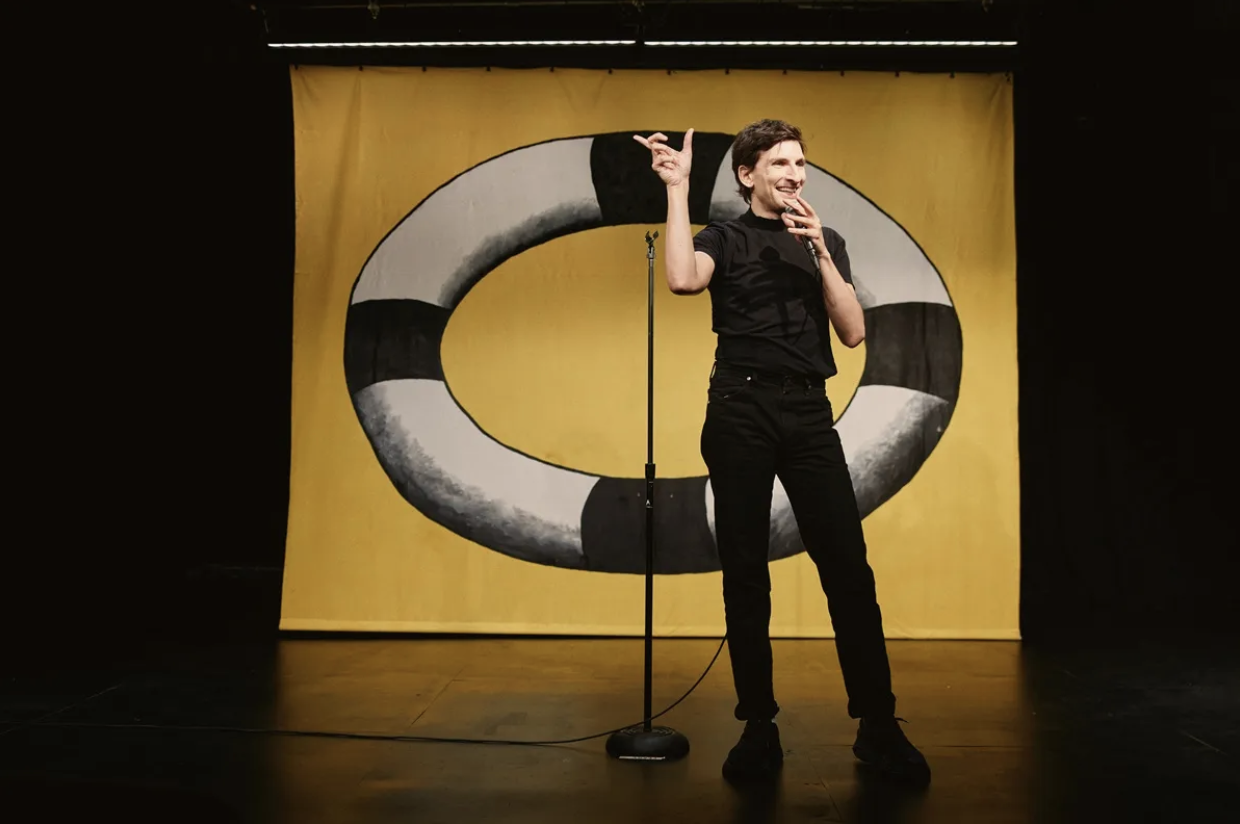

In their hysterically provocative and slyly passionate “solo” performance piece, Can I Be Frank?, writer and star Morgan Bassichis unearths the past. Combining their own writing with works by queer comedian, performance artist, and activist Frank Maya, Bassichis conducts a riotous metatheatrical séance for the assembled. Ahead of Frank’s return to SoHo Playhouse for a remount run (May 21 – June 27), I connected with Morgan Bassichis and director Sam Pinkleton to talk the superpower of telling the truth, the dangers of nostalgia, and the political importance of a really, really good time.
The following interview has been edited for both length and clarity.
Ethan Karas: With remounts of shows, when you’re bringing it back or rehearsing it, it’s almost like an excavation, like you’re going back to the choices you’ve made or the text that you’ve written. And Can I Be Frank? is also, as a show, an excavation, revealing an artist and an activist the audience isn’t potentially familiar with. Are there things over this past year that you’re uncovering as you start to return to the material?
Morgan Bassichis: Well, it’s a revisiting of a show that he did in 1987, which his friends also revisited at his memorial in 1995. So there’s this ongoing queer tradition of revisiting, reinterpreting, re-performing, reimagining performances that happened. Two years ago, we did it at La MaMa, and then we did it again last summer [at Soho Playhouse], so it feels like the revisiting itself is the work, and then trying to get really present and telling the truth about what’s going on now. I’m excited to see what iteration of it shows up. The revisiting itself is the thing.
Sam Pinkleton: Morgan has a superpower of not being able to tell a lie, which means that the show is constantly existing in whatever context it’s in- and that changes daily, and it did during the [prior] runs. There were performances that just felt heavier or lighter or more angry. Speaking for myself, I’m very excited about seeing how it’s shaped differently because of Morgan’s aliveness with the people in the room on the night that they do it.
MB: Sam and I both share a kind of love of endless refinement. We will be open to whatever opportunities there are to sharpen and discover new things.
EK: How do you both build the container to have it feel structured enough that we’re going on this ride, but also loose enough that there is that ability to adapt?
MB: That was something I really feel Sam brought to the process because I maybe go too far to the extreme of, “Every night is its own night,” and working with Sam was really my first experience of being… I was kind of like, “I’ll figure it out when we get on stage,” and Sam was like, “No, let’s actually rehearse it and actually figure it out beforehand.” The theatre of it all was a nice combo with my “Every night is my first night on Earth” kind of feeling.
SP: Especially bringing it to Soho Playhouse last year, there was a period where we were like, “Oh, it’s okay if we say that it’s a show.” It’s okay that there is actually a very clear structure. One of the secrets of the show, I think, is that it’s just an exquisite piece of playwriting, and that is not an accident, and that’s not figuring it out in the moment. But it took a weird combination of courage and surrender from both of us to embrace that there was a thing there that could be repeated, as opposed to a nightly social experiment.
EK: That experiment, has it changed from the audiences that you’re getting at La MaMa to the audiences you’re getting at Soho Playhouse to the audiences for the return to Soho Playhouse when there’s more familiarity with the work? Have there been shifts in how that experience has impacted people?
MB: I definitely went from the beginning of knowing every single person in the audience, and performing for the fifty people I’ve known for a million years, to mostly being people I don’t know in the audience, which is a really fun task and adventure, and the thing you want. You want it to go beyond the people you know. Hopefully, one of these people this time will have a lot of money.
EK: That is always the hope. (laughs)
MB: We’re screening for that…
SP: Or access to cosmetic surgery.
EK: With shows about queer history, I feel sometimes like I’m pressed up against a glass in a museum exhibit. It’s hard for me sometimes to feel the heat of the thing because my own experience of queerness feels so vastly removed from what someone like Frank Maya is going through, or the art that they’re making, or the context that they’re making it in. But also, you’re working in a theatrical medium that feels like a very live way to break through that glass barrier. When you were initially constructing this show and in the time since, is that distance something that you’re thinking about?
SP: I think there’s no substitute for excellence, and Frank wrote these amazing monologues that Morgan has put real time into embodying with specificity. Morgan has a way of talking directly to the audience that is completely disarming, and of creating intimacy with strangers that I think can make strangers be like, “Wait, do we know each other?” And that unlocks openness and a vulnerability in people that allows them to actually go on this journey and feel like they not only know Morgan, but that they also knew Frank. I think that is a major magic trick of the show that is almost entirely credited to Morgan’s uniqueness as a performer.
EK: Morgan, do you feel like that truth-telling ability is what allows entrance for that level of intimacy with an audience?
MB: I have an allergy to feeling like this is pretend or something. I wanna really believe everything that’s going on. I don’t want people to feel like, “We get to sit back and watch a show.” I wanna be like, “We’re having a conversation right now.” When I get lost in what the show is and who’s in the audience, Sam’s always like, “Just talk to the audience.
That’s what you do. Just talk to the audience.” I think I also have another allergy to a kind of nostalgia that you [Ethan] described that says, “Go look through the glass, and you’re not a part of this,” or “I’ll describe a party and be like, ‘It was so fun.’” That’s a boring experience for people, you know? I want to create a thing that we’re doing together right now, rather than a thing I’m telling you about that already happened. Part of the point of the show is that Frank wanted to get laid and get famous, just like we all do right now.
EK: There is both an incredible amount of artifice in that it is Morgan as Frank. But also, the awareness built into the show dissolves it from feeling artificial.
MB: One of the things we share is a deep reverence for that period of downtown East Village performance and its intersection with activism and counterculture, and also an allergy to nostalgia and sentimentality.
EK: What was that initial spark for you about that time period, about that culture?
SP: Part of it is just that great work was happening. My favorite art of all time came out of downtown New York City from 1981 to 1994, and that includes work that is explicitly political and angry, and it also includes the work of the B-52s and the Talking Heads, just like joyous stuff.
I’m obsessed with the Pyramid Club. I’m obsessed with the whole story of going out dancing in contrast to everything else that was happening.
It’s a period of imagination that feels like it could only have happened in such a specific context, and that context isn’t just AIDS. That context is also about the cost of living, about community, and about not having technology. I don’t think it’s as simple as, “everyone was dying, so they made great art.” That feels awful, actually. A thing that we both love about Frank is that he was like, “Sure, sure. Yes, all of that, and like, I want to be famous and get laid. And can’t I still talk about that even though all of this other stuff?”
MB: We kind of can’t overstate the impact of that period of art and performance on dominant culture now. So many of those aesthetics, experiments, and genre intersections are now normal and taken for granted. Whether it’s about certain kinds of drag and gender fuck, or literally what was happening in the late ’80s, which was people started talking. And that’s his show in the 1970s called Frank Maya Talks, and this was the era of Spalding Gray, Eric Bogosian, and Holly Hughes, and the birth of the kind of “solo talker” which I think is really what’s underneath the kind of stand-up mania that we are living inside of now.
What’s really important for me is to acknowledge that what we do now comes from that time, it’s made possible by that time and by a lot of people who died and whose work did not get recognized and who labored under very different conditions, and to resist the kind of amnesia and gentrification of that time that can happen. You look at things, and you’re like, “Wait, but you know we’re in a lineage here.”
SP: Both in our own ways and in the work we make together, I kind of resist the notion of originality period. With Oh, Mary! even, I’m like, “Cole [Escola] is a super distinct voice, and we’ve done something really specific, and let me draw a line through fifty plus years of queer performance to tell you how this happened.” Have we put a stamp on it that only we could do? Totally. But nothing is new, and I feel like those guys knew that, too. It’s part of why I don’t get bored doing what I do. That kind of cultural magpie work is more interesting to me than being like, “I’m a visionary genius who created something out of a white room.” Fuck that. That’s not real.
MB: And it’s very, very straight white male, obviously. This idea that anything would ever be original is such a deeply fucked up idea. The reason that we know about Frank, that I know about Frank, is because of the people who were around him, his loved ones who cared for his archives and cared for his memory and talk about him. So it’s not only about recognizing the lineage of artists in that time, but also the lineage of the loved ones around them, and the audiences that make it possible for us to know about them. Even when there’s one person on stage, obviously, there’s never just one person on stage, it’s always a collective act. So, by talking about history, by rooting us in lineage, we’re refusing the idea of both originality and individuality.
EK: Which feels like part of that lineage of queer art. You’ve touched on it for a second, how has working on this show affected the work that you’re making outside of it?
SP: I will again talk about Morgan like they’re not here. Morgan sets an incredibly high bar for intelligence and specificity and not being bullshit-y. I live a lot of my life in a commercial theater space. Like, I work on Broadway.
MB: You heard that, Ethan?
SP: I don’t know if you guys have heard of that. (laughs)
MB: Make sure to mention that.
EK: That’s the pull quote right there, yeah.

SP: Morgan sets such a high bar for like, “Why the fuck would we ever make performance and also ask people to give their night and their money to a performance?” It has been a service to me to make the show and make the show the way we have, because it has given me a sense of accountability in my other more- for lack of a better word- mainstream work. It doesn’t mean that I always necessarily pass that test. Sometimes it actually just means that I feel terrible about myself. But there’s a way that this show and the process of making this show, for me, completely separate from the reception of it or the thing that we’ve made, has been a bit of a lightning rod of, pardon the cliché, “Why We Do It.” I love making big stuff. I love working on Broadway. And a thing that I, on the best days, can try to do in these spaces that I have access to is challenge a room much more than I might were I not exposed to Morgan’s work and brain.
MB: I’ve really spent the past 13 years in more of art/performance art spaces, and getting to work with Sam has been kind of a boot camp in what it means to make theater. Which is why I initially came to New York, but didn’t quite figure out how to be a part of that world. Getting to work with Sam has really deepened my respect for theater-making, and for the rigor of theater-making. Sam said something to me early on that was like, “First and foremost, we have to make an entertaining, amazing night of theater for people.” All the politics, the history…all of that is secondary to our first goal, which is to make a really entertaining night of theater. That is a needle to thread constantly that keeps us accountable to not resting on nostalgia or sentimentality or anything like that.
EK: There’s that tension of entertainment in turbulent times, which was happening then [in the 80s] and is happening now. “Entertainment” can become a bit of a dirty word, in that it implies a certain artificiality, or a certain sentimentality, or nostalgia, or a smoothing over of things. For both of you, what does entertainment mean to you, and why is it so important?
MB: The false dichotomy between entertainment and political work is something…obviously, there’s a lineage of people who are like, “No.” Entertainment itself can be deeply political, transformative, and boundary-breaking in lots of ways. So to me, it’s like a reclamation of the word entertainer, not as a slur, but as a modality.
SP: I have such fatigue from the notion of “turbulent times performance.” I think in theater at least, we’re living through an epidemic of work that you feel like you should like but actually don’t because it’s boring, but it’s important, so you need to. I so thoroughly reject the notion that we come to performance to suffer. I suffer just fine all day. We are all actively living through horrors all day. The thing that I wanna do, whether it’s with Morgan’s show or whether it’s with Annie, is to be like, “You made it to the end of the day. Congratulations. Have a nice time.” And that doesn’t mean that we have to present you with something that’s brain-dead. And in fact, I think the fucking Trojan horse opportunity that we all have as performance makers is to make something that is a delight, that is entertaining, and that doesn’t deny the reality that we’re all living in. I have absolutely no patience for, “I wanna bring you here to feel bad.” Read The Atlantic. You don’t have to put pants on for that. You’re gonna pay money to go to the theater to feel awful about something that you already know about? That is crazy to me. Call me a fucking entertainer. I would so much rather be an entertainer than an artist right now.
MB: “Read The Atlantic.” That’s another good pull quote for you, Ethan. (laughs)
SP: We have to think about what the form can do. We have to think about why we chose this form.
MB: As someone who is really committed to organizing…[there is] a politically suspect logic that says feeling bad leads people towards being more active. It’s actually not true. Toni Cade Bambara says this important quote, which I say over and over again: “The goal of the artist is to make the revolution irresistible.” Whether it is a protest or whether it is a play, I wanna make joining this thing irresistible and something people want to join. The idea that you would come and I would lecture you and tell you how bad you are and how good I am is the recipe for people saying, “I do not wanna be part of that.” So, yes to everything about entertainment for its own sake, and also, if you are interested in propaganda and in recruiting people to feel a part of something bigger, you wanna give them a good time.
EK: What is the revolution that you’re trying to make irresistible? What are the things that you’re longing for, whether in art or in the world at large?
MB: To me, it’s not vague or abstract, and I think vagueness and abstraction are where good politics and good art go to die. We have to do every single thing we can to stop our government from sending billions of dollars to massacre the people of Palestine, Iran, and Lebanon. That is front of mind for me at all times. That’s not the only crisis going on, but it certainly is a defining crisis of our moment when we look back and say, “What did you do?” People always like to think of themselves, “Oh, if I were in the Holocaust, I know I’d be hiding those Jews. If I were in the civil rights movement, I’d be on that bridge, I’d be on that bus. If I were in the late ’80s, I’d be in the ACT UP meeting.” Cool. Okay. So let’s talk about what’s happening right now. Everyone’s a radical for something that already passed.
My work is also about normalizing saying we need to stop sending weapons to bomb the people of the Middle East. That’s also a through line in my work that doesn’t get flattened. It’s always there. I want people to go be like, “Oh, that’s normal now. Now we all say that.”
SP: A huge part of what lights me up about working with Morgan is their insistence on specificity, which they just demonstrated. There’s a coziness of politics on Broadway especially that is people screaming about things that we all fundamentally agree on, which I find to be absolutely hilarious. I do think that when we get the Broadway musical that’s like, “Actually, you know what’s bad? The extermination of Palestinians,” then we’re maybe onto something.
I’m really obsessed with people learning from the ancestors in a way that isn’t nostalgic or gooey, that’s toothy. Part of that is acknowledging the inevitability of death, which has its own set of politics. I look to Morgan, separate from our collaboration, separate from our identity as artists or entertainers, as a North Star politically, always. Sometimes behind their back, I’m like, “I don’t know how to feel about this because I’m too stupid and busy! Okay, what’s Morgan caring about?” And that is the gift of an organizer, but it’s especially the gift of an organizer with a sense of humor, which does not describe many organizers.
MB: A dear friend who is now an ancestor- passed on over the past year: Miss Major, a legendary Black trans activist. If you knew her, you would know she loved to have a good time, loved to make a joke, and loved to get laid. And that was the secret sauce of her, as of so many good organizers. It’s not what we’re up against, but what we want. You can only be up against something for so long until you say, “But what are we actually moving towards?” A good organizer gives you a taste of the world to come. So that’s what she did, she was like, “Let’s talk about boys while the world is trying to destroy us.”
Morgan Bassichis is a writer and performer who has been described as “fiercely hilarious” by The New Yorker and “I think an actor but hasn’t been in anything” by their father. Morgan’s performances have been presented by MoMA PS1, Whitney Museum, New Museum, The Kitchen, REDCAT, Portland Institute for Contemporary Art, and Danspace Project. Recent shows include A Crowded Field (Abrons Arts Center, 2023) and Questions to Ask Beforehand (Bridget Donahue, 2022). They are the author of The Odd Years and co-editor of Questions to Ask Before Your Bat Mitzvah, both published by Wendy’s Subway. Morgan edited and wrote the introduction for the 2019 Nightboat Books reprint of the 1977 cult classic, The Faggots & Their Friends Between Revolutions, written by Larry Mitchell and illustrated by Ned Asta. An exhibition of Morgan’s work, More Little Ditties, was co-presented in 2023 by the Carpenter Center for the Visual Arts at Harvard University and the Institute for Contemporary Art at Virginia Commonwealth University. Morgan won a 2026 Obie Award for writing Can I Be Frank?.
Sam Pinkleton is a Tony, Obie, and Drama League Award–winning director. His work for the stage includes the current Broadway revival The Rocky Horror Show at Studio 54; Cole Escola’s Oh, Mary!; Josh Sharp’s ta-da!; Morgan Bassichis’ Can I Be Frank?; Noah Diaz’s You Will Get Sick; Untitled DanceShowPartyThing (with Ani Taj for Virgin Voyages); Elizabeth Swados’ Runaways; and deranged revivals of The Wizard of Oz (A.C.T.), Head Over Heels (with Jenny Koons), and La Cage aux Folles (Pasadena Playhouse). As a choreographer, credits include Sondheim’s Here We Are, Jeanine Tesori and David Henry Hwang’s Soft Power, and Natasha, Pierre & the Great Comet of 1812. Film and TV: “Dying for Sex” and The End (starring Tilda Swinton). Upcoming: the participatory Scottish dance musical Ceilidh.
Leave a Reply