
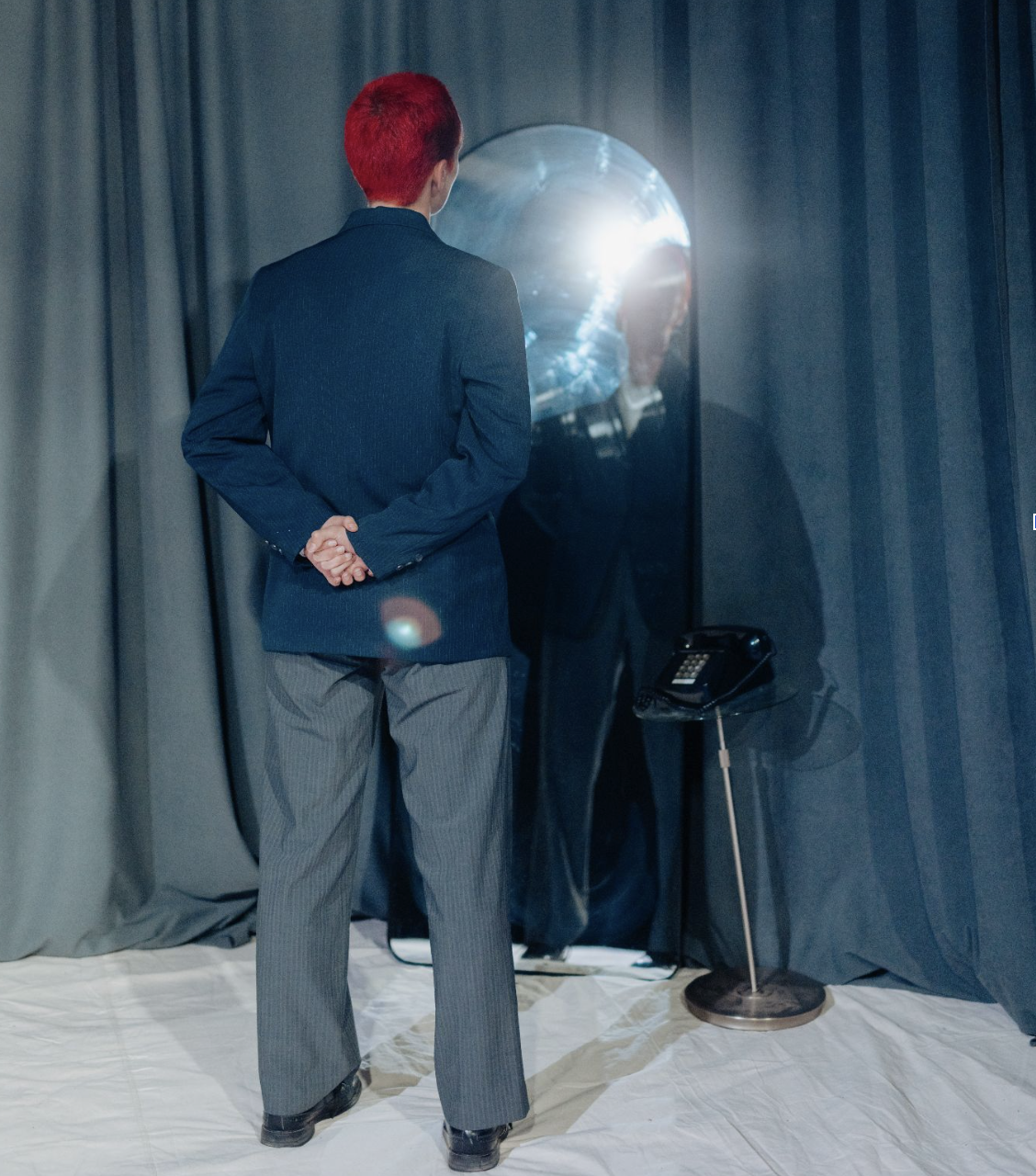
Sam Kann’s Mouthpiece, performed with Chloë Engel at Life World, unfolds as a cinematic dream. Morphing through characters’ interior and exterior worlds, the duet welcomes the viewer’s narratives only to slip into new illusions. How are we being watched all the time? Is it ever possible to remain unseen?

Maia Sauer: It feels worth mentioning that we’re having this conversation right now on the edge of Herbert Von King Park on a particularly busy afternoon. As we watch people catch up and linger on picnic blankets, I’m already considering the dynamics of watching and going unseen that you contend with in Mouthpiece. What inspired this frame?
Sam Kann: So I had just seen “Temporary Boyfriend” by Niall Harris and Malcolm X Betts and was thinking about identity in dance and in the body. I was reflecting on previous dance work that I’d made, where I was kind of following this postmodern thread of the “neutral” body—like, yes, we could have a Black man and a white cis lesbian on stage, but we’re pretending that everyone is the same and not paying attention to how these bodies are seen in different ways, socially. “Temporary Boyfriend” is a piece that could only have been made by two Black gay men. I was interested in this kind of dancemaking rooted in identity, perception, and perception of identity.
That’s what led me to want to work with Chloë [Engel], because we share a lot of identities. We have similarities with regard to gender queerness, we’re white, and we’re both from Connecticut. There was a lot of overlap, some more and some less superficial. We’re of fairly similar height, we have similar-sized boobs. There was this way of acting as a double for each other. Within that, I saw the opportunity to make a dance about how bodies like ours are seen and flipping or subverting that.
I think this piece has been a coming-together of my film and dance training. So much of my writing for film has been more explicitly rooted in my identity and experiences, but I think in dance, for some reason, that’s less how I’ve thought about making. But everyone has a body and is being watched, so the ways that you’re seen outside of the theater will still clearly show up. So how do we pay attention to that and then fuck with it?
MS: I’d love to hear more about the duet structure you’ve chosen. You’ve mentioned this doubling or mirroring effect that you lean into and subvert at different times, but what are some of the other challenges or unexpected joys of the duet?
SK: So much of this dance is thinking about distance: between two people and between the inside and outside of one person. Something great about the duet form is that we can both be totally separate and the same person. Often, I feel like Chloë represents, or has become in this show, an inside version of my outside. Because we also look a bit similar, we’re allowed, I think, maximum visual closeness. And then we can be totally in our own worlds, too. That merging and overlap is exciting.
The challenge of the duet—and it’s mostly just a challenge of being in your own work— is that it’s hard to see what’s happening in real time. We’re not really looking at each other for a lot of the dance. A lot of it occurs in separate dimensions.
MS: I know you’ve been working with characters. From the roster of roles you’re moving between, how did you decide which ones made the cut?

Photo by Jenna MaslechkoSK: Until a few weeks ago, I was primarily moving through this Diva character. Now, as of only recently, I’m mostly in this Businessman character we call Jaw. I found with the Diva, I didn’t really want to be in beauty mode, ultimately. It wasn’t as interesting to me. I like being sort of disgusting with Jaw. I think there’s something really exciting about performing as hyper-masculine, given the distance between my gender presentation as I walk around the street and that hyper-masculinity. That distance felt a little bit funnier and richer to me than going in the Diva direction.
A lot of the other characters have become more and more blurry, in a way that has emphasized this internal-external idea. Chloë’s characters have kind of blurred into “magician” and “id.” Chloë has become more of the real, internal self, while I’ve become more of the external, presentational self.
MS: Can you talk about how stage design and costumes have played into the internal and external shaping of the characters?
SK: Yeah, one of the very first things we had were costumes. We had this breakthrough in the piece as we prepared to perform the initial version for Plex Arts Festival in Vermont. I wanted to try a score with marshmallow fluff oozing out of my mouth. We were rehearsing on my roof, and I was like, hold on, give me a sec. I went inside and put on suit pants and this sort of slinky shirt, and it immediately helped embody the character and build Jaw’s world. Costumes are so amazing for giving you permission to go to a character’s extreme.
The set has been a really fun journey, as well. There’s a repeated refrain in the piece when I walk onstage, which came from a real conversation that Chloë and I had about the dynamic of walking into a room and having everybody be like, oh my God, I need to know that person—our fantasies of positive social perception. That conversation led to me wanting a fantasy room onstage, and to break down that room as the body is also breaking down. The room itself became part of the exploration of the internal and external, and the fictional constructions of both.
The other big inspiration for this set was thinking about David Lynch’s Red Room in Twin Peaks and the Red Room-esque place in Mulholland Drive. I was thinking about dreams and dream dramatizations and how I could create a room that felt both familiar and really strange. An imaginary place that you’ve seen before.

MS: How else have your experiences as a filmmaker influenced your dancemaking?
SK: For a long time, I saw dance and film as separate mediums for me. Then I had a conversation with the playwright, Amanda Horowitz, who trained as a sculptor. We were talking about not necessarily putting dance and film together, but about a combined lens that I could use to view my own process across mediums. That freedom has been really fun and exciting to explore.
I think people hear dance-film and they’re like, oh you’ll project a video in your dance or you’ll have a dance moment in your film. But I’m realizing it’s not necessarily about literally putting the medium in any single work. It’s about the lens I use.
With Mouthpiece, I’m drawing from cinema’s use of images. The rehearsal process included a lot of improvisation, and at the end of each score, I’d take the still images that I liked—like the cinematography or mise en scène of the space. I was basically film editing: rearranging, like: What if we tried this over here, because it needs a bit more space… I was talking to a friend recently about David Lynch and how his movies aren’t just like dream sequences, but they themselves are dreams. I’ve been trying to think about that in dance, as well.
MS: The word dreamscape brings up the question of what’s authentic versus imagined or unreal. How do you relate to the idea of authenticity?
SK: There’s this quote about how any drag queen knows that sometimes two wigs are better than one for getting to your true self. I think artmaking is a way to get at authenticity through the extreme. Mouthpiece was rooted in improvisation, which can feel authentic just because it’s unplanned. But the crafting, choreographing process has been about how to maintain that initial authenticity, to make something that feels real at every moment while also thinking about the magic trick we’re trying to pull off on the whole.
I was texting my friend Neva the other day, and they were like: the audience just wants the truth. I think this dance is about showing the inauthentic in order to reveal the authentic and play on its spectrum.
MS: Because sometimes the inauthentic has a truth somewhere in its expression, right?
SK: —and is also ridiculous and laughable! This is also part of me playing a high-powered businessman: the distance between how I’m typically seen and who I’m playing onstage reveals the in-authenticity.
I guess another thing I’ve been thinking about is the breakdown in dance making. Dance is such a great vehicle for falling apart. That’s actually a score that we used a lot at the beginning of this process—”fall apart.” It’s honestly hard for me to make dances where the whole piece is not only falling apart. The crux, for me, becomes constructing the choreographic arc of a piece solid enough to set up an eventual crumbling. Buildup builds desperation, and there’s an authenticity to desperation, I think.
MS: I’ve heard you mention that “there’s nowhere to hide” as a performer in Mouthpiece—that the stakes of this dance feel different than in previous work you’ve made.

SK: Well, I guess it comes back to the identity stuff. There have been a couple of moments making this piece where I’m like: Oh, I really want to have dreamy audio, and somebody has to say it…I guess it has to be me! I’ve had feelings where I know what the dance needs and then realizing I have to be the one to figure it out. It’s just me and Chloë up there. I’ve had to encourage myself as a performer into things that are scary, because the dance needs it.
So there’s nowhere to hide there, but also in the sense that the dance is about the internal world and all that comes with it—the sex and violence—and about revealing the distance between my personal internal and external. So it feels vulnerable in that way. It’s also kind of a harsh dance. There’s sappy, vulnerable voice overs, but also there’s a gunshot. It’s revealing both the soft, embarrassing parts and the violent, intense parts.
MS: Were there any other images or references that were useful as you played with choreographing these soft and harsh tones?
SK: A big one was the book Ice by Anna Kavan. I was thinking about it again today. It’s this slipstream sci-fi book loosely about this guy who’s on a planet where a sheet of ice is slowly taking over. He’s trying to find this girl he’s in love with, but she isn’t that into him. There’s this other guy who’s sort of her husband but sometimes her captor and sometimes the king. These characters, none of whom have names, are all slightly different permutations of themselves. That was exciting to me as a model for character slippage, as well as for the intense and dark intermingling with a softer dreamscape.
MS: Knowing that Mouthpiece has been performed as an excerpt at the Brick Theater already, do you have any hopes or curiosities about how this full run will go?
SK: Doing an excerpt is hard, because I’m so interested in the journey, you know, the slow dancing in all its detail and build up. It’s like listening to a really long song that repeats and not noticing you’re going to a new place until you’re in the new place. So I’m excited about this full version to really feel the progression. To really fall apart.
Mouthpiece by Sam Kann
Performed by Sam Kann & Chloë Engel
Life World – May 14, 15
Lighting by Shana Crawford
Set support by Lydia Kern
Special effects by Hilary Brown-Istrefi
Sound by Jack Herscowitz
Sound and lighting support by Jeremy Wiles-Young and Ava Renz
Leave a Reply