
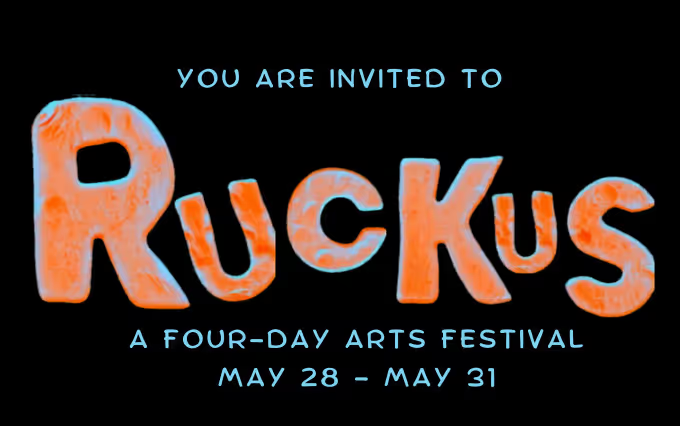
Did you ever rassle up a bunch of cousins and put on a show? That is the energy the founders of RUCKUS, an ambitious new performing arts festival, bring to a Zoom interview. I mean that as a compliment. Longtime friends Alex Wanebo, Cara Ronzetti (whose friends call her Cronz), and Carson McCalley are bursting with joy and wonder—about art, about community, about even the most mundane logistics of bringing people together.
It’s a good thing that they have so much energy, because they’ve been busy. Later this month, Ruckus will present thirty shows in four days. The scrappy trio has assembled an expansive lineup, from Broadway performers to rock musicians, poets, and clowns. The range of performers is intentional: the creators of Ruckus want the audience to discover. Each performance is short, and they are programmed one after another. Come for something you know you like, stay for the next show, and stumble upon something you love.
This interview has been edited for length and clarity.
Annie Rasiel: So let’s start with how you know each other! How did the three of you meet?
Cara Ronzetti: College!
Carson McCalley: We all went to Carnegie Mellon.
AR: Are you all actors primarily?
CM: Primarily is a tough one. We all do so many different things. All three of us write, direct, and act, depending on what feels artistically fulfilling.
Alex Wanebo: Carson and Cronz have both written, directed, and produced their own short films in the past year. Cronz is at a festival in Europe right now with the movie she made! And we all act sometimes.
CR: I also teach.
AR: What do you teach?
CR: The classes are called Character and Imagination and Directed Screen Acting. They’re acting classes at Stone Street, which is one of the Tisch studios. I teach acting to the Gen Z, and I love the Gen Z. They teach me so much. Like this! [Ronzetti makes a heart with her fingers in the classic Gen Z style.] It took me two years to learn how to bend my fingers like that.
AR: Why did you start this festival? What inspired Ruckus?
AW: It just felt so hard to find a theater space that was exciting to us, a place where people really felt invited to be introduced to new artists. And it’s so expensive to do anything in New York City. We wanted a way to bring a bunch of artists together and encourage people to see art they wouldn’t normally see, to refill your creative reservoir and expand the kinds of performances you see. Having this many shows in a row encourages people to expand their horizons as an audience member. If you like comedy, come for a comedy show—and then stick around another twenty minutes and you might discover that you love performance art.
CM: We keep coming back to this idea that the festival is half about the audience and half about the artists. When I directed Alex’s play at the Fringe in Edinburgh, we were struck by this community element in European theater. If you go to Germany, there are repertory theaters that are really about the way that the audience experiences the show. There’s an expectation that the audience should learn or experience something new. Commercial theater here isn’t like that. We wanted to cultivate that energy. And with that, I think, comes a cool vibe. You can make theater cool by returning to what people are in theater for, which is being together in community—not trying to make a million bucks by making a tourist hit.
AW: And we certainly won’t be making a million bucks!
CR: But I think that’s kind of beautiful. Our intention was never to make money here—and, speaking frankly, if we break halfway even, I think we’ll be happy. When Alex and Carson told me about this idea, I immediately wanted to be involved. It was something I’ve wanted for years. For the last four or five years, I’ve really been in the indie film world in New York. There was this moment in my life where I was like, “Wait a second, why did I stop doing theater?” That was my first love. I moved to New York—which is supposed to be the capital of theater—and it somehow felt so inaccessible. Filmmaking was more accessible to me than renting a venue in New York City and producing theater. For so many of us, theater is our first love, but the gates are locked so tight. It was exciting to me to find a way to unlock those gates with two of my closest friends, not just for ourselves, but for others.
CM: I love the image of the locks. It’s making me think about how what is needed for the art form changes the form itself. The type of things that you can produce changes because of the barriers that are in place. Accessibility allows you to take bigger risks. Even as an audience member, if tickets are cheap, you’re probably more likely to take a risk. The locks change what is being made. That is something we’re hoping to change with the artists and audience that comes to Ruckus.
AW: That was beautiful.
CR: That was so beautiful! One of our performers just buzzed me about some equipment. He’s playing music, which reminded me to say that this is a theater and arts festival. We aren’t just producing theater. We’re doing all kinds of live art, which is so exciting. Though now I’m asking, what is theater? Is theater anything that exists on a stage? Music can tell a story. Is music theater if it tells a story?
CM: We have performance art, we have clowning—
CR: Which I’m so excited for, because I don’t think I’ve ever even seen a real clown act.
AR: Do all three of you have shows in the festival?
CM: We do! Alex and I are bringing the show that we did at the Edinburgh Fringe Festival, and I’ve also written something. I’m not performing at all, which is kind of cool. Normally performing is my way in, and I’m excited to be experiencing this festival differently. I’m directing two pieces.
CR: I’m having the opposite experience from Carson. In the last few years, I’ve really moved away from acting. I’ve mostly been behind the camera, writing and directing. For Ruckus, I’m dusting off my acting! I’m acting in one play, and performing a piece I wrote about that explores gender identity and memory, through eight rounds of boxing.
AW: And I’m acting in the play I wrote that Carson and I did at the Fringe a while ago.
AR: What kind of producing experience did you have before this?
AW: None of us had produced on this scale. We had all done a little bit. I had produced a play. Carson had produced a short film, and he and I produced another play together. Cronz has experience producing films. I had never produced for someone else.
CR: I’ve done a lot of producing in film, and I self-produced a short play that I did in Queens. I’ve never produced a theater festival. I keep thinking about the hardest producing job I’ve had, which was a short film. It had around twenty-five actors and took place across different generations. It was a complicated film. I keep thinking, why is this harder than that? That was a really complicated film to produce! It had somebody who was eight years old and somebody who was eighty years old! I think what’s so specific about this experience is that we’re producing one festival, but the festival consists of thirty different productions.
AR: How did you get from Alex and Carson having the idea and bringing on Cronz to the festival being less than two weeks away?
CM: Overcoming fear was a huge part of it. We just had to go one step at a time. Just step by step. That sounds obvious, but we were scared, and breaking it down like that helped us. And remembering why we got into theater as children. It’s because theater felt like a really safe place to be. We constantly remind ourselves that we’re doing this because we want it to be fun and safe and exploratory and exciting.
AW: Our individual personalities, skills, and communication styles have been important too. I’m often the reigning pessimist. I’m always the one asking, “what if this all goes horribly wrong?” It’s been so important for me to have collaborators who respond, “what if it doesn’t?” We’ve given each other permission to go after exactly what we want and to dream about the best case scenarios. We imagined our dream venue, and then we found it. We’re obsessed with Box of Moonlight in Bushwick. All along the way, we’ve been like, “what is our top ask here?” And then it falls out how it does.
CM: That’s the benefit of having collaborators as well. We take turns being scared. We take turns taking the reigns. We champion each other.
AW: It’s like when you’re a small child walking between your parents, and each parent takes a hand. We take turns being the one in the middle.
AR: Was there anything that really surprised you or anything that you’ve learned along the way?
AW: People have been so generous with us. Beyond even just artists. We have collaborations with Brooklyn Art Haus and 1319 Press. People have been so generous with their time and their energy and so excited to help.
CR: I experienced that when I made my first short film, the shock of just how generous and eager to help people can be. It’s been a pleasure to watch you guys learn that lesson. What’s that phrase from the bible? “Ask and ye shall receive?” It’s shocking how often that is true. Asking for help still isn’t my strongest muscle. It still feels awkward, and I feel embarrassed and guilty, but people have been stoked to help—I think because they can sense our genuine loving intentions, or because we want to make art and help people we believe in make art, and people want to help with that.
We have a space we’re calling The Den, and it has a loungy, in-the-round feel, so we wanted to cover it with carpets and floor cushions for seating. And Alex and Carson were walking home the other day, and they passed by this store that sells the most beautiful cushions and rugs—
CM: Sarab in Williamsburg!
AW: Mahmoud!! We told him what we were planning, and he immediately offered to partner with us. He is decking the space out.
CM: He was like, “Take everything I have outside and return it when the festival’s done.”
CR: This was a man they just walked by. He’s incredible. It makes me want to cry. It’s like, holy shit. People are just out there trying to help each other. They sent me a picture of their car with the trunk totally full of all these beautiful cushions and rugs. He really came through.
CM: Expectation is such an interesting thing to wrestle with when you’re producing. Obviously, you can’t bank on something like that happening, but you have to leave yourself open to it, to the spontaneous possibilities of the world. We stay open to the world and open to each other. When you’re working alone, you can create an image of exactly what you want to happen. But when you have three people all working together, you have to release your expectations. You have to stay open to what other people can contribute, whether it’s your partners or a stranger. By releasing our own expectations, we can allow for these beautiful kismet moments.
AR: That spirit of openness feels essential to this festival. You’ve stayed open to all these different collaborators, from the performers in your thirty shows to all the people who have helped along the way—and, in turn, you are encouraging the audience to be open to a wide range of performance.
CM: When you produce just one piece, you need to be in control. You need to know how it’s going to go and what everyone is going to feel. You can’t do that with thirty shows. This has been a process of releasing all that.
AR: What were your first steps? Did you like look to any other festivals? Was there anyone you went to for advice?
CM: Creatively, we were solid from the beginning. Logistically… There was a lot to learn. George at Breaking the Binary festival was wonderful. Isabel Pask was also helpful. Brenna Power, who ran a film retreat where she produced five short films in two weekends, gave great advice about making sure artists are all on the same page in terms of expectations for the festival. There were other people who advised us about logistics too.
AW: We talked about bringing on a line producer or executive producer, but we realized that we were excited about doing every aspect of the work ourselves. We wanted to get our hands dirty in every aspect of it. A big part of the joy in this project has been learning by doing.
CR: I talked to several friends. It was a lot of hitting up buddies and asking for feedback. It’s been this beautiful, communal leap of faith, the three of us holding each other’s hands as we jump. And the audience is taking a leap of faith in coming to see kinds of art they’ve never seen before. And knowing me, and knowing Alex and Carson, it’s fitting that our first time really producing theater is so wildly maximalist.
CM: I’ll also say that—as much as the logistical advice was helpful and so appreciated—we are attempting to do something that I have not seen in New York. Even among festivals, it’s typically a week per show, or even just a day per show. We are packing shows back-to-back into four days. As far as I know, no one is doing that. So I actually wonder if a more experienced producer would have been more rigid in their approach, if they might have tried to limit us to what they believed was possible rather than serve this crazy vision.
CR: The reality is that this is a community effort. We have this thing called Legends. The Legends are our friends and people in our community that are volunteering their time to help run the festival. We’re giving them free tickets but they aren’t getting paid. These are just people who want the festival to work, who want it to be great, from a place of love and shared vision. When something is based in community, its bones are so strong.
AR: Is this something you want to do again?
CR: Oh hell yeah.
AW: Ruckus 2027, baby.
CM: We already have a document that’s a list of everything we’ve learned.
AW: It’s called LESSONS LEARNED, and it’s loooong.
AR: What are your biggest dreams for Ruckus? Do you have any dream acts? What does Ruckus 2050 look like?
AW: I want to go on tour! Build tents! Go state to state like a traveling circus! I want to get a boat! We can do Ruckus on a boat!
CM: Thinking about dream acts is interesting, because we aren’t really focused on individual acts. We think more about how they all come together. Of course, there are so many incredible artists involved—but it’s how they all come together as one experience, how their performances bounce off each other that excites us.
CR: I think what’s special about this year is that we didn’t approach it with a curatorial mindset. We led with community. I think it would be exciting as growing producers, to experiment with what that might look like in future iterations of this. What would it be like if we had a unifying theme or a central exploration for the artists? The artists in this festival came from our inner circles, but, God knows, we’ve got some beautiful medium circles and even bigger circles. It could be exciting to see what could come from casting a wider net with a theme. And maybe we do two Ruckuses in one year! Maybe one is about the environment and we partner with environmental organizations. That’s very specific to me, but I love a theme.
CM: Through this experience, we’ve seen that people really need rehearsal space. Maybe someday Ruckus becomes an Arts Development Center.
CR: YES!!!
CM: I want to build something that feeds back into the needs and dreams of artists who have something to say and don’t have a place to say it. I want to provide them a place to develop work and a place to perform it.
AW: Gotta get a warehouse.
CR: We could even—call me crazy—but it would be amazing to get a rich art lover to throw us some money and actually pay artists. God forbid an artist gets paid! We should dream big like this, because we all deserve that. The artists we’re believing in deserve that. Mark our words, we’re going to do all of this someday.
AR: I like that artists getting paid came after boat in terms of wild dreams. What are the craziest things you can imagine? A traveling circus, a boat, a warehouse, an arts center, and then getting paid—the biggest of dreams.
This feels contrary to what you were saying earlier about not emphasizing individual acts, but I want to hear about what each of you is working on. Plug your shows!
CM: Instead of pitching our three pieces, could we plug somebody else’s? I would hate for it to feel like the festival is about our work.
AW: Our very first show of the festival is a work in progress by Dillyboi called On Our Backs. It’s the perfect show to kick everything off. It’s a femme fantasy cabaret, inspired by Dilly’s queer archival research. There’s glamour, vulnerability—she said “bring the spirit of your highest heels” or something like that, and I don’t know if I know what that means but I love it so much.
CM: Keyon Monté is a playwright I’ve admired for a long time. He recently produced a version of Macbeth in an office basement in Kansas City in which the costumes and set were made out of trash bags and duct tape and other easily accessible materials. When we were creating this festival, I thought of him as such a perfect fit. He is someone who is willing to get really creative and do a lot with a little. He’s premiering his second play, Second Born, and I’m so excited to see it.
CR: Something I’m super excited about is this initiative called Human Instruments. The founder, Nick Demaris, is determined to prove to every single person that music lives inside of them—whether it’s banging on something or using their vocal cords, everyone can make music. He uses words like Gertrude Stein, finding music in the syllables. What’s really exciting about this is that it’s a workshop, so it’s immersive. I’ve done this. He did a workshop at my friend’s wedding, and I was like, hell yeah. It was a bunch of people moving around in a circle, making sounds. And he would kind of spontaneously conduct us, or have us move our mouths in certain ways. We picked up on his kind of sign language just by following him and trusting him. I’m a secret recorder—I’m always secretly recording things—and when I listened to it afterwards, it sounded gorgeous. None of these people were trained singers. They were just people using their bodies and their voices to facilitate sound and his magical ability to conduct humans in space and to hone in on each person created an incredible symphony. He’s going to lead the workshop, and based on what comes out of that, he’s going to come up with a piece and perform it that same day. It’s very experimental and very live and very impromptu, and I’m so excited for it.
AR: Wow!
CR: I love proving people wrong like that. So many people claim they can’t sing. Little do they know…
AR: It reminds me of a line from the cartoonist Lynda Barry. She says that adults constantly claim that they can’t draw, but you never hear young children say that. When kids draw it’s all about the joy of the motion and the storytelling, and they’re less concerned with the final product. At a certain age we start thinking about what the drawing should look like, and then we become self-conscious. I’m sure I’m butchering the quote, but it’s something about how all children can draw confidently and joyfully, but the vast majority of adults freeze up when asked to draw.
CR: That’s it. Man, that’s exactly it. I think that’s what our festival is about. We aren’t focused on the product of it. We care more about facilitating the process of it and bringing us all back to the massively enjoyable and godly thing that is to create. Creation is godly as hell!
RUCKUS: A WEEK OF THEATRE AND ART
MAY 28-31, 2026
BOX OF MOONLIGHT
17 SARATOGA AVE, BROOKLYN, NY 11233
Leave a Reply