
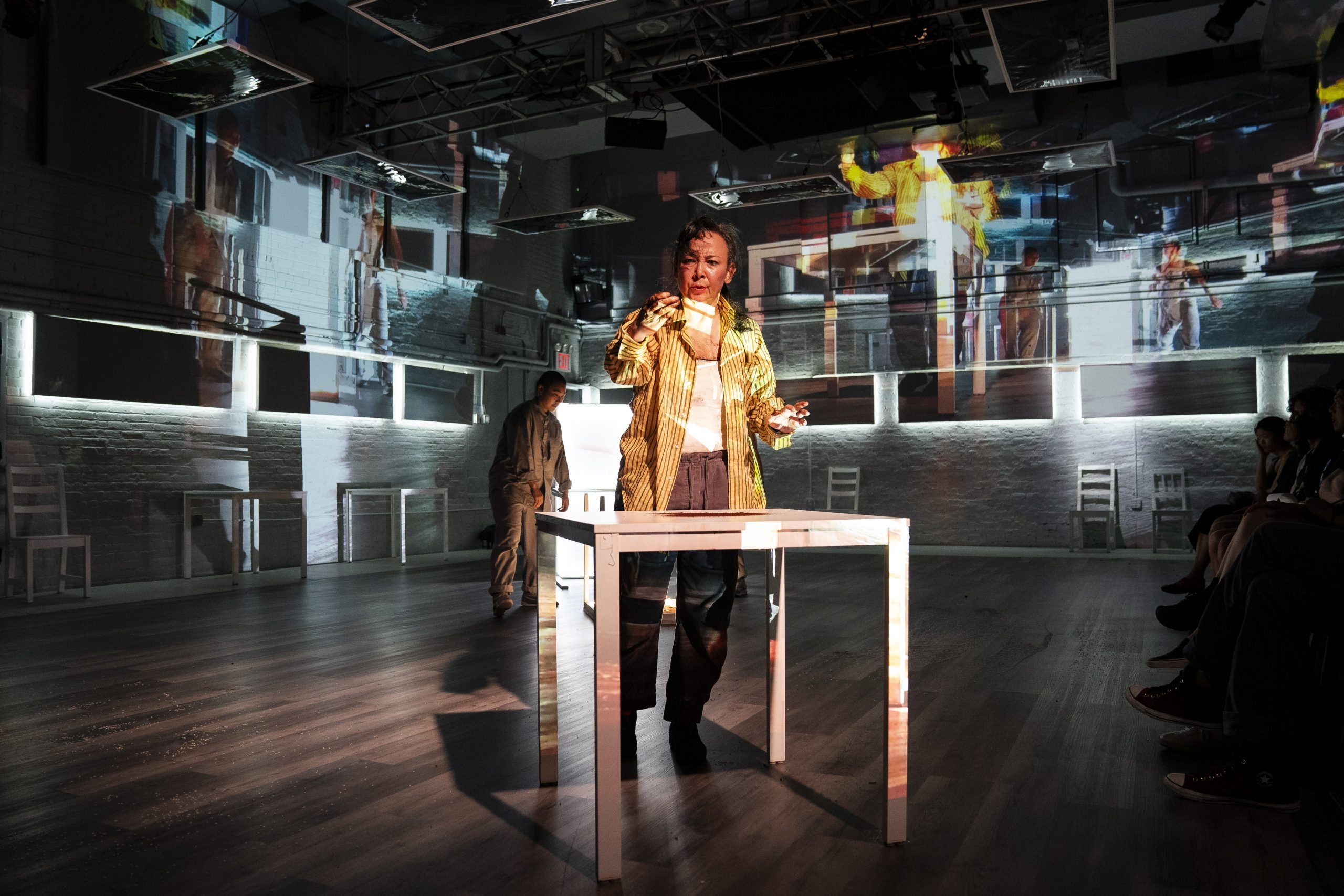

You could mistake it for a race. The first thing that happens in Pink Fang’s “The Table,” performed June 5-14, 2026 at The Gym at Judson, is a single performer jogging in place at center stage with an aspirational, distant look in her eye. A finish line approaches, carried by two figures dressed in shades of gray. The line approaches the runner, rather than the other way around. It briefly retreats, to her great confusion, but ultimately returns, and she bursts through it. What might be a great accomplishment is soon revealed as a delicious fake-out. This run is no race, this journey has no victorious end, and this performer has no chance.
For roughly twenty minutes, that same performer, maura nguyễn donohue, maintains a steady jog while manipulating and being manipulated by a barrage of objects. Things fly in and out—a laptop, a lamp, a teddy bear, an umbrella. Of course, they don’t really fly, but are carried by Rami Margron, Shannon Yu, and Julia Gu, all appearing in grayscale contrast to nguyễn donohue’s yellow button-down. At first, the runner seems in control, grabbing each object and maintaining their focused gaze on the horizon, then hurling the objects offstage. The objects become more unwieldy, and our protagonist does too. Things start sailing past unmanned and on wheels. Yu enters on a bike and drops dozens of boxes, beach balls, and balloons. Gu creates a fog with an aerosol spray, then a gas mask flies in for nguyễn donohue.
If the endless intrusions weren’t enough, this runner also has internality to contend with. She wipes her ass, masturbates, takes a nap, all while running. She gives birth (and hurls the baby offstage). The final straw comes when Yu, seemingly without malice, grips nguyễn donohue’s body, wrapping around them and bearing down, dragging them to the floor crying, frustrated, desperate, whether to keep running or to reach a destination it is unclear. Finally, they collapse, and the scene shifts.

The dynamic of one supremely human person intercepted by three neutral, grayscale figures persists for the rest of the piece. Margron, Yu, and Gu are the forces of this universe, less characters and more mechanics of nguyễn donohue’s reality. This reality, by the way, is not exactly ours. It’s a low saturation box of a world in which livestream projections of the performance intermittently appear, distorted and gray, on the tall walls, feeling less like a mode of surveillance and more like the visual manifestation of a mnemic trace.
nguyễn donohue awakens underneath a white table and chair. Next to them is a white bowl, just out of reach. The stark lights, masterfully designed by Tuce Yasak, flash off and on, each time revealing the scene rearranged. An industrial, rhythmic soundscore, designed by Justin Hicks, begins, and a new world of frustration for our protagonist is born. All they want is to eat whatever is in the bowl; the world seems designed to prevent it. The figures tip the table and chair so she can’t reach. They snatch the bowl as she reaches for it. They spin around her in a tornado, table and chair whipping through space, unclear whether she is chasing them or vice versa. The gray figures, as well as stagehands, propel onstage many more tables and one more chair and bowl. Whenever nguyễn donohue gets close to eating from one bowl, the other appears to call to her, but by the time she gets to it, it’s been plucked away. Finally, after much ado, two of the figures tip the bowls over and dry white rice cascades to the floor.
“The Table” feels Freudian. One could view Margron, Yu, and Gu as the subconscious, shaping nguyễn donohue’s reality beyond the limits of logic, reason, and belief. Hunger is at the center of the work, but it feels like a hunger born of desire, not of need. The gap between our desires and what we can attain simultaneously drives us forward and drags us back, tempting us with the thought of what our life could be, then rudely reminding us of our discontents. Sometimes, our desire is a cage.
And sometimes tables are a cage. nguyễn donohue finds herself trapped inside a cage of stacked and sideways tables, boxed in by the setting of her desires. She reaches deep into the pockets of her sensible pants and pulls out fistfuls of dirt. She reaches into her crotch and her bra—more dirt. She is disgusted. She wretches, then spits up a tiny plastic man. Then another, then a few more. They land on a table, in the dirt. Cameras appear, one a smartphone and one a wand-like device. The phone tracks her as she puts the wand in her nose, mouth, and ear, creating live projections of her insides that join her blown up face on the theater walls. As the tiny men emerge, so does spit. Then blood. All of it mixes in the dirt, and nguyễn donohue’s face registers all the distress and disgust that you’d expect.

With “The Table,” lead creative artists Mei Ann Teo and Erika Chong Shuch have carried forward the tradition of the organization’s founder, Ping Chong, whose retirement in 2022 prompted the renaming and reorganization of the company, which officially relaunched last year. The work is ambiguous, mysterious, and symbolic, but also filled with images that potently evoke the known world. nguyễn donohue’s fearless, vulnerable performance grounds the work in humanity, while the simple (excellent) stage and costume (Peiyi Wong), lighting, projection (Hao Bai), and sound design transform it into a mindscape. As in many of Chong’s works, one feels the importance of Asianness. The choice of rice is specific, cultural, weighted, but not prescriptive. Culture exists as an omnipresent facet of our psychosocial reality, so in this world it can be fodder for absurdity, experimentation, and manipulation.
It ends with a Lynchian turn. A siren call of bright pink light and an ecstatic, distorted chorus draws nguyễn donohue through a pair of upstage double doors. They reenter through another door and return to their center spot. A Daipoong-brand bag in the rafters descends via wire to hover just above their head. They stab it with a knife and are showered in pounds of dry white rice. Cleansed, perhaps, they exit toward the horizon. Then, a new performer with a new affect appears. Ching Valdes-Aran, both older and more predictably human than anyone we’ve seen so far, sits in a chair that is already virtually claimed by projections of Gu and nguyễn donohue. Their ethereal, disembodied images sway behind her as she eats a bowl of rice and sings Bob Dylan’s “It Ain’t Me, Babe,” the work’s first and last verbalizing. Yu and Margron return (in the flesh) and pass an armful of dirt back and forth, cradling it to their naked breasts like an infant. With each exchange, some dirt falls to the floor, some remains on their skin, and some is delivered onward. When there’s only a fistful left, Yu passes it from hand to hand until it has all slipped through the fingers. Valdes-Aran cheerfully sings Dylan’s refrain about not being able to fill the capacious emotional shoes demanded by a needy lover. Yu and Margron demonstrate that no matter the careful handling, things slip through our cracks (but leave their mark). And nguyễn donohue, for all intents and purposes the star of the show, doesn’t return until bows. It’s a study in nonattachment, then. No matter how badly we desire, the universe has a way of moving the finish line just out of reach. Then we finally cross it, only to find a hunger even more insatiable on the other side.
Leave a Reply