
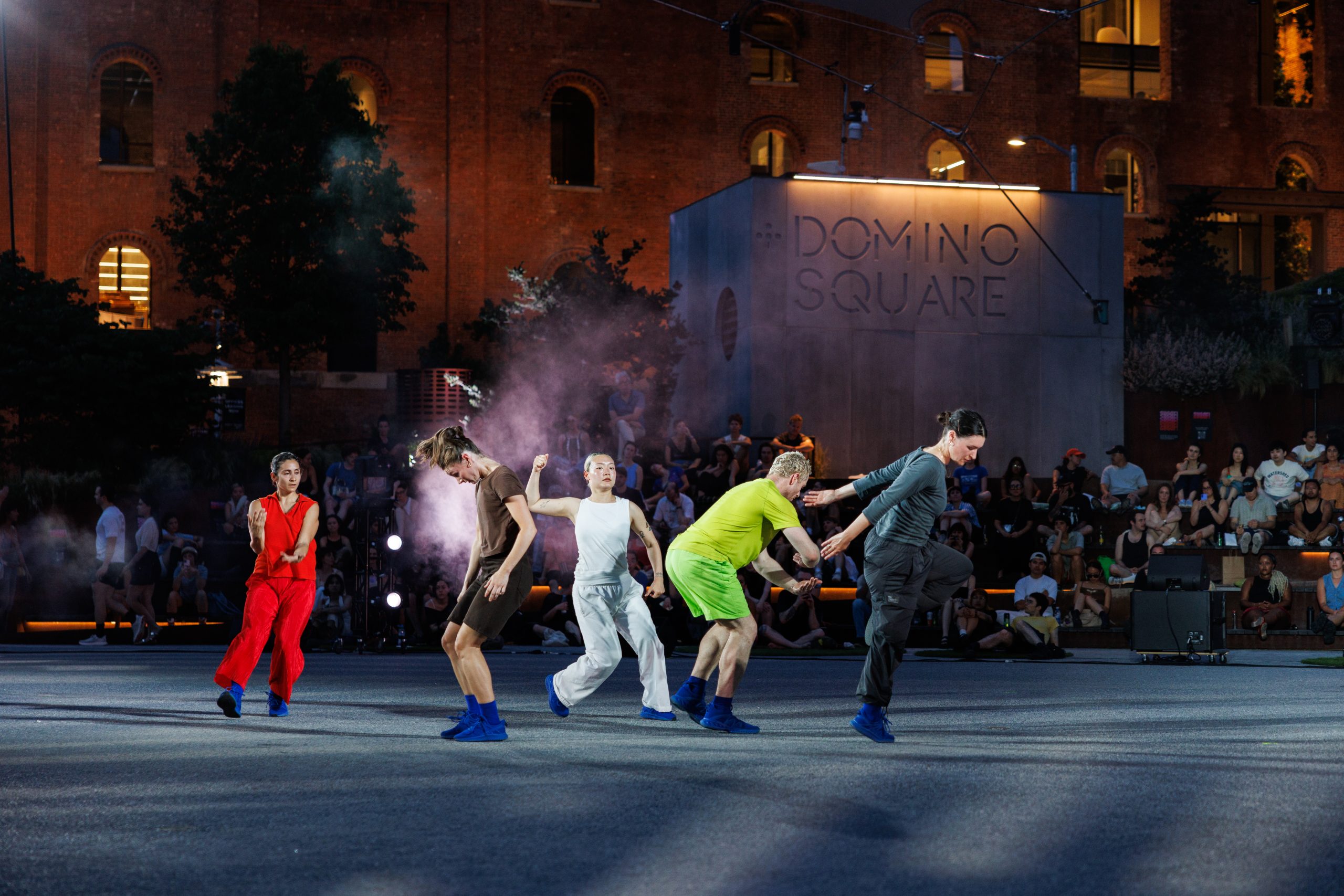
The plaza-cum-amphitheater in Domino Park is in many ways a strange space for performance. Situated just north of the Williamsburg Bridge, its wide, cracked-open bowl of wood, metal, and concrete risers (which are remarkably ill-suited to extended sedentary contemplation) splays open onto a screen of young trees and the bustling East River. The skyline obliterates the horizon—but for Lady Liberty hovering in the peripheral middle distance—while shiny, hard-edged glass and steel condos hem the park in, surging ever upward with gentrificatorial smugness. There’s beauty of a kind (and its more nefarious shadow), though when it comes to performance, the space proves diffuse and distractible in its capacity to sustain attention: performances all but evaporate from its broad circular arena.
These spatial and attentional challenges number among the many quirks and perks of performing outdoors, and in the second edition of the Sugar Sugar! performance series this June, four experimental dance makers tackled the space in markedly different ways. Across two split bills drawn from a broad spectrum of formal and thematic approaches to performance, artists Julia Antinozzi, Isa Spector, Malcolm-x Betts, and Kat Sotelo each brought their unique voice and vision to life. In conversation as much as in the substance of their works, the spirit of risk and experimentation remains alive and present across the board.
June 10 & 11: Julia Antinozzi and Isa Spector

Antinozzi most often creates and presents her highly-structured postmodern dances for theatrical settings, so the Sugar Sugar! commission offered a chance for her to think differently. “I knew I needed to do some sort of spectacle, I wanted to draw attention in some way, so I chose to work with a band and have them play live.” In performance, Andy Boay’s songs filled the air with a range of focused instrumental arrangements and plangent vocal harmonies—Boay sings alongside his brother, Edwin—that Antinozzi says complement many dimensions of her aesthetic: “It’s rhythmic and driving and has a hopeful, heartstring element.” Spanning ballads and bops and the blurs between, the confluence of music and dance offered tinges of romance, nostalgia, and quiet joy.
The dance, titled Strangest Days, also accounted for the timing of the sunset over the course of its 30-minute arrangement of interweaving solos, duets, and group passages for five sensitive performers. “The dance is structured into musical sections, but there’s a longer durational sunset that keeps time over top,” Antinozzi reflects. The choreographer’s movement language draws from ballet and modern dance idioms while retaining a pedestrian quality that touches recognizable tones of rigor and buoyancy. Subtle motifs flicker as touchstones: the rhythmic, summoning turn of hands raised in a high vee, arms flown back in lush backbending lunges, striding triplets and sharp pivots shaken off in a jog. As the bright streaks and hazy sunset pastels gave way to darkening dusk, Strangest Days meditated on the transportive alchemies of movement, melody, and space.

Wildly different in form and tone, Spector’s Dionysus at the Equinox took the shape of a “dance concept musical” adaptation of Euripides’ classic tragedy, The Bacchae. With a background equally weighted in theater and dance, Spector takes particular interest in the intersections of the two. “I’m trying to contextualize the abstract qualities of dance that I find very beautiful and transcendent within a social narrative,” he says. No stranger to nontraditional performance spaces in the “DIY dance scene,” he shares: “When I’m given a space it’s so much fun to make a story about the space, because the materials of the space become the character, and it invites a collective experience of us seeing the room that we’re in.”
To that end, Spector put fresh twists on the play’s thematics, which he locates in “gender, divinity, religious ecstasy and devotion, and a certain kind of madness expressed through dance and movement.” Despite the tragedy at its core, Spector leaned heavily into wit and humor: biting sarcasm, cheeky puns and one-liners, and a jazz band led by a lounge lizard dressed as a bunch of flaccid grapes. Bright, stylish costumes colored the characters’ overblown adversarial antics that persistently subverted power to poke fun at the sacred. Activating the entirety of the amphitheater, the ensemble of five bacchantes punctuated their debauched noodling with bursts of athletic unison and plenty of spirited chaos. Greek tragedy was a tall ask in this forum—exposition at times slowed the action or muddled the cadence of climaxes—which Spector took on with a playful spirit of public engagement.
June 24 & 25: Malcolm-x Betts and Kat Sotelo

In approaching his Sugar Sugar! commission, Betts came from a critical perspective that brought personal and political thematics into conversation with spatial materiality. In his work, Falling castles and broken dreams, Domino Park—which he cites as “the BBL of public spaces,”—became a forum to challenge assumptions about history and power. With his consummately poetic body and voice, Betts claimed the gentrified space of the park. “It’s about not necessarily associating falling with failure, but rather to lean into failure,” he shares. “And broken dreams refer to my connection to gentrification and being a native New Yorker, and zooming out even further to the Atlantic slave trade and themes of labor and extraction in my physical practice.”
Betts and collaborator Justin Musyimi moved through improvised states of exertion and exhaustion to comment on the immediacy of embodied experience amid systemic entanglements of power. Their kinetic ode shaded a multidimensional Blackness: sculptural, rhythmic, restless, wild, tender, unrelenting, and free. Amid GENG PTP’s shifting soundscape, swirls of motion and cascades of words defied legibility and dissolved boundaries of interior and exterior experience, spiraling through anxiety, effort, grief, rage, and surrender. Vibrant, larger-than-life paintings of the pair adorned a U-Haul truck that packed and carried them away, stripped down yet indomitable in their elegy to displacement. Betts reflects that the work is “an arriving to the otherwise: the otherwise as a space where I can be less violent to myself to bring it closer to heaven.”

Sotelo’s aspirations heavenward took on a much different shape in her epically-scaled ensemble work, IS THIS BEAUTIFUL OR AM I TIRED? With a thoroughly maximalist aesthetic and background in sculpture and set design for film and TV, Sotelo says of her process, “I start with the image and the composition of a visual space with costumes, set, and props from a sculptural mindset. And then the dance and the embodiment comes later. What character is in this space? Who is inhabiting this world? And that’s where the two collide.” Collide, indeed. Heavy machinery met saccharine sex—think scissor lifts, cake, and champagne—as a band played doo-wop and punk renditions of familiar pop tunes.
In an over-the-top birthday celebration, Sotelo hauled a 15-foot blonde braid behind her twinkling lucite heels, dancing alongside two equally blonde, sequined, and fringed compatriots. Anything but demure, their girl group vamping poked at the exhausting commodification of beauty, fun, youth, sweetness, and the all-consuming preoccupation of the “summer bod.” The women are as smart and subversive as they are brash and brazenly ridiculous. “Chaos, desperation, glory, perfection, failure have all been circulating in my work,” Sotelo shares, “And so this was the perfect time to bring in the big guns, the stunts, the bigger, higher things.” The pièce de résistance? A cake-shaped parachute skirt unfurled from atop a raised scissor lift to billow in the breeze—pure spectacle at its finest.
All told, Sugar Sugar!’s ventures into experimental performance bore evidence of a “yes, and” curatorial and production ethos (Williamsburg’s cup quite clearly runneth over in the budgetary realm), though at times the wild ambition and spectacular exuberance threatened to eclipse the substance of these artists’ voices. Risks were taken, skies stayed clear, and a bunch of artists who probably can’t afford to live in the neighborhood got to take over for a handful of hours. I can only hope that the forces of gentrification might keep showering money on experimental performance makers, and that spaces and audiences might be cultivated in turn to embrace the gritty intimacy as much as the spectacle in their work.
Leave a Reply