
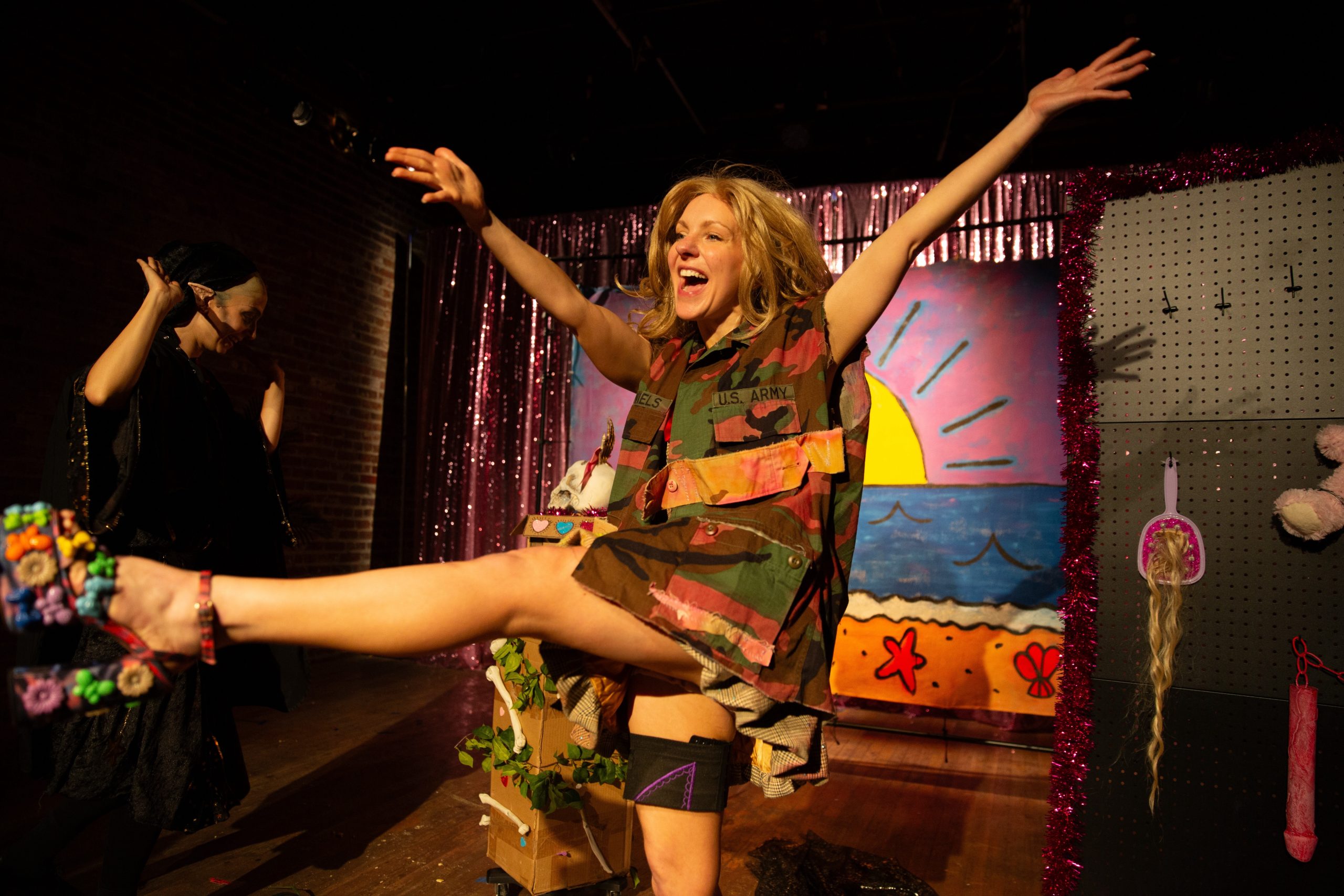
Cecilia Corrigan in conversation with Alex Tatarsky

ALEX: Hi Cecilia! Look at us! Two busy clowns dashing all over town. Can barely find a moment to connect. So I’m going for it! Can you please describe for me how you prepare for an epic like The Gay Divorce? How do you get in the zone? What does The Gay Divorce require from your spirit?
CECILIA: Wow, whatta question! How can anyone prepare for the coming storm?! I’m in tech and I was actually thinking about you cuz I was wondering if you do tech. I mean of course you do! But you improvise a lot and it always seems like you’re doing everything in the moment! I know your shows are very carefully planned out but is it this stressful? Cuz I’m going nuts!
I think in the final days it’s about entering a state of acceptance. Especially with anything clownish. You’re making an offering and accepting that you can do what you can do to prepare but ultimately things are just going to happen. I’ve also been nesting back into the performance and the characters. I want to be really precise in my language this time, I feel like that’s where I can really focus. And sometimes it feels like figure skating. I don’t figure skate. But I can imagine that it’s really fun.
And I’m going to snatch as much sleep as I can and stay hydrated. And I try to keep it as silly as possible, not to get too somber under pressure. When things are stressful, you gotta be silly! That’s why it’s good to work with people you can be silly around.
ALEX: I am currently voice memo-ing you naked from a tent in New Jersey and I’m curious to hear more about this question of precision in language. I met you as a poet person! That’s how I first got to know your work: a poet person who was also funny and fun to watch. (No offense to all the other poet people!) But it’s really special when you see a poet who is also really a devoted performer and has a sensibility around rhythm and character and state and style as well as precision of language. So how did this happen Cecilia? How was the journey from poet to… whatever the hell you are now? What are you now?!
CECILIA: I like the motif of naked in a tent in New Jersey. I’m not naked but I probably should be because it’s 3:30 in the morning. I took my friend out for a piece of cake for her birthday – my friend Suzy who’s been helping with the show doing stagehand stuff. It was her birthday so I took her out to the diner near the Brick and now it’s 3:30 and I am on my way to being naked. Why were you naked? Wait okay can I just say… I worry about bugs in a tent. You know? Are you – was it okay? I would find myself too nervous to be naked in a tent if bugs were a presence.
Well, different strokes for different…. cloaks. I was going to say folks but I was thinking clown and I said cloaks. Should that be the plural? Cloaks? You tell me! You studied clown for a long time and I’ve just done my fair share of workshops but we all know it’s not the same thing. Clown is kind of like poetry in that there’s a conservatoriness to it. You realize a lot of it is about who your teacher was and stuff. And I like that!
But in answer to your question: I would just say that I’m an entertainer, honestly. [laughs] I think this show in its current iteration feels like my truest attempt. I’ve always been really into really just trying to be entertaining. My work has felt more and more honest ever since I allowed myself to fully commit to being entertaining and the ways that I fail at that, or whatever makes me weird or whatever. But I kind of obnoxiously try to insist that I don’t think I’m weird.
I just want to make people laugh til they cry. And I want it to be also the most fun movie they’ve ever seen. And I also want to ritualistically lay a bloody heart in a bed of white roses in a dark forest glade at their feet in total silence under the moonlight. You know, just a fun night out for the girls!
ALEX: Okay amazing! I, too, basically just want to make people laugh and cry. I am in fact desperate to make them laugh and cry! And not to be corny by bringing up my favorite topic which is etymology — I once had a crowd literally start to boo because I was going on about the etymology of the word “flotsam” — but I really love the word entertain. It means to hold together. Lol hold it together! I think entertaining, whether of guests at home or audience at a theater, is one of the ways we try to hold it together. Amidst and despite and through it all!
May I ask how you approach writing a thing like The Gay Divorce? Are you writing on the page? Are you writing on the stage?
To your point about tech I basically improvise for years and years and years until the thing reveals itself to me and then it eventually gets increasingly set, which can be really satisfying because I like to work with lighting and sound design and choreography in a really precise way. But it also loses something of the anarchic, terrifying thrill of not knowing what you’re going to do and the audience being able to feel that terror and delight in it with you. I very rarely write on the page, I always “write on my feet,” as we say in clown land.
So I’m curious: where do you write? On the page? On the stage? On your feet? In your head? On a bike? On the bus? On a boat?
CECILIA: I know what you’re talking about with the improvising and losing something when you tighten it up, that fear! The first time you do a show – that raw viewing – you’re supplicant slash victim slash fellow traveler with the audience and you’re just like ahhh is this anything?! Your radical vulnerability also kind of makes you less vulnerable. Cuz the whole idea of trying to shape something feels inherently as if you’re supposed to have something at the end of it. Effort is weird. I don’t know about you but I have a weird thing about effort. And I think part of starting to grow up a little bit as an artist has been realizing that having fears about how much effort is too much are actually just useless and not helpful. More is good, actually. Less can be good too. But I think we’re often waiting for permission to let ourselves go all-in and ultimately that has to come from you. But then you’re admitting how much you care and you risk being disappointed! Ahh!
Anyway, to answer your question, at this point the show is very scripted. Lots of effort and care and precision, I admit it! There’s a lot of intense choreography with music and lighting and objects, and I work towards creating a type of disintegration and chaos that can only come through if you are extremely tightly rehearsed. I want the audience to be able to see what’s falling apart around my character, clarifying the disintegration as opposed to making it a blur because a blur is actually quite calm. Early Looney Tunes is really good at this kind of economy. It’s also something I’ve found in clowning– that rhythm between stillness and chaos is important to me, to my characters.
ALEX: I totally know what you mean actually about how being super raw and improvisational can also be a way of not being vulnerable LOL because then no one can really judge you! You’re like this is all unplanned and unfinished and unknown! I’m being brave in front of you! And writing – like, choosing words with intention and shaping a repeatable structure – that’s some scary shit because you have to really stand by your choices and be confident. Like yes this is what I want to say and I’m saying it! Night after night! I guess improvising and writing are each vulnerable and terrifying and mortifying in their own special ways!
Talk to me about character. How did these characters emerge and make themselves known to you? Do they have names? Do you hang out with your characters? Do they babble to you? Do they teach you life lessons? Do you like some more than others? As a person who has lived with certain characters for years and years at this point, I’m curious about your relationship to your character cabal!
CECILIA: Oh I love this question, I love talking about my best friends. In this show in particular I’ve been able to spend time with the voices for a luxurious amount of time. Some of the characters have a pretty full social life outside of The Gay Divorce, like Bufana the immortal witch has done multiple shows across multiple cities. I mean, Bufana could do anything and be a star. All the characters in this show kind of arrived in a different way, like the Worm sprang fully formed out of my body like Athena from Zeus’ skull, and Bufana feels like she may have found me via some fragmentary energy of my amazing late grandmother who was the most innately powerful person I think I’ve ever met, and Girly feels like she’s an assemblage of all my favorite shames and delights kaleidoscoping the dumb blonde trope I’ve been thinking through in pretty much everything I’ve ever made. And Jesus was kind of a delightful surprise, but he showed up via a reaction, maybe a defensiveness to making a project about an experience of abuse, and thinking about the concept of victimhood, of how cringe-y it sometimes feels for me to identify as a victim, like oh look at me up here, I’m a martyr, look how brave I’m being. And Jesus feels like the lightest character for me because he really is okay. Like, he’s actually doing fine being crucified because he gets lots of attention, and in every representation throughout history everyone is looking at his pilates body being like, damn. And honestly showing off your abs and having everyone admire what a good person you are is kind of the dream, right?
Anyway, I’ve found that training in more somatic practices has helped me escape my writerly tendency to know characters before they actually show up, if that makes sense? I mean like in dance, or acting, or (big-time!) in clown, you learn how to feel something emerge before you name it. And I think that’s helped me a lot. I love like the weird otherworldly magic in letting these guys emerge through my voice, muscles and body as opposed to the writerly brain-typing-page dynamic. It’s much more vulnerable in my body. I feel much safer on the page, even though writing can be its own kind of torture. But moving and vocalizing and letting the forms or characters or whatever they are take form, it feels so contrary to so much of the training the world imprints on you. Especially right now, fascism is all about corporeal control from above us or outside of us, and I think a lot of the show is about that, especially the way we learn to perform having a body as a way of exchanging our bodies for security.
LOL ok this got kind of heavy at the end, can we end with a joke? You’re the funniest person alive, can you think of a way to cut the weird tension I just created by pounding my fist on the imaginary table? Daddy’s ranting again!
ALEX: Haha I love this! Yes! I mean my own personal clown daddy guru teacher Jacques Lecoq (he was dead by the time I started my training so I’ve only studied with his acolytes) apparently began teaching physical theater in large part to help people in Europe loosen up — like physically — because all that fascism and rigidity and grief and horror was trapped in their bodies. We tense up to protect ourselves but it also cuts us off from feeling. These days when I start stretching, exercising, moving, dancing I just want to weep — often I do start weeping! (I’m quite annoying to rehearse with as a result!) Sorry I don’t have a concluding joke I just want to talk about weeping! But yeah it’s like all the feelings we push down to get through the day just get shaken to the surface and released as weird salty water. Ugh! I truly think it is a necessary and also very difficult task that we performer people take on to try to stay in a soft state, to seek that embodied vulnerability and openness that is necessary for the exchange of energies with an audience. Goddess bless you on the journey, Cecilia! And I know you have some very exciting next stops… where can audiences catch The Gay Divorce next?
CECILIA: Ah I love that you get weepy while rehearsing! I’m generally in favor of tears. Sometimes I get weepy when I feel inspired, usually when I’m alone, looking at the moon or something. I actually found myself crying at certain points during the show, (we closed yesterday! ahh!) which felt very uncanny since my conscious goal is always to make the audience laugh, but yeah, this show definitely unlocks some deep caverns of emotional experience, at the same time. It’s weird when you make something that has comedy as the goal but it ends up containing all these gems and germs of vulnerability and truth and…. that’s clown baby!! I love talking to you about this because you are so powerful in your goofy and vulnerable states, which is why I love following you into the liminal space as an audience member!
And yes, yes yes. I’m actually writing this from a U-Haul post load-out and looking ahead to our run in EDINBURGH at the Fringe Festival! We’re running the show all of August at Greenside Riddle’s Court. It’s exciting and terrifying, but less the latter now that we’ve had our run at The Brick. Like I’m so glad we got to play to sold-out, laughing crowds in Brooklyn, because who knows what our audiences will be like during our marathon of shows at the clown olympics. I’m excited to rest a little, then roll up to the castle gates (there are castles all over there) with Allison and Cliff, and to deliver the glamorous, tearful, silly glitter bomb that is The Gay Divorce. Plus, I get to be in the same ancient city as so many brilliant performers. I love clowns.

Leave a Reply