
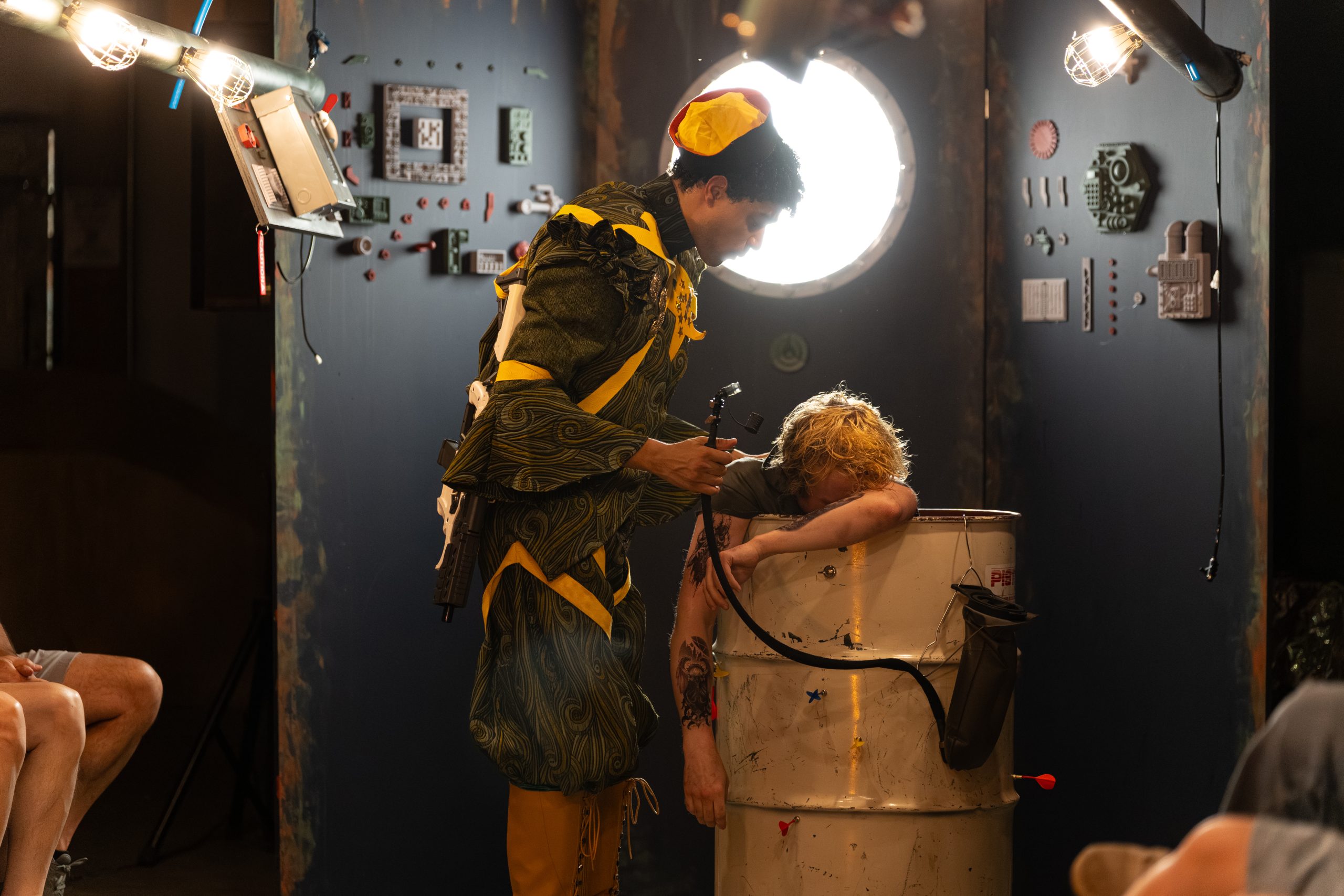

I think about mortality and that of myself and humanity more often than what would be categorized as normal. I am skeptical of the world and the one to come. I am not sure what can be done. I do think, though, that performing these fears is a form of processing, for audience and performer alike. This is, after all, the conceit of speculative fiction. It doesn’t attempt to drive you the way realism, especially in theatre, tends to. It’s along for the ride with you. SUB is one such play that takes the backseat.
I was initially going to classify Alex Aguirre’s SUB as a speculative fiction, then narrowed in on alternate history, then realized that there is nothing alternate about Aguirre’s projection. With that, SUB is a prediction on the permanence of digital culture, the development of post-cash capital and, as a result/for the most part, the celebration of warfare. Set in 2085 on a nuclear powered submarine floating above sunken San Fran, the play recounts a typical work week for three cogs in the war machine. In this future, militias have been formed out of subcultures, such as “indie sleazers and the black metal brigade.” Freya Rex (Addie Guidry, slyly sensitive and pointedly funny), daughter of a powerful weapons magnate, has been tasked with dressing them, and Peter (Nick Walther, warring Guidry’s tone and wit to a T) with arming them, after Freya’s father paralyzed him and killed his wife for intending to use the submarine as a traveling art gallery. Their security detail is Arnold (Jonah O’Hara David, sublime in this role,) a humanoid robot who was given the job after Freya’s father accidentally got his family blown up in a trial. He scrolls through a feed of memories and knowledge like this TikTok, and often muses on his own lacks and conditions due to his personage (“feeling very reflective lately…like a mirror”.) Together, they serve high profile clients, such as film noir warlord Barnaby Miller (Santiago Mallan, cool and calculated whilst committing to the bit-within-a-bit), and his “Hyper-Pharma CEO” wife Cloë Chimæra (Chloe Claudel, perfectly “post-human”,) who happen to be at odds with one another in a strange, sadomasochistic way, leading to revelations and resignations amongst all.
There is something uncannily realistic about Aguirre’s vision of Western culture sixty years from now; trendy clothes are still fits, conventionally attractive people are still baddies, and there are still the same liberal arts schools, except they’re now packaged as “nostalgia” institutions, immersive experiences that simulate a time preferable to exist and make art in. At least their cultural connotations remain (“I actually went to Bard” “That explains why you’re so annoying”.) What also remains, more unfortunately, is the presence and practice of fascistic politics. Nowadays, these attitudes are often referred to as “dangerously on the rise”, though many can see clearly that it’s already here. In Aguirre’s future, fascism is a state of mind. It is simply the norm, and though many characters wax poetic about its shitiness, nothing can be done about it. It is inherently disingenuous, though, which clashes culturally and with the more general human experience. Freya sums it up best; “all these cosplaying murderers want is to feel like they have an identity, but they have no idea how to articulate their identity, because they suck.” True identity is only afforded and formed out of humility and empathy to oneself and others. Without these traits, an identity that feels sincerely reflective of oneself cannot be reached. And yet, we should not feel bad for repressed fascists. There is really no explanation worth trying to make for such behaviors and livelihoods beyond that these people suck. This simple truthfulness was so refreshing amidst a field of plays that attempt to humanize evil and violence for the sake of non-committal politics disguised as liberalism. When a playwright makes their politics clear, their intentions as a storyteller clarify as well, and if they’re confident in their craft (some with clear and critically sound politics do not write them for the stage well), it’s smooth sailing.
On top of this textual triumph, there was a real unity amongst the design team and their service towards the directorial vision. Mitchell Polonsky’s work (direction, lighting, and sound design) is calculated yet expansive, making imaginative use of the tight quarters the play is set within, sonically and somatically. Owen Versteeg’s set design (he also did lighting with Polonsky) does a commendable job at spatially communicating not a claustrophobia within the space (though it is teeny), but a perpetual desperation. After all, the ship is under 24/7 surveillance and armed at all times. Its inhabitants, to an extent, must perform, always aim to please even when it means betraying oneself. A strict social code is explained to us textually and, more pointedly, through garments. Olivia Vaughn Hern’s costumes are post-fast fashion, using consumerist wares and thrift-looking pieces to communicate a culture after its current form, one that harkens to but never truly builds upon the past. They are archetypal, costumes in every sense of the word. Except Arnold’s, though an elaborate coatee, which ironically looks the most homey, most “cozy” of the ensembles. It was constructed by Freya after all, who keeps a roll of star stickers on her waist so she can put one on Arnold’s badge whenever he’s feeling blue.
It was dramaturgically keen on Aguirre’s part to have Arnold be the source of tangible and pure optimism in the bunch . “My vulnerability and sincerity shouldn’t make me a target in your eyes.” Even whilst being cognitively controlled and delayed by Peter (not to mention living in a cube,) he comes out of every spat in the moral clear, always spotting something on the horizon, an action that allows the others, even briefly, to dream. I did worry at certain points that the story would veer entirely into cynicism, but was always relieved and heartened by the earnestness that shone out of Aguirre’s text, moments that provided structural benefit and affective beats. But still, Aguirre remains critical of the more popular hope, one that is manipulated and ultra-processed to sell a model of life, one that upholds suffering for the sake of affording a beach trip or theme park visit, our current “nostalgia” institutions. At least it’s better than pure hell, as Freya muses, “once you remove hope, you don’t really have humanity, you just have biology, and biology doesn’t let you dwell too much on how meaningless and pathetic your life is. So we stay complicit, in whatever paradigm this is.” I think often about the fact that we are simply animals who managed to assign meaning to existence in a particular way. Encompassed in this meaning is an urge to look so deeply inward we almost cut ourselves open scavenging. This experience would not exist, though, without the promise of hope, the promise that we’ll one day look out and see it all taken by the wind, out of sight, out of mind. And yet, there is a real enjoyment in this suffering, something to relish about knowing yourself deeply enough to feel so bad. Aguirre’s characters grapple with this contradiction, one created by a world that, today and likely for years to come, shrouds true freedom from all.

Leave a Reply