
The ugliness of today’s world can often leave me feeling depleted and cynical. In moments like these, witnessing the depth of human imagination and creativity through art can prove an important balm to renew my spirits. But experiencing profound wonderment in the theater is often rare, as is seeing a live performance that was so moving that it left me speechless.

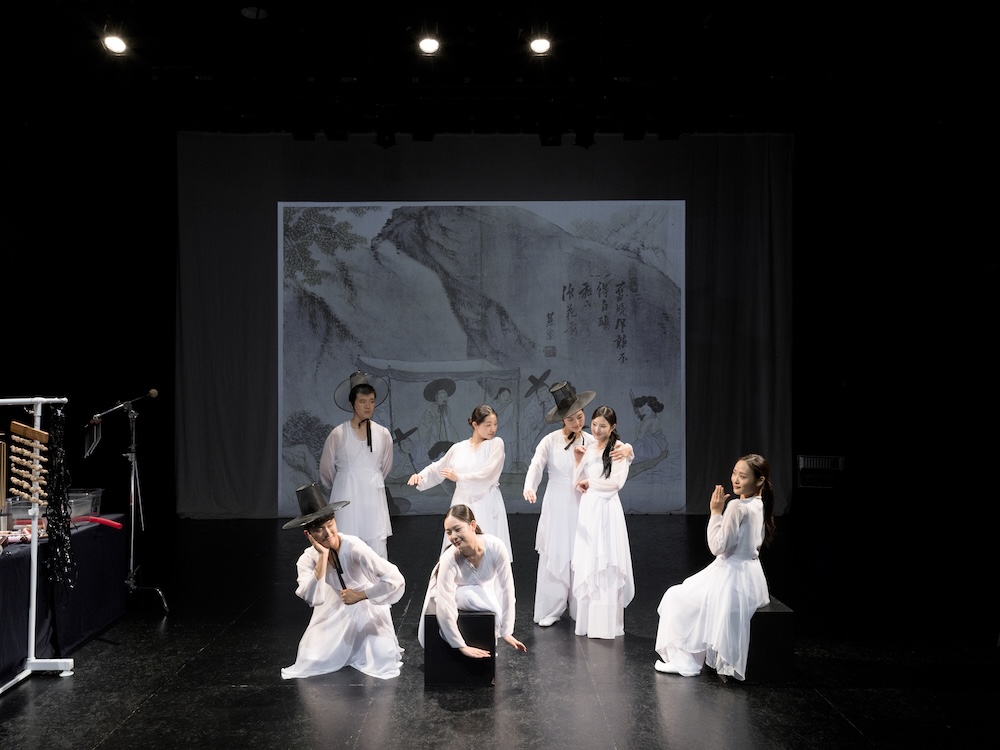
Last month, I got to have one of those experiences. In association with the Seoul Institute of the Arts, La MaMa presented the world premiere of maedeup: Weaving Shin Yun-bok for a limited run in its Downstairs Theatre. Created and performed by an interdisciplinary performance ensemble from Korea called kNOT Company, this piece quietly affirms the value of beauty, and was one of the most moving experiences I’ve felt in a long time. A refreshing alternative to all of the screens that clutter our lives, a kind of ultimate rejection to any and all AI-generated slop in the arts, this 70-minute work weaves together light, shadow, sound, movement, and visual art into a singular and coherent celebration of human creativity.
The company debuted in 2024 with a performance inspired by the work of Kim Hong-do, developed with the Ansan Cultural Foundation and presented at the Kim Hong-do Culture Festival. For their latest work maedeup, kNOT drew inspiration from another Korean painter of the Joseon dynasty, Shin Yun-bok (1758-1813). Considered far more erotic than the illustrations made by his contemporaries, Yun-bok’s “genre paintings” detail intimate encounters within urban life, with each image articulating complex personal interactions using vibrant uses of color and line.
Structurally, maedeup reimagines about ten of Yun-bok’s paintings, creating a sort of short story collection performed by kNOT’s talented ensemble of multitalented performers (Shim EunSeop, Kim SaRang, Kim SeoRan, Ko ByungYong, Noh SoonMo, Shin RaHee, Lee Eun, and Seo GwanYoung). All of these tales are conveyed non-verbally, and the company is fluidly talented in gesture, movement, and facial expression. At the conclusion of each section, the performers hold still in a tableau vivant as the original source-painting by Yun-bok is projected onto them. This effect not only establishes the connection between the past and the present for the audience, but also highlights the range of extrapolation kNOT made in creating each of these sequences. The two-dimensional images from the past are literally brought to life.
In “Lovers under the moon,” for example, we witness the entire courtship before glimpsing Yun-bok’s static image. Two performers play the two lovers, adorned in perfectly rendered costumes designed by Lee Jieun, Ko Sukhee, and Kim SoYi, while three other members stand and sit strategically onstage with hand-held lights. These devices are used to make the man’s shadow bigger than the woman, implying distance or power; to depict traveling across great distances (even though they are simply walking in place); and to have their shadows dance together in a romantic waltz, even though the performers’ actual bodies are physically separate from one another. Meanwhile, a third projects her light onto two-dimensional buildings close to her body, forming projected shadows of cities or of houses on the upstage wall for the lovers’ shadows to “enter” into. This doubling effect visually–of the shadow theater combined with seeing the actors’ real bodies onstage–casts a dream-like spell onto the audience’s eyes.
Another is the use of more modern technology to induce visually magical effects. In addition to reimagining classical Korean painting, kNOT has a “story within the story” of maedeup. A young visual artist stage-left watches the live performers onstage, while making numerous visual art pieces using collage, paint, watercolor, and rice. An overhead camera set above her table projects onto the upstage wall, thus creating a kind of moving scenography for different sequences within the piece. This artist, both inspired by and interacting with the performers, serves as a kind of proxy for the audience, engaging with Yun-bok’s art through kNOT.
The stage compositions and movement sequences by choreographer Kim SoYi run the gamut of mood, tempo, and tone, from creating a scene of people playing on a swing by the river (“Scenery on Dano Day”) to a delightful recreation of Yun-bok’s “Dance with Two Swords.” Sonically, maedeup also features a lush and varied recorded soundscore by composer Woody Pak, which helps to couch the live performers in a particular setting. Simultaneously, two performers stage-right become Foley artists, creating audio magic in real-time with two long tables filled with multiple objects. By blowing bubbles through a straw, snapping open a fan, striking two wooden sticks together, and much more, these sounds accent a performer’s tilt of the head, or underscore a small physical detail made by a hand or foot.
Multiple layers of effects and expressions happen simultaneously during maedeup: Weaving Shin Yun-bok, but at no point does the performance feel cluttered or chaotic. Director Kim JiYoung skillfully synthesizes these various ingredients together into a unified whole, with the piece unfolding simply and smoothly, and the incredible level of precision and effort required to pull the entire performance off hidden from view. This is a stunning work.
By the end maedeup, its two worlds merge poignantly. The young artist who has existed on the periphery as an observer is now welcomed into the fold of the ensemble, and the entire company performs a final dance of splendor. With this work, kNOT Company encourages audiences to revisit or discover Korean classical painting, as well as the present-day potentialities for ingenuity by gazing upon the past.
maedeup: Weaving Shin Yun-bok
kNOT Company
La MaMa in association with the Seoul Institute of the Arts
September 24-27, 2026
Leave a Reply