
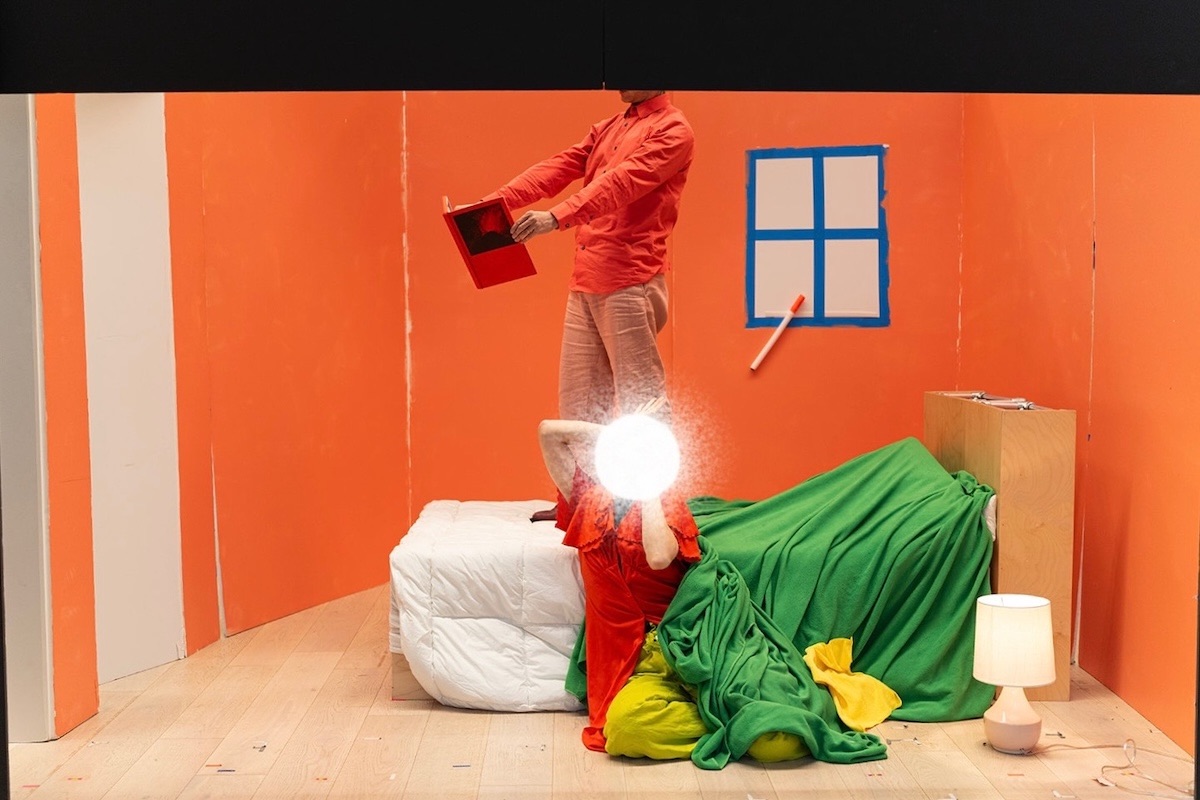

It is only apt that a play inspired by the work of Kate Bush would dream larger than life. The Kick Inside, loosely based on the Bush album of the same name, is a remarkably ambitious project hatched by Nicolas Noreña, whose work as The Million Underscores has both induced me into uncontrollable giggle fits and moved me to breathlessness. Noreña has a knack for folding the wonder of quotidian minutia into his hunger for great scale, and the resulting symbiosis takes its newest shape as the oddball tale of a woman seeking communication in an indecipherable world, written by a baker’s dozen of playwrights.
In the week before The Kick Inside’s tech rehearsals at HERE Arts, I chatted with Noreña about aiming dizzyingly high, threads of coincidence, the impossibilities of language, and stitching together this exquisite corpse of a play.
LEAH PLANTE-WIENER: Good morning! I have Nico Noreña with me.
NICOLÁS NOREÑA: It’s been a busy morning. We load in next week.
LPW: Is it a tech-heavy show? From the reading alone, I couldn’t tell how this was going to be executed.
NN: There’s a lot of stuff. There’s moving set pieces, props galore, crash mats, fake cocktails, giant cigarettes.
LPW: I want to pinpoint the origin of The Kick Inside.
NN: I started with the Kate Bush album, the first scene already in my head, and the want to have some fight choreography, some action scenes in the show. Also, the frame that shifts for every scene.
LPW: An actual physical frame on the stage?
NN: Yeah, on the very edge of the stage. Each scene is visually framed differently. I started playing with that in our October 2024 workshop at Mercury Store. I had Tim [Scott] and Alenka [Kraigher], who was here from Slovenia. I started by building some fight scenes. I knew I wanted one with three dogs and a bar fight. We simultaneously started to pull out some characters. One of the first characters, of course, was Alenka, the character that we follow.
LPW: Was that based on your desire to work with Alenka, the person?
NN: Yeah. I had worked with Alenka several times. We were in Richard Foreman’s Old Fashioned Prostitutes together. That’s where we met. She was also in 1001 Sur, which is a piece that we did at Target Margin. Alenka was saying that she really wanted to work on stuff in New York, and I was like, do you want to work on this Mercury Store thing? That’s how we started. Tim and Alenka were the people I brought in, and everyone else was Mercury Store.
Slowly, we started building the characters around the people we had. I wanted Tim to be the man in Alenka’s room, which comes from the Kate Bush song “The Man with the Child in His Eyes,” which is in The Kick Inside. I knew that I wanted a cousin character, so Frankie [Placidi] was the cousin, and has been since the very beginning. We made the character of the dog, Felix [played by Felix Teich], because of the dog fight. We had our characters kind of built, and I started writing down the scenes in sequence.
I wanted to try something out about language experiments. My idea was that if I set the scenes in places that have very codified, normal rules of behavior and of the way that people speak to one another, that it would be a good context to begin writing these things. At the time, I thought I was going to write the show myself.
LPW: I was curious about how much text factored into earlier workshops.
NN: We started with no text. I was working physically first and setting the image world of the show. From the beginning, we set a lot of the scenes as they will be presented.
Then, I invited John Jesurun to take a look at what we were doing, thinking that he could give me some advice as a playwright. He jokingly said something like, if I were you, I would hire a young writer who just graduated college to write this for you. I just laughed, but the idea stayed with me, that maybe someone else could write this.
Mercury Store then offered me this residency called Big Play, where you have three weeks to develop a big idea. They asked me what my big idea was, and I was like, I’ve been slightly considering this idea of asking different playwrights to write each scene. That was the biggest version of this play that I could imagine.
LPW: How many playwrights do you have?
NN: Thirteen. I’m really into the number thirteen. If people are like, there’s no thirteenth playwright, well, I wrote the scenes that have no text, so.

LPW: I’ve been thinking about this. I’m a playwright, but there is a whole portion of my practice that is very compositional, physical, sound-heavy work. What I say is that playwriting, the literal act of writing a play, takes so many forms. I see the choreographing of bodies in a movement sequence, or something more devised, to be a form of playwriting.
Knowing your work, it’s clear that you have a background in very physically involved theatre, which makes sense considering that you came up under Richard Foreman.
NN: Yeah, and Mary Overlie is where a lot of my physical stuff comes from; my physical vocabulary, or the way that I think about theatre physically. It’s through Overlie’s work, the Six Viewpoints.
Each scene in this play is meticulously choreographed. There is my writing in the sense that I wrote down what each scene is, and gave the shape of the whole thing. There was a moment when I wrote one scene, but I didn’t want my text to be in there. It seemed like too much.
Once it was a go with the Mercury Store residency, I started asking some people I knew, like Jess [Barbagallo], friends of mine who are playwrights. I don’t know a lot of playwrights, but I asked Jess and I asked John. I asked Richard, wherever he is, to send me something. I opened my computer, went into his notebooks, opened the first notebook, and that was it.
LPW: Wow.
NN: His text is perfect. It fits perfectly in the show.
LPW: And it’s as is?
NN: As is.
LPW: That’s giving me chills.
NN: It was really wild, and as the play has accumulated, it makes more and more sense. It’s really bizarre.
LPW: During the reading, I was writing notes about playwrights’ lineage. I was thinking about the mark Richard left on Downtown theatre. You worked so closely with Richard when you were younger, as did other people who are involved in this, and other people that you work so closely with, like all of Object Collection. There is this actualization of playwright-erly progeny in The Kick Inside that makes it feel uniquely like a product of the Downtown theatre scene and its history. I was also thinking about the fact that Hillary Gao and Nazareth Hassan were NYU students in the last decade, and Jess and Normandy Sherwood are-slash-have recently been NYU professors, which you yourself are.
NN: There’s also Brooklyn College, the Mac Wellman strain. I also wanted to have [son of Object Collection co-founders Kara Feely and Travis Just] Marvin Just.
LPW: Marvin! How old is he now?
NN: Thirteen, but he was eleven when he wrote that scene.
LPW: He’s awesome.
NN: He was writing, at the moment, a lot of horror stories. He got an award from R.L. Stine from Goosebumps. I was like, this is great. I’m going to have Richard, who died a few months ago, and Marvin.
The way that I started gathering scenes is so non-methodical, or methodical in how it’s non-methodical.
LPW: I mean, the methodology reveals itself, right?
NN: So much is about chance. I met Penny Arcade at a dinner with my friend. I wrote to Penny, and Penny was like, yeah, I’ll do it. Nazareth, I had asked before, for Mercury Store, but they were busy at that time. Then I asked Naz if they’d still be interested, and they said totally. It turns out that we’re neighbours. Normandy came because she was working on the set, and I thought it would be cool to have someone involved in another part of the show also write something, so that it’s coming from a different understanding, a different relationship to the piece. Fiona [Templeton] and Hayley [Stahl] came from Alenka and Emily [Davis], who had been playing Alenka in different workshops. Hillary [Gao] was one of the last people I got because I needed some sewing in between scenes, to give us some time between transitions. I also wanted Frankie’s character to hover around in our imaginations.
LPW: I immediately heard Hillary in the Frankie phone calls, and I was very satisfied to see that I was right. I just knew the anxious, ruminative older Gen Z voice that is present in Hillary’s work, that circles itself and ponders about family and belonging. It’s going to be such a game for the audience members who are clued into these different playwrights and their tendencies and idiosyncrasies.
NN: So many beautiful things come through from each of these playwrights, and give so much to the show. You know, Dhari [Noel] is writing about double entendres and multi-entendres, and it’s really sexy and weird. Jess’s tendency to make inanimate objects or spaces speak totally shifted the show. That was the most exciting part about sending the playwrights an idea and receiving stuff from them. All of a sudden, the show had another character called Her Room, you know? With Naz’s scene, all of a sudden, the main character loses her heart very early in the play. It’s all of these strange things that I’m interested in. I never wanted to polish anything. I wanted to maintain all of the particularities of each playwright, so that they clash and resonate in ways that I didn’t expect them to.

LPW: There still is– holistically, over the course of the piece– your interest in language and systems of language. During the reading, I wrote down ecstatic states, languages, magic, desire, systems of order, the power of thought. The obsession with language has coalesced into one of the most readable primary engines of the piece.
NN: And, you know, it’s interdimensional language between things that we coexist with, like my dog, my apartment, this phone that I’m holding in my hand. It’s part of our everyday realities, so it’s nice to give voice to all the things that we are actually communicating with.
LPW: It’s a piece that’s particularly attuned to the very fabric of the universe, which is a very Kate Bush concern to have.
I am curious as to what about the album The Kick Inside made you know that it needed to be theatre.
NN: I mean, have you listened to the album?!
LPW: No! I haven’t!
NN: It’s so theatrical. It’s so playful. It is mystical and sexy and funny. It’s so special, you know? It’s innocent and tender. I listened to it, and I was like, this, this needs to exist, or, this is something I want to engage with. This is something that I want to bring forward and offer as theatre.
It’s seeped in in so many strange ways. I was already staging a bunch of stuff, but then I found some of Kate’s music videos. There’s one where she has a fight with these two spies, or agents, and I’m like, hold on. This is incredible. I can’t believe this exists.
LPW: It’s so wonderful when you get cosmic approval of the work you’re doing. I do want to talk about fight choreo, which is an obsession of mine. Work that has great physical ambitions, particularly in the staging of violence, is thrilling to me. So, I do want to hear more about this initial desire to do fight choreography.
NN: I’m so angry at so many things in the world, and there’s so little of it that is actionable. My body can’t express that rage. So, I wanted to see some really elaborate violence. Also, Tim was obsessed with John Wick. You know, I didn’t get it, but he would watch it on plane rides, and I thought, the choreography of this is so powerful. It was so elegant, and so funny, and so violent– the tone of it was wild. I was thrilled about how it opened up boundaries.
LPW: I am also someone who watches violent movies on plane rides, because they’re the only thing that keeps my attention on a plane. Mad Max: Fury Road is a big plane ride watch for me.
In rehearsals, are you receiving rewrites from writers? Are you in communication with all of them?
NN: I was in conversation with some. My relationship with each playwright is very unique and very different. There are some writers who came for the week of our September BAM residency, and the purpose of that week was to work on some of the language and make cuts with them, but some edits were made before then. We touched every scene, so we staged the whole show during the BAM residency. After that week, we locked the text.
Last week was a lot about remembering. Theatre is such a memory medium, and I think that we forget this often. It’s so much information, to remember all the blocking and the words and the set changes. It’s just layers and layers and layers of memory. Who’s moving that flat? Who’s bringing that chair in? The actors are doing everything.
Last night, we did our first stumblethrough of the whole play. It was really exciting because it was the first time that I had seen all of the material in order. I think that we were all thrilled to understand what it is that we’re doing. There’s so much beyond the text. There is so much movement and there are many, many props.
LPW: You often end up involved in shows that have many, many props, Nico. I will say that this is a throughline for you.
NN: Absolutely. Yes.

LPW: Any particularly surprising revelations from the stumblethrough that you feel at liberty to share?
NN: No, I’m still processing. I don’t think in words that well.
LPW: Was there a physical sensation that stayed with you?
NN: Total excitement. I think that each character is just so charming. Each time that I see each character, there’s something so moving about them. It’s been really nice to see each actor finding, or inhabiting these roles more and more, starting to feel the dance that all of these characters are doing between themselves. It’s exhilarating.
LPW: You can’t help but fall in love with these characters and their strange entanglements. The piece is deeply lovable– and it’s not that it doesn’t challenge you, or make you think hard. It’s a piece that has an open heart and that leads with curiosity. I think that people will find comfort in it, and not an easy comfort, but I found the warmth of it very comforting. I felt like I was part of something much larger than me.
NN: To answer a bit more of what you were asking me: seeing language as trial and error, or language as something that never fulfills itself, or is successful, but that transforms things nevertheless– I think that’s what stayed with me [from the stumblethrough]. From the beginning, I wanted this show to be an act and a half, because I didn’t want Alenka’s language to come to fruition, or for the language experiments to have a conclusion. Who am I to say? I don’t know anything. There’s so much to keeping things ambiguous. Not for the purpose of being lazy, but to leave wiggle room for the imagination, and for the play to speak to people in different ways. It’s open for people to thread through it.
LPW: That’s what makes it so human. It’s not tidy, and it doesn’t give you answers. It’s a mirror for the audience, and the audience will find what it needs to find.
NN: I hope so.
LPW: Did you bring The Kick Inside to Williamstown for your residency earlier this year?
NN: No, the piece that we brought to Williamstown was Seconds, which Yuki [Kawahisa] and Tim are both in. That was another huge show. I’ve put up two really big shows, or– at least to me– experiments in scale.
LPW: Experiments in scale… that’s great.
NN: I work so closely with space. Seconds took up so much space and continues to ask for so much space, so we did it at a really big theatre in Williamstown, the ‘62 Center. We had the audience sitting onstage and the performers onstage, and then moving into the house, where there were trees, and into the balconies and up into the catwalks. It moved so far away and it was really, really big. The Kick Inside is big in a very different way, in all of the worlds that it’s trying to cram in.
LPW: Which space are you in at HERE?
NN: We’re in the upstairs space. We were going to be in the downstairs space. I told HERE that I wanted to do the show in the Dot, because the first show I saw when I moved to New York was Arias with a Twist, in the Dot. It was such an amazing show and there was so much packed in it, and I want so much packed into this show. In the summer, [HERE Arts co-director] Jesse [Cameron Alick] contacted me and told me that they needed to move us upstairs, and I was like, oh no, why? Jesse said, we have a show that we have to do in there, and I was like, what show? And Jesse said, Arias with a Twist. It’s really wild.
LPW: It’s a perfect full circle story.
NN: Joey [Arias] has to make a cross through our dressing room before our show begins. There’s this really strange connection that is enthralling to me.
LPW: It’s cosmic approval once again. The universe is telling you you’re doing the right thing.
You’ve been calling this show an exquisite corpse. Tell me about that.
NN: For a while, I felt that this was like writing for television– I would be like a showrunner–
but I didn’t like that language. Then I was like, this is an exquisite corpse, which is a Surrealist game started by André Breton. The Surrealists were really into games. There’s different ways of playing it, but someone writes something and leaves the last two words, and then the next person continues writing and leaves the last two words. Sometimes people also do it with drawings. Someone draws the head, someone draws a body, someone draws the legs, and that’s an exquisite corpse.
LPW: Ah! Obviously, I’m familiar with that.
NN: The show has its roots somewhere in the Surrealist movement, in this idea that there’s not one vision that prevails. It’s more about the clashing of visions, the clashing of dreams.
LPW: That’s the name of the interview. Let me write that down.
This interview has been edited for length and clarity.
The Kick Inside runs at HERE Arts October 21 – November 7.
Leave a Reply