

Who is theater for? Where and how does theater speak for, from and to the margins, the marginalized, the forcibly displaced, the intentionally erased? What conditions must be in place for performance to engage a collection of individual audience members to become community? How can live art invite us to shift out of a consumer mentality and feel ourselves as both witness and participant in world building, and legacy protection?
Director Charlotte Brathwaite has been answering these inquiries with incisive clarity, most recently in her Forgotten Paradise: PASSAGE which I had the honor to experience on a sunny Sunday earlier this month in Southampton, NY. I’ve known Charlotte for decades, since we were both howling ancient Greek in ruins outside of Athens as part of La MaMa’s Great Jones Rep Co in the 90s. For the last several years, each encounter with her work has set off a deeply resounding bell in my soul. She has conceived, organized, and led a number of inspiring projects that make theater matter to the people, for the people, and by the people.
This work was developed with fellow Guild Hall William P. Rayner Artists in Residence Malick Welli, as well as Collaborative Artists: Gregory Corbino, Sunder Ganglani, and Tareke Ortiz, Eastville Community Historical Society & Pyrrhus Concer Action Committee: Dr. Georgette Grier-Key, Southampton African American Museum & Pyrrhus Concer Action Committee: Brenda Simmons, Community Partners: Guild Hall Teen Arts Council, and members of the Sag Harbor Community. Live music was by Hadi Eldebek, Ramzi El-Edlibi, Mohamad Eldebek.

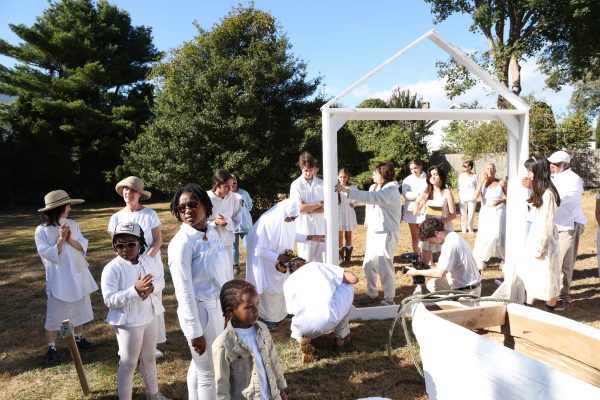
The day was part of a necessary escape from the city. Fellow Great Jones member Juan Pablo Toro and I had spent a few hours crossing Long Island talking about theater, acting, and life. Upon arriving, we quickly looked through my hastily grabbed collection of white clothing, a request for all attendees, and donned our apparel. As we walked up the drive to a pocket of land, we ran into Charlotte who warmly pointed out that we were arriving for a housewarming, not a show. A burst of gratitude and relief filled me. A housewarming is a practice for the future, a communal action of energetic prayer. We would be at a gathering to fill a structure with the warmth of our belief in a sustainable life-cycle of shelter and respite. It also meant I wasn’t going to be expected to sit still, passively receiving for another three hours.
One of the central acts of PASSAGE was our collective raising of a small, white wooden house. The cooperative effort allowed those assembled to embody the larger task of reclaiming erased histories. PASSAGE is the third chapter in the ongoing, creative investigation FORGOTTEN PARADISE. Imagining the dreams of the forcibly displaced, and enslaved peoples across the European/American, trans-Atlantic slave trade, PASSAGE pointedly honored the legacy of Pyrrhus Concer, a historical figure and 19th century whaler, whose remarkable journey from enslavement to freedom was a cornerstone for the gathering.

As we sat on the land of his former home on Concer’s Way, I could feel the large truck holding the timber of his torn-down home. A stunning 4-foot-tall photographic print by Malick Welli, created in collaboration with Charlotte Brathwaite, was draped from it. The image showed two veiled figures dressed in white, standing on a shoreline. Soon teens, also dressed in white, from The Guild Hall Teen Arts Council began to read with Charlotte. Concer’s story was revealed, through a list of chronological statements. A few excerpts:
- Don’t Forget Me. My name is Pyrrhus Concer. I was born down the street from here, in Cooper’s Hall, next to the library, on March 17,1814…I became one of the most celebrated men in Southampton Village…
- At 5 years old, I was taken from my mom – sold to the Pelletreau Family for $25 and set to work on their farm. They lent me out to work for others in the Village at times…
- I inherited a home from my grandparents right here at 51 Pond Lane, where we are right now…
- My family was forced into slavery because of the color of our skin. I will never understand how the law can give the right to force, and enforce, that one man owns another…
- Elihu Root, the US Secretary of State at the time, saw me not as an enslaved person but as an equal … He even paid for a huge tombstone for me, my wife Rachel and my two boys who preceded me in death. It reads: “Though born a slave, he possessed those virtues, without which kings are but slaves.”

With all of us wearing white together, the line between performer and audience disappeared, allowing us to blend into a unified field, to diminish our distance and become an integrated whole. As such, Concer’s story shifted from one told to us into one that (I know) we have continued to tell to others. It became part of our collective remembering. Built strongly in an ethos of collaboration, the energetic presence of partnership filled out the experience. Dr. Georgette Grier-Key and Brenda Simmons brought a powerful legacy of local organizing. The welcoming musicians and dancers, the vibrant teens from Guild Hall, the contributing artists, the local attendees, and the city pilgrims all served as robust arteries to the heart of this dream of unity and resiliency.

As Concer’s story became part of our emerging community, one told among us, I began to sense intersecting lines of grief and hope in the way that trauma is, unfortunately, the training ground for our capacity to survive. This sense would strengthen at several points in the day as we wove ourselves deeper and deeper into the fabric of shared histories and resiliency work through mutual future casting. We built a house under Gregory Corbino’s careful guidance, draped flags with designs from the Guild Hall Teens, and danced the Dabke together in a wide spiraling circle around the house. As we gathered around a boat set inside the home, the invitation to care for our world through subtle acts of observation led me to think of the myriad perilous waters that many of us, many of our ancestors, and many still to come must cross.
In an ever-tightening web of mutuality, we sang together, chanted parts of Pyrrhus Concer’s story, rang bells, raised a large flag with the silhouette of Concer, and, eventually, broke (corn) bread and shared in delicious stew and collard greens together, ingesting the day for a full metabolizing of all that had been shared. Our material selves were altered through gifts for each sense and our souls had been nourished through moments of healing kinship. Each of us comes to learn how circles of interdependence can be a vital balm for the wounds of history. During PASSAGE, the participatory nature of the performance score allowed us to embody the lessons. This, in turn, revealed a pathway to sustainable futures. Yes, the only way out is through, but the only way through is together.

Leave a Reply to Brenda SimmonsCancel reply