
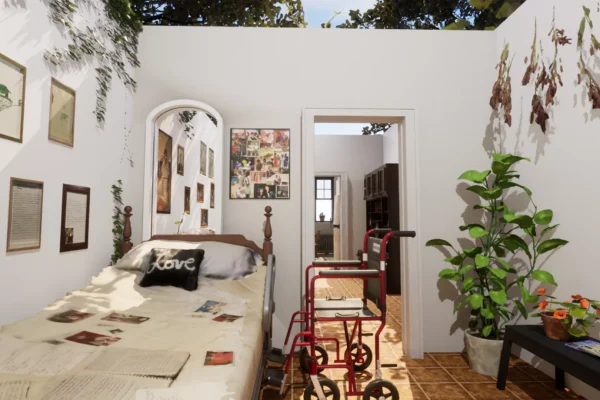

Mercedes, Part 1 is a multimedia installation by Modesto “Flako” Jimenez. The production will include a documentary, gallery, and healing room. Mercedes, Part 1 is dedicated to Flako’s grandmother, Mercedes Viñales, and her impact on her community in Bushwick, Brooklyn. Mercedes raised Flako in Bushwick after he immigrated from the Dominican Republic at the age of nine, and Flako later took care of her as she lived with dementia. Mercedes, Part 1 is premiering at the Brooklyn Academy of Music (BAM) from December 3rd until the 8th.
The production is the culmination of three years of research, community outreach, and experimentation with other storytelling elements, such as a stage play and VR experience, which each required their own research processes. In my interview with him, Flako emphasized the Mercedes project’s central theme of community, which drove much of the outreach work. For example, the Mercedes team has been partnering with Citymeals on Wheels, which Flako credited with providing a perspective outside of art on the lives of elderly people. Flako visited elderly people receiving food from Citymeals and shared his art with them.
The designers for the BAM premiere have been committed to the Mercedes project for these past three years, and Flako praised each designer’s artistry extensively. The gallery is modeled after Mercedes’s apartment (including a bedroom, kitchen, and foyer), which the audience is meant to walk through. The healing room will provide art supplies and a space to process after experiencing the rest of the installation, and a social worker and art therapist will be there to provide support. The set of the gallery and healing room were designed by Michael Minaham, the lighting design is by Megan Lang, the sound design is by Drew Weinstein, and the installation was curated by Cricket Brown.
The two video designers on the design team, Victor Morales and Juan “Wamoo” Álvarez, each contributed separate elements to the production. Wamoo, whom I also interviewed, designed three television feeds within the gallery, one for each room, each representing a different stage of dementia as experienced by Mercedes. Wamoo also designed a video composed of letters sent to Mercedes by her family members. Victor designed all of the art in the documentary, including AI-generated images of flowers and of Flako’s father reading a letter to his mother, Mercedes. The documentary was directed by Brisa Areli Muñoz. In regard to the documentary, Flako said, “Let me not tell you about the story, let me show you the story that is my grandmother and me. And that taps into family and community, and not just art.”
Flako resists the narrative that is often externally assigned to stories about the death of a loved one. “If I’m sharing a moment of a celebration of a person who passed, some people might consider that trauma, and I’m constantly reminding an article or a person who wants to write about it, like, ‘Hey, hey, hey, hey, stop projecting.’ I’m here to celebrate my family and the legacy of Jimenezes who now are all over different states. … People die, yes—let’s celebrate their life. That lady brought a lot of us and gave us space to be able to gather our thoughts. Why wouldn’t I want to celebrate that?”
The BAM production’s resources for elderly people will mirror the way the Mercedes team (including ¡Oye! Group, BAM, Citymeals, and the other companies involved in the process) has already been engaging with the community. Flako told me that “on December 4th and 5th, we’re bussing six different senior groups to give private shows in the mornings, and then feed them in the healing room with Citymeals on Wheels, and then be able to give them a to-go plate. So this is what we’ve been doing in the boroughs with Citymeals on Wheels. We give them a pop-up of Mercedes: we show them the documentary you’ll be seeing, then we bring in a dance instructor, then we bring in the live band that composed the music,” and also provide healing rooms, each with a social worker and an art therapist. The team has also conducted senior center visits and home visits in each of New York City’s boroughs as part of a musical tour with the Mercedes band. They run longer healing room programs for two months each at different senior centers and have worked with the elderly people there to produce a coloring book, which will be given out at the BAM production.
The installation premiere plans to reconnect with these same communities. Flako explained, “And now at BAM, we’re kind of bringing all those worlds together and then asking those people we had been visiting to come and see the final product of a moment of healing, and a migrant story that forgot themselves, and her son, or grandson, documenting that story so it’s not forgotten for the family.”
Flako clarified that Mercedes was not “a community activist or a community caregiver. She was a home attendant, so she worked…she was herself a caregiver her whole life, and she also took care of a tribe in an apartment. You could be family or not, you still could stay in this apartment. So it wasn’t about her making community activities, no. She just took care of a whole community in a third floor apartment, railroad apartment, in New York City. There was always space for you to come and process, whether it was just for one day, whether it was for three years.”
Flako and I discussed the Mercedes team’s many different approaches to community outreach and aid, and the amalgamation they developed of “research tools that have come by community, for community, that can be shared.” According to Flako, reaching out to so many different communities enabled the Mercedes team to ask, “Does this make sense for your community?” and to receive feedback “from the people actually going through it, and not just what books we’re reading about it,” because “you need the actual now—what is happening now, and what are the people needing now?”
In response to many of my questions, Flako phrased his responses with the language of “doing the work” and “sharing tools,” both of which he feels must be based on what that specific community needs in that specific moment. This understanding of community need drives Flako’s work as an artist and as an educator.
Flako is the artistic director of ¡Oye! Group, which he founded in 2012 with his cousin Kevin Torres, who is the producing director of ¡Oye! Group and the producer of the documentary component of the Mercedes project. Flako talked to me about “creating those spaces of caring, of care, for your community or for the people that look like you, because that’s the one radical thing about ¡Oye! Group: that we know we’re doing it for our people.” Flako emphasized ¡Oye! Group’s mission to “make sure that other Latinos are being heard, that all people of color have the space to be able to process, because that’s our key in that company, the word ‘process.’”
¡Oye! Group offers several monthly and seasonal educational workshop programs, free of charge and for people of all ages. The workshops teach participants about different forms of art and are run exclusively by local artists. These programs foster self-exploration and strengthen community care through the process of creating art.
Flako talked to me about one program in particular, Fresh Start, which is an educational arts program for incarcerated youth. After they are released from prison, students can expect “sneakers and a bookbag full of supplies,” which Flako refers to as their “pay” for engaging with the program, “so they can come home to at least something, as soon as they leave the jail.” Students learn about whatever types of art they are interested in, and thus the curriculum always “changes by the second day—what do the kids in here need?”
Flako’s outlook on art as a set of tools to share places an emphasis on inter-community communication, communication between people. He said to me, “My art is not going to change the world. At all. I hope my art is going to bring a little smile somewhere for a couple of minutes and make you forget we’re all fucked in this climate change, damaged-as-fuck world. That’s all. If I did that, I could die happy. I’m not here to change the world. I am here to provide some tools that I learned. If people need them, grab them. If you don’t, thank you for coming. Take care of yourself.”
In our interview, Flako emphasized the necessity of not being alone and the sense of community that theatre can bring out among its audience. This is evident not only in his conception of the Mercedes project and all of the work he has done with elderly people, but also his perspective toward the value of teaching, art, and community. When I asked him why he is an artist and educator, he said, “I don’t know. That’s the shit that’s always been in my head. … It’s in my heart, it’s in my brain, it’s in my life. It’s everything to me. I don’t know how to not operate as a person who likes learning and a person who likes teaching what he learned.” Flako also said that his work shouldn’t be primarily “ego-driven,” how it is instead a matter of contributing to his community: “I believe in the gray, whatever the time and moment need. I will look into the toolbox that I created in my life and see if I have any tools I can share. And if I don’t find any, I’ll say I don’t. You want to talk about it and see if we can come up with a tool together?”
Lastly, I asked Flako to tell me about the first time he felt recognized by someone else as an artist. He told me about when he performed as Benvolio in a Wooster Group production of Romeo and Juliet in high school: “I remember a bunch of gang members that stole a van to come see me do a show. They risked their life to come and see a friend do a theatre show. … There’s that reminder of the essence of what a show can do to people that are not from that world of theatre. It’s beautiful. That was that moment for me. It’s, ‘Oh shit, look at my people engage with theatre … and we’re all gang members … but they came to support me in this.’ And now we have ¡Oye! Group.”
Leave a Reply