
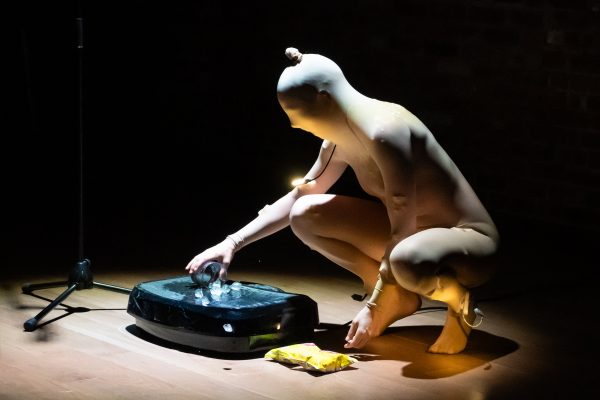
The first piece, Arantxa Araujo’s Cuerpos que Crujen: Huesos y Sabritas, opened from both ends: a door at the far end of the long stage opened and a figure in a head-to-toe black bodysuit slipped into the darkness, momentarily lit from behind. At the opposite end of the stage another unearthly figure appeared. Its skin was made of nylons pulled tautly over, and distorting, its face and body. It had a light, like an angler fish, protruding from its chest and two more from its shins. There was something beneath its “skin”; the creature pressed its hands against its own body and an amplified crispy crunching sound filled the space, ASMR-style. Potato chips!

This first piece of Martita Abril’s curated evening “El Club MEG” at La MaMa took us from the parallel reality of an alien landscape (the taut-skinned creature slinking, flat-footed, lit by their own eerie projections) into the stark light of straight-up performance art. The creature selected from the audience, placing their first tribute noshing on Sabritas potato chips near a mike, the second attempting to juggle potatoes that emerged from a chips bag, and the third on a contraption called a “vibration plate” reading a New York Times article about the immanence of a third world war and declining fertility rates. Earlier, having exposed their head, Araujo placed a cup of ice on the shaking machine. The ice danced wildly; spilling out, only to be thrown back into its very unstable container.
Having seen Martita perform her own recent solo at Judson church, which did involve balloons and a butcher knife, I was not surprised to see that her curation travelled so far into the expansive realm of performance art-dance. As the oddly erotic salty smell of potato chips filled the room (the creature pushing a pile of crushed chips towards three lonely potatoes, adding a candle to make it into an altar, and then leaving the candle in the dark pulsing to Mexican music) I found myself returning to a recent query about the relationship between form and content in contemporary performance. Is dance more about form and performance more about content? If Post-Postmodernism amalgamates it all, is it time Post-Postmodernism had a new name?
One of the hallmarks of Postmodern dance (think Martha Graham’s students: Alvin Ailey, Paul Taylor, Merce Cunningham, Doris Humphrey, etc.) was its minimalist insistence on form. It did of course have content implications for some more than others, but there was an overall love of formalism throughout. Performance art, one could say, sees everything as content. Between the two, inevitably, there is overlap and convergence. In the Fluxus performance art movement, art was often “by direction” (think Yoko Ono’s Cut Piece, 1965), just as dance in performance is often “by direction”: a cornucopia of meanings (content) invited by a predetermined form.

The next piece to reckon with this question about the convergence of dance and performance art was Josie Bettman’s piece “Clinical Trial Performance Appraisal”. Based on a screenplay project, the piece opens on Josie (spotlit, back to the audience, leaning against the wall with one hand pressed against her cheek) dancing and speaking one half of a phone call. The conversation is between an older woman, a has-been we come to find out, and a younger it-girl personal assistant. Mostly we hear the older woman’s side; she seems to have a crush on the it-girl, she wants her job back, she wants to be seen as a mentor but is also full of jealousy. Part of the humor was between the words and the movements: a distracted synchrony.
The narrator switches and the conversation climaxes: the it-girl confronts the has-been, “I don’t know what kind of transference you think is going on here…” With illusions shattered language falls away and, back against the wall, we see Josie’s character (now neither the it-girl or the has-been, or perhaps as both) repeat a phrase of high to low poses faster and faster until, suddenly, she walks off. We waited for her to return but she was gone. The phrase “cut to the quick” came to mind, which means not to end something too soon (although we were eager for more), but instead to wound deeply. What is there to do after humiliation but to evaporate?
Back to the topic at hand, this second dance was a happy melding of form and content. There was a narrative, there was pure moment, and there was a conversation between the two. Movement alone, or pure form, can be full of content. As the dance-only section of Josie’s piece showed, sometimes form can speak for itself. Raw content (i.e. the cacophony of meaning seen in the first piece) can be heavier, and sometimes feel so dense it becomes abstract again. The trend, seen so far and in what is to follow, is definitely cinematic. Contemporary viewers, and creators for that matter, are capable of and rapacious for performance that levels-up our mere understanding of what the goals and rules of performance even are. We want to be immersed in a para-reality that both points to and away from our predetermined understandings.

The next piece, “Aqua y Telepatía” by Coco Villa, was definitely a para-reality. A thin blue string was placed on the floor in a large circle and the audience was invited to sit on the stage around its perimeter. In full lighting two figures entered each wearing a brilliant shade of blue I have seen often lately that seems to glow from within. As in the first piece, these dancers wore stocking-material stretched over their faces. Theirs was slightly more decorative, lined around the neck with hanging blue beads. This dance was what I am referring to as formal, partially because there were no words but also for its amorphous sense of meaning. First, now in a spotlight, their movements echoed each other, then they froze. The light became (magically) like clouds moving quickly overhead.
This combination of stillness, an outside feeling of natural-time, and then the dance they did that turned the circle into a clock and the dancers into its ticking yet curling arms, was truly satisfying. Next their time-dance became a dance-off and they were both totally working it. At the perimeter the audience joined in, grooving as the dancers busted moves to the insatiable club classic “Gas Pedal” by Sage The Gemini. Funnily enough, the song is about slowing down and time. When they froze again the feeling in the room was one of a sensual denial. We loved the dance and we wanted it to keep going, but when they withheld it we were so in their hands we could really appreciate what it is to have to wait. The lights faded out slowly.
Meaning is inevitable and subjective, regardless of whether the performer engages the minimalism of pure form (dance) or the maximalism of pure content (performance art). The last piece, by Hannah Kallenbach, was a great example of content maximalism. Its form was in the use of props and the wielding of a general sense of sardonic unease. I had seen Kallenbach in the breaks between the earlier pieces, I realized when she stepped out in full-on Mickey attire. A confetti cannon exploded, a huge fake stone tablet marked “Cease & Desist” slid crashing into Mickey. We learn that Mickey has been up to no good, pushing a pregnant lady into a lake, and so has been majorly fired by Walt. From there things got even more unhinged. Up next? Mickey has a redemption scheme: the first ever Hottest Pregnant Person Pageant!

Before we got there things again took a left turn; the Mickey mask came off and a very vulnerable stand-up storytime commenced. Kallenbach told us her story: from a conservative abstinence-only upbringing, long-term straight relationship and employment as a nanny for the famous and wealthy to coming-out and finding love while reckoning with the infuriating conflict between wanting to have children and not being able to afford them. It was all really real stuff. And there wasn’t any release at the end. One of the hallmarks of performance-art is its grasp on the power of not letting up. Where formalism and minimalism and dance can err on the side of thinking beauty is redemptive in an ugly world, performance art like Kallenbach’s, and Araujo’s piece at the beginning, refuse the false comfort art has claimed to provide in the past often by bypassing dire political realities. So, while utterly uncomfortable, it is very worthwhile.
Co-curating with Blaze Ferrer, Martita, whose facilitation is always fabulously bilingual and multicultural, set the space with tequila from her hometown, oranges, water, beer and tastily seasoned dried crickets. The evening ended with a select few sticking around for a barren but extremely entertaining round of karaoke DJed by Le Papi Shiitake. The vibe was very: here we are in the midst of a fascist coup, what is left to fear? Lots, obviously. But the old obsessions with boundaries and criticism are too much to carry now. It is great to see our artist so free in their choice of medium, able to pick whatever tools fit their truth. As far as a new name for this Post-Postmodern performance art-dance form and content hybrid that is roaming the streets these days I have no idea. But I am eager to see where it is going.
All photos by Steven Pisano
Leave a Reply