
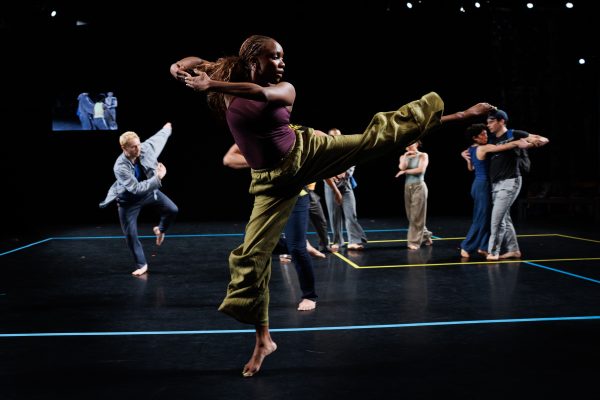

At the conclusion of the electrifying performance of Curriculum III: People, Places, and Things, members of the Bill T. Jones/Arnie Zane Dance Company took their bows to a standing ovation from an enthusiastic audience. When the dancers invited their company’s Artistic Director to join them, it was no surprise. Opening nights, especially when it´s a world-premiere, often feature the choreographer coming onstage to join the company and take a bow.
What was surprising was that, instead of standing and accepting the thunderous applause, Bill T. Jones shouted “No!”. And he repeated this complete sentence, over and over again, as he pointed at various members of the audience, who quickly began yelling back, a unison chant of outrage suddenly created. But Jones was still not done with all of us yet: he paced back and forth in front of the front, shouting “No” louder and louder. Sometimes he stood nose to nose with an audience member, remaining there for a few roars before moving on to the next person. His whole body quivered with coiled anger, and the entire New York Live Arts theater vibrated with a collective declaration of defiance that Jones had instigated. He commanded everyone’s attention as if he were a seasoned general on the edge of the battlefield, rallying his troops.
The shouting lasted nearly five minutes, and could have gone on for much longer, if Jones had not calmly held up a palm. The audience responded and immediately stopped, but there was a palpable buzz boiling through our veins. When he next spoke, his tone may have been softer and quieter, but its urgency was dialed up a notch.
“Don´t be fucking puppets,” he pleaded. “Don’t let them get away with this shit. Enough! Don´t be puppets!”
Everybody stood suspended in the charged silence.. Then, after putting his hand to his heart, Jones thanked us for coming before walking out.
Rarely have I seen a contemporary dance performance get everyone this fired up, but these are not ordinary times. While some seek art which can provide an escape from the troubles of our world, Jones aims to tap into them, to galvanize them. During a career spanning more than four decades, including powerful works like Last Supper at Uncle Tom´s Cabin/The Promised Land, and Still/Here, Jones has never been afraid to center politics into his richly textured choreography. In Curriculum III: People, Places, & Things, he and his company channel their fury with exceptional commitment, while simultaneously displaying their virtuosic prowess within a 90-minute work of multidisciplinary work. The subject? The current state of America.
Even before People, Places, & Things began, agitation hovered in the theater. While other audience members found their seats, I noted faint sounds along the periphery of my consciousness. I heard the blades of a helicopter, but also the sounds of something burning. The piece opened with a small screen upstage depicting a picture of a building on fire, which later spelled “EXIT” (but in reverse, as if the door to freedom had been shut) in multiple languages throughout the evening. The shadowy opening grew more eerie with the presence of a surveillance drone circling over the company members, each one writhing on the floor in dark pants and a black hoodie. As each member of the cast came forward to introduce themselves, a grainy black-and-white picture of them was projected on the wall behind them, like a mug shot. In this vision of America, everything is on fire, and everyone is a suspect.
The first to speak is Mak Thornquest, who tells us a bit about themselves and their “family´s myths.” It´s a question Jones asked each member of the company to answer, part of the collaborative process that created the script for Curriculum III. All the stories heard within this piece are true, sourced from each dancer’s actual lived experience. While crafted and theatrical, the fact that these are real makes each one of these episodes a little more revealing and packs a more visceral punch. Thornquest alludes to an uncle´s tall tales, interrupting their monologue with bursts of dancing–a leap, a fall, a sudden turn. As they continue speaking, the audience is invited to reflect on our own family histories, and to interrogate what myths we tell ourselves. The stories become more flexible, less stable; at the same time, during the course of People, Places, & Things, the stories of who we and our families are revealed to be crucial to our own sense of identity.
During Thornquest´s opening monologue-slash-dance solo, the other performers enter the space, appearing not just from offstage but also from red seats peppered throughout the audience, a further implication that this performance is not only for the audience, but about us as well. The dancers carry backpacks or pull suitcases on wheels, repeating circular sequences that look like they are in transit–perhaps at a train station, or an airport. These motifs–of “traveling” with one´s baggage, as well as having each performer address the audience with their personal stories–will recur and develop over the course of the evening. Eventually, they will poeticize these familiar objects, dancing with them during phrases of intricate choreography; later they will fight over these bags like a desperate mob.
Barrington Hinds starts, stops, and then restarts his story a number of times, treating the words of his family of origin almost like a choreographic phrase, each time changing its quality by repeating sentences with different emotional intentions (pride, guilt, rage) which alter what we hear in his story. Danielle Marshall, after dancing expertly with other members of the cast, begins to sing a stirring rendition of “America the Beautiful” as she slowly walks around the stage and through the audience. At one point, Hannah Seiden gleefully explains to us why she identifies as a “fake Jew,” all the while doing gymnastic feats that display her exquisite flexibility and physical control; while Shane Larson takes a pause from his athletic dancing to tell us sardonically that he is a “generic white.”
Everyone in People, Places, & Things gets to be featured within one of these autobiographical stories telling moments, all this component of the performance affirms that every dancer– already exceptionally talented– is also a rather compelling actor. Each story plunges us into the personal politics of identity, the complexities and frequently contradictory nature of who we are–nuance which is sadly lacking in our polarized public discourse. But at the conclusion of each one, the dancers affirm, “I am an American!”

Huiwang Zhang’s story comes towards the end of Curriculum III. Born in Beijing, he introduces himself by saying, “I’m not an American,” a statement which inspired at least half the audience to applaud, and a response which seemed to surprise everyone in. Zhang shared his journey of preparing an application for a student visa to go to Utah for a Dance MFA program: the stress of practicing his English, and the disorientation when the (white) American diplomat at the US Embassy greeted him in Mandarin. Zhang later added that he was not an American yet, but that his children were. In the pause that followed, those who had applauded his non-American status earlier seemed confused. Once again, Jones and his company shows us that national identity, like gender or race, lacks clear edges like a box to be checked. These are stories, packed with detail. .
Immigration, identity, power: the canvas for this performance sprawls with ambition. The Bill T. Jones/Arnie Zane Dance Company prove they can act and sing as well as dance with passion and skill, interrupting a seemingly simple monologue with explosions of complex movement and sequences of the body. They gesture towards our nation’s history of immigrants while also referencing our current administration’s intolerance for difference and dissent. Curriculum III: People, Places, & Things is often uncomfortable– there are projected images of a devastated Gaza to excerpts from Trump during his televised ambush of President Zelensky in the Oval Office back in February– but always profoundly beautiful.
It all makes sense. At no point does the form or content of Curriculum III feel overwhelmed by its intentions to engage and stimulate. Instead, watching this nearly 90-minute performance feels like a gift. Watching Bill T. Jones´ work is to be in the presence of a passionate genius, an artist and a man who not only wants us to bear witness, but get off our asses and actually do something once the show is over. When we return to our lives.
“Don’t be puppets,” Jones said.

You heard the man.
Leave a Reply