

A row of dancers sitting in folding chairs form two perfect, parallel lines, each person facing an equidistant partner. They had arrived there with urgency, pulling the chairs from where they rested in a pile in the far corner. Having completed their task, they now sat completely still, faces neutral, neither resting nor waiting for anything in particular to happen. As we, the audience, sit in our own uncomfortable folding chairs, neither resting nor waiting for anything in particular to happen, the arrangement of bodies on stage begins to shift: the scene looks at first like a hospital waiting room, then a gladiatorial match, then a horribly organized speed-dating event. As the dancers themselves wait for some impulse to arrive, it becomes clear that the movement of the work comes as much from the dancer’s choices as from the audience’s own capacity for interpretation.
Caitlin Adams’s ASSEMBLY, presented at the Center for Performance Research over a three hour period on Thursday, June 26th, is the culmination of years of score-writing and improvisational research by Adams. In 2023, Adams brought her musical collaborator, Jeff Aaron Bryant, into her research, and together they worked with a close cohort of dancers and musicians to devise rules, limitations, and grid points that could be equally followed in sound and in movement. “I invited Jeff in because I wanted to hone a shared landscape of music and dance,” says Adams, “him with a musical mind, me as a choreographic mind, but both of us having an equal obsession with the other’s medium.” Structured around a series of improvisational prompts, the work asks questions about what constitutes performative space. Numbers, shouted by members of the ensemble, prompt spatial arrangements like this seated face-off. What follows from that original prompt is up to the performers to decide.
Suddenly, Laura Carella hurls toward center stage. She twists and lunges, before paddling over to the dancers on stage left, still seated and waiting. She approaches with trepidation – I’m reminded of the line from a long-lost P.M.C. Smith poem I once loved that goes, “Do apologies exist, or is there always an attempt to say/that wasn’t me, I promise.” A call goes out among the dancers, and they rush to rearrange the chairs in one long line along the back wall. PJ Verhoest straddles the chair in a handstand and twerks, Savannah Jade Dobbs slumps in her seat like a predator looking for a wounded gazelle, Megan Siepka stands on her chair and smacks her back into the wall like a bored high school senior waiting for homeroom to end.
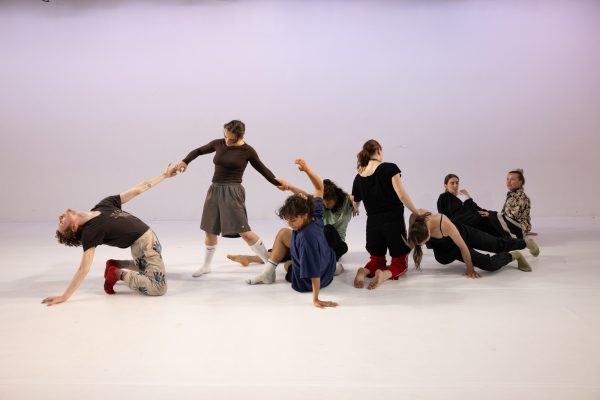
The delight that arises from witnessing ASSEMBLY comes from its invitation to the audience to figure out a secret: what is the code the dancers are interpreting? In addition to numbers, calls of “Ready!” and “Go!” ring out among the ensemble. Slowly, we figure out that a call of “Four!” prompts an amoeba-like structure of bodies tumbling over one another to make a diagonal across the stage. “One!” results in a center stage unison. “Ready” means a little tensing of the shoulders, the feeling that the body is about to launch into some new action.
“Go!” is an affirmation of consent. Meaning emerges from this limited vocabulary as well. “Ready? Four!” becomes “ready for” a dangling question asking, “ready for what?”

The improvisational soundscore, performed live by Jeff Aaron Bryant and Chris Knollmeyer, moves in and out of relation with the dance, sometimes emulating the mood, sometimes mimicking particular choreographies, and sometimes iterating on a sonic idea discovered before. Using a palette of flute, percussion, and electronics, Bryant and Knollmeyer’s collaboration is incidental rather than intentional. Like an impressionist painting that gains coherence the further away you walk, the sonic landscape is made up of the ideas that draw Bryant and Knollmeyer’s ears and eyes. Clear rhythmic patterns are overtaken by synthesizer noises, which give way to atonal melodies; these sonic shifts reinforce the sense that the world of ASSEMBLY is in a constant state of change and play.
From the line across the back wall, Siepka descends and launches into a series of bounding soubresauts. Other dancers join in a joyful, exhausting, explosion of momentum. The dancers spread out in one long, staggered line across the stage; they look like a marching band that isn’t sure whether it’s time to play. The chairs are pulled to the front of the stage and the dancers sit in front of the audience, blocking our view of the trios and duets that emerge as performers launch from their now front-row seats. Stillness recurs, too, in this space, and after the ensemble dance dies down, both audience and performers are left staring at an empty stage. I think of my friend Otis, who tells the story of watching Tsai Ming Liang’s Goodbye, Dragon Inn on a date with his now-boyfriend, Gregor: “He came over, put on this movie, and fell asleep. And I just sat there watching a six-minute scene of an empty movie theater and having the time of my life.”
While the audience is busy keeping track of the commands and their results, a greater shift is taking place. The lights fade, and in the sunset of the 30-minute loops that make up the performance, dancers revisit gestures, postures, and movements that came before. The structure is simple, but the effect is sublime. Two dancers form a fragment of the amoeba, Verhoest sits in front of the audience sans chair, and Gioia von Staden replays a moment of unison choreography, becoming, very briefly, an ensemble of one. Just as you know a friend appeared to you in a dream, although they look nothing like they do in the real world, familiar shapes and patterns stir feelings and sparks of recognition from the loop before. In the dark, we realize we’ve been paying attention all along, that just by watching, we know the dance by heart.
As the movement reaches its climax, day breaks. The lights rise, and the loop ends. Dancers collapse on stage, wipe their sweaty faces, and grab water bottles lined up neatly off stage. Even in improvisation there is time for rest.

Leave a Reply