
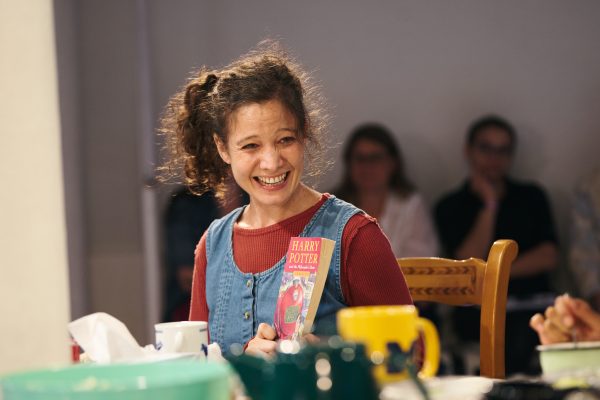

When I was a 13-year-old Jewish girl post-Bat Mitzvah, I did not meet weekly to wrestle with the Talmud, like the heroines of Liba Vaynberg’s deeply felt, deeply thought new play The Matriarchs. I did, however, spend a lot of time recursively examining a single text, unraveling its intricacies with affection and frustration, and appropriating it to understand my own life. That’s because when I was 13 I wrote a lot of fanfiction.
Vaynberg describes the dramaturgy of her play as Talmudic, and I think Talmud and fanfiction are closer than one would think: they both understand that inside a single story is a multitude of meanings. So when I say The Matriarchs reminded me of fanfiction, I am saying it is: detailed, metatextual, instructive, joyful, pleasurable, cozy, unexpected, provocative, and confidently obsessed with the inner lives of women at the margins of a male-dominated text.
The characters of The Matriarchs each correspond to a biblical counterpoint, the Jewish matriarchs whose names we sing in the Amidah (with the addition of Tzipporah, Moses’s wife, and his sister Miriam). They are impeccably cast in a way that feels uncanny. (How do I explain that Miriam felt like Miriam, that Rachel and Leah squabbled like Rachel and Leah would?) At first, I experienced this correspondence – Tzippi’s crush on Miriam’s brother, Sara wondering about being called Queen Sarah (“Sarai” means princess in Hebrew) – mostly as delight. In the same way that the seating arrangement invites us to circle the girls as they circle a table, these references made me feel welcome and warm.
But as The Matriarchs progresses, its relationship to the source material reveals itself to be more substantive. Its structure is a Talmud/Torah mirror: it begins with meta-narrative commentary on the 13-year-old girls (Talmud – commentary), switches to a naturalistic representation of the girls at 13 (Torah – history), jumps forward to a naturalistic representation of the now-women at 30 (Torah again), then end with meta-narrative commentary on the women (back to Talmud). As a result, the back half of the play is steeped in a sense of inevitability. The scene of the women at 30 gently mirrors the scene of the characters at 13: the same two characters are bickering, a drink is being spilled, a mom is just outside the door, a (very very funny) song is being sung. In the second meta-commentary, our matriarchs meet the fates outlined for them in Torah. Sometimes that meant I knew a character’s agonizing crisis would be resolved. Sometimes it meant I knew tragedy was coming. Like a fan revisiting a favorite story, I was in the agonizing/delicious position of knowing the ending.
The cumulative effect of this inevitability, this sense that these stories have been told before and will be told again, is achingly moving. It’s essential to this play’s deeply Jewish understanding of G-d (voiced by a perfectly unsentimental Rachel Botchan) not as someone who intervenes but rather as someone who elucidates. When Miriam suggests that adherence to Jewish law should have saved someone she loves, Hashem is insistent: “I never said those things would save you, Miriam!… I taught you to look around. Instead of up.” The stories will recur; as Jews, we don’t observe in order to change their endings, but to understand them. After all, our fates for the year ahead are sealed in the Book of Life just a few short dates into the Jewish calendar.
If all of this sounds very heady, please know that The Matriarchs is a play shot through with joy and drama. It has detailed, well-drawn characters; it features performances by some of my very favorite Jewish actresses in the city. Unlike Talmud (or fanfiction, for that matter) it sustains itself as its own story, one that is rich and dramatic. But I think what makes The Matriarchs so special is that it is not only authentically Jewish in content (complete with a University of Michigan mug serving as Miriam’s famous cup – come on), but also in its wrestling, recursive, authentically Jewish structure.
In a moment where so many theatrical institutions insist on only one kind of Jewish play – the intergenerational family drama, the naturalistic debate, the safe sell to subscribers – it’s a privilege to encounter a piece that is deeply Jewish in its form. Having sat with the play like a fan writing up a Tumblr “meta” (fandom commentary, quasi Talmudic in form), I am so deeply excited to see what Vaynberg wrestles with next.
Leave a Reply