
Founded in 2012 by Ben Kidd and Bush Moukarzel, the London- and Dublin-based theater company Dead Centre acquired an international reputation almost immediately with their first piece, Souvenir. Following critically acclaimed runs in their home cities, the show toured to Brisbane, Seoul, and New York, where it was performed at Abrons Arts Center. Dead Centre has since brought their work to Estonia, France, Romania, Italy, China, Holland, and beyond. The company returned to Abrons with Lippy in 2014, and, more recently, brought Hamnet to BAM in 2019 and Chekhov’s First Play to the Irish Arts Center in 2022. This fall, Dead Centre presents a piece called Good Sex, co-produced by IAC, as part of the inaugural Powerhouse: International Festival. Presented inside a 117-year-old former site of a power plant in Gowanus, Powerhouse’s festival aims to respond to the present political moment by fostering cultural exchange and democratizing access through the availability of 10,000 $30 tickets. Dead Centre is featured in a lineup which also includes artists such as William Kentridge, Carolina Bianchi, and Mette Ingvartsen.
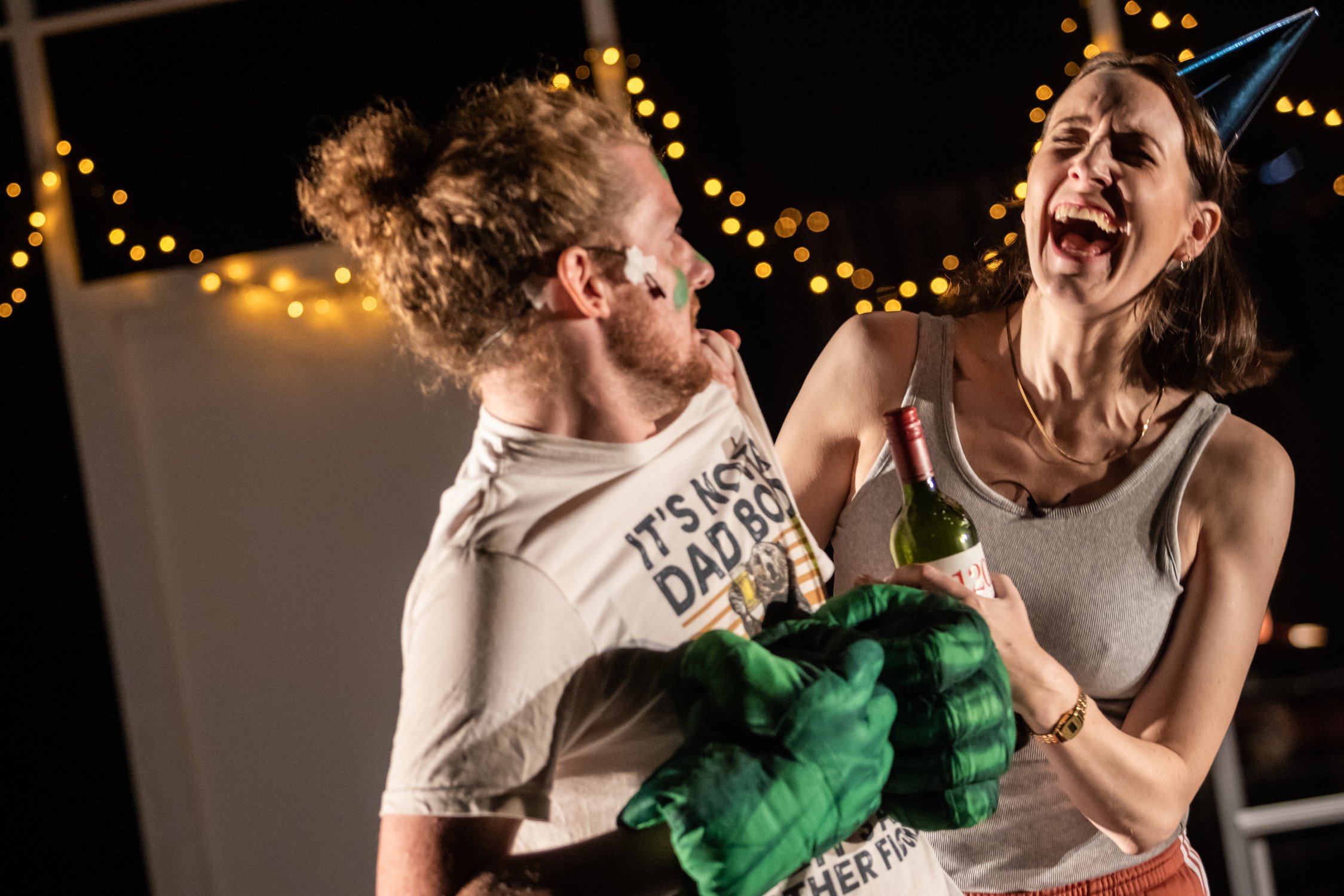
In Good Sex, a rotating pair of stars (Carla Gugino and Arian Moayed, John Cameron Mitchell and Elliot Page, Morgan Spector and Constance Wu, and, finally, Brandon Flynn and Chris Perfetti) join Dubliners Liv O’Donoghue, Alexandra Conlon, and Barry McKiernan on stage each night. The couples, who are unrehearsed, encounter the script – co-written by bestselling author and scholar of modern drama and memory studies, Emilie Pine – for the first time while performing via earpiece.
I spoke to Dead Centre’s co-artistic directors, Kidd and Moukarzel, who serve as director and dramaturg (respectively) on the production ahead of its North American premiere about the process of creating something so formally daunting. Good Sex will perform from November 5 to November 8, 2025.
The following interview has been edited and condensed for clarity and length.
Miranda Jackel: I would love to first hear a bit about the process of rehearsing and developing the piece, given that the actors are not part of that rehearsal process.
Ben Kidd: A nightmare, simply put. We made the show in 2022 and we’ve toured the show three or four times now, so we’re fairly familiar with it. We have a team who go on tour and include actors who feed the lines to the guest actors and another actor [Liv O’Donoghue] who’s onstage with the guest actors every night. So I think of the show almost like a little machine. We’re oiling a little machine that we can then drop guest actors into each evening. Nowadays, we’re relatively well-versed in how to rehearse that, but, of course, you can’t really rehearse it. It’s a very, very difficult show to rehearse. Making the show originally was really stressful and complicated and certainly was almost too much for my brain to be able to deal with, because it involved a lot of people who would come and help us for a couple of days and try things out and you go back to the drawing board and say, okay, well, that didn’t work, so we’ll try something else. And you’re trying to make a little machine so that two actors can come in any night and have a great time. That’s kind of the ambition of the piece for me. If the two guest actors have a good time, then usually that means the audience has a good time too. It’s the only place to start really, because it’s a show that is about asking actors to jump in at the deep end and to engage in something where they’re not in control and they don’t know how it’s going to end or how it’s going to develop. But it’s not interesting to see someone genuinely uncomfortable or genuinely freaked out. We’re never trying to exploit anyone or take advantage of anyone or make people look stupid. That’s not interesting. What is interesting is seeing how good actors are at not looking stupid. How good they are at dealing with the unexpected.
MJ: I assume you were involved in selecting the actors at each tour stop. What were you thinking about, particularly in casting actors that would be familiar to audiences? Was that always in your mind? And what do you think that does to the play?
BK: When we made the show originally in Dublin, we cast the show ourselves because we know the scene. [When] we’ve been anywhere else, we let the festival or the presenter take the lead on casting because they will have a better sense of it. But it’s always been a really fun, exciting show for us because we get the chance to work with loads of people we might not normally work with because they might not be available for an eight-week rehearsal process and run. But, yeah, it’s exciting and interesting for an audience to know a little bit about the performers who are going to play the show they’ll see that night. And to not just say, oh, I know that actor – I like them in X, Y, and Z, but – I like them in X, Y, and Z and I wonder what they’re going to do in this when they’ve got no rehearsal and they’re not prepared. That’d be cool. That’d be interesting. So it takes a lot of courage, I think, from anyone who signs up to do it, especially if it’s someone who audiences will know from other work. It was never conceived as a sort of casting machine or something where you could get famous actors. But, certainly, the idea is about leaning into and enjoying the fact that audiences have a connection with the actors, or love the actors, really puts their faith and trust into the actors.
MJ: Have you been able to experience different cultural reactions to the show, or have you not had the chance to see it in each city?
BK: We’ve traveled with it, so we’ve seen it play in Ireland (two different places), Germany, and Holland. We also just made a French language version in Belgium, which we’ll tour in France next year. So, yeah, we’ve seen different audiences respond to it. Different cultures in acting are different, and different actors have different relationships with the audience. For me, its main points of difference are always the sensibilities of the actors – the actors’ sensibilities around humor, around how serious to play it, around text.
MJ: Tell me about your collaboration with Emilie Pine. Did you begin conceptualizing this piece before bringing her on? Had you wanted to work with her?
BK: We knew Emilie’s work – she wrote a very great book of essays, which was very popular in Ireland and the UK, called Notes to Self. Bush and myself had written most of our shows up until a certain moment and we wanted to start working with other people who would write for us or with us. We wanted to work with Emilie, and then, in initial conversations about the subject matter, the thematic stuff she writes about and is interested in, we had the idea to work with her. I went to Emilie and said, “hey, what about this”? And she very gamely said, “yeah, okay, sounds a bit weird, but why not”? But it was a challenge because, when you have a formal idea like this, the script is always, in a sense, feeding the formal idea. With our work, the form tends to come first, and especially with something like this, the way the actors hear the text in earpieces and then say the lines that we tell them, that asks certain things of the text. The text – in all our shows, I think – is part of the story [and] the conception, but the intimacy coordination and the actors not rehearsing was the driving force behind the evening. Everything else follows and interacts with these choices.
MJ: Can you situate this piece a bit within the larger context of Dead Centre’s work? I’m curious to know more about what feels aligned with your general inclinations or if anything feels like a diversion.
Bush Moukarzel: I would say one thing for sure is we always make an evening that could somehow go wrong. That seems to be a sort of driving impulse, because, with that, you get liveness, which is a holy grail of theatricality. How do you ensure and create that liveness?
BK: Yeah, and hopefully a throughline in terms of a playfulness with form that brings the audience with us, that isn’t a sort of straight play, but also hopefully isn’t cerebral or too interested in form for the sake of it or in an academic way. I think there are divergences, though. I think our work often diverges and often explores different things. This show is probably technically, in a sense, a little simpler than some of our work and maybe a little lighter as well, tonally. Having said that, we’re often quite interested in humor and allowing very serious things to be funny. But I think we do tend to – if we have an idea, we follow that idea wherever it wants to lead us, basically. So that’s led us to make shows with no actors onstage using puppetry. It’s led us to make shows with lots of video work and led us to make shows that tell very real world stories about war and also has led us to make shows that tell slightly smaller stories about love affairs, such as Good Sex. I think there’s a kind of hunger to keep moving on a little bit in our work, thematically anyway.
MJ: I read another interview where you talked about the intimacy coordination on Normal People as a source of inspiration. I thought that was so interesting, because, obviously, that is television and so much of this piece seems to be about the liveness you’re speaking of and the particularity of performing sex onstage. Could you speak a bit about how that show sparked your interest in making a piece about the field of intimacy?
BK: Well, I guess it came to the attention of the culture through television and film work, and specifically through that show, certainly in Ireland and the UK. And the woman who did the intimacy coordination on that show, Ita O’Brien, was the kind of leading light of bringing that work to the industry in the UK and Ireland. At the time when that show was on, there were a lot of articles in the press about it, like, what’s this new craft? And it was part and parcel of a wider cultural conversation that was being had about how we’ve done things as a culture in the past and ways in which certain voices were being heard that hadn’t been heard in the past. Practices and power structures were being investigated in ways that they hadn’t been before. Also, one of the things that interested me about intimacy coordination work was the way in which it would often be talked about as choreography, almost akin to fight choreography, or, indeed, like the choreography of dance – that you learn moves and you do those moves. And you’ll often see stories in the press about actors recoiling against intimacy coordinators because, ah, well, it gets in the way of my process and it’s all fake – very much the point! But the interesting and, I think, quite nice argument is that, yeah, it is fake, and because it’s fake, then you can do it with more confidence and trust and, therefore, do it better.
BM: I think not just that, but that it’s fake all the way down. If you see the way intimacy coordination is used in something like Normal People, the goal is to achieve a level of realism, and it does it quite successfully. Putting it onstage and investigating the mechanism is not so much so that you might achieve a particularly realistic, intimate scene – you might, you might not – it doesn’t really matter. It’s more about investigating this mechanism to look at the philosophy of fakeness, let’s say. And the idea, in that case, of learning choreography, is that even the most private acts have this public dimension. We know from psychology that desire is learned – is something taught by the culture to the growing individual and that these things aren’t purely instinctive. The way we do our most intimate things are borrowed gestures. These are borrowed from the time we live in and the context and culture, so, in that way, the private is public. And that is what theater does very well: it takes a private moment and makes it public.
BK: And, in a way, it’s harder to get that realism onscreen. Something like Normal People – it was very intimate and they were both fully naked and it was very sensitively and passionately done. In a theater, you can cheat really easily and the audience will know that it’s not real, just the same as if you do a punch in a theater, we know it’s not real. But you can get away with it because the theater is a place of fake things – exploring just how easy it is to simulate and just how easy it is to lie. Theater is often a medium to investigate how easily we can deceive each other.
MJ: I noticed that there are two intimacy professionals credited on the show; I would love to know more about their involvement.
BK: Both actually worked with us when we were making the show. We were trying to make the show creative – what should the show be like and about – and the show isn’t about intimacy coordination, but it’s part of it. And it’s the soul of it, but the show is, in many ways, a love story as much as an evening about sex or intimacy coordination. Nevertheless, both Sue [Mythen] and Abi [Kessel], worked with us in rehearsals to create the piece and to conceive it and also the practical how [do] you do this – basically how you can keep people safe and also make an interesting piece. Abi’s here with us in New York; Sue has travelled with us in the past. They come with us.
MJ: I’m also curious to know what stage of the process you were in when COVID happened and how that changed the piece?
BK: Well, we started thinking about the show before COVID happened initially. We wrote and developed the show during COVID, really, and we opened the show in 2022 at Dublin Theatre Festival. And it was the first time we’d had a theater festival in Dublin since the pandemic where everyone was allowed to sit next to each other in the theater. And I do think that really informed the show in a way that we probably weren’t necessarily conscious of – I mean, we were in some ways. But I think the show became, at its heart, a very joyful kind of celebration of everyone getting together in a room and telling a story together – performers and audience members. And a celebration of acting and actors and that communion that we’d lost in the pandemic. I do think that’s in its DNA very much. Maybe there’ll be a shelf life on people being interested in that, but I think that’s one of the things that’s specific about it in our work – that it was a response to the pandemic a little bit, a kind of celebration of being back in theaters.
BM: And also, the metaphor that a culture had to learn how to touch again. In that way, it wasn’t just the people onstage, an audience had to re-remember the choreography of being in a crowd.
MJ: This has been so enlightening and I’m so excited to see the show. Is there anything else that you want New York audiences to know before you open?
BM: We’re in this building for the first time, Powerhouse Arts Center, and it’s an incredible space. I hope this becomes something the city wants – not our show only, but meaning this festival as such, because this is their flagship year. I think it’s so healthy for any city’s arts ecology to have international work coming through; it’s such a big thing for us back home, our International Theatre Festival.
BK: It’s an honor to be here in the first one, and, in 20 years time, it’d be nice to be able to say, yeah, we played the first Powerhouse and it’s become a fixture in the Brooklyn arts scene. That would be very cool.
Leave a Reply