
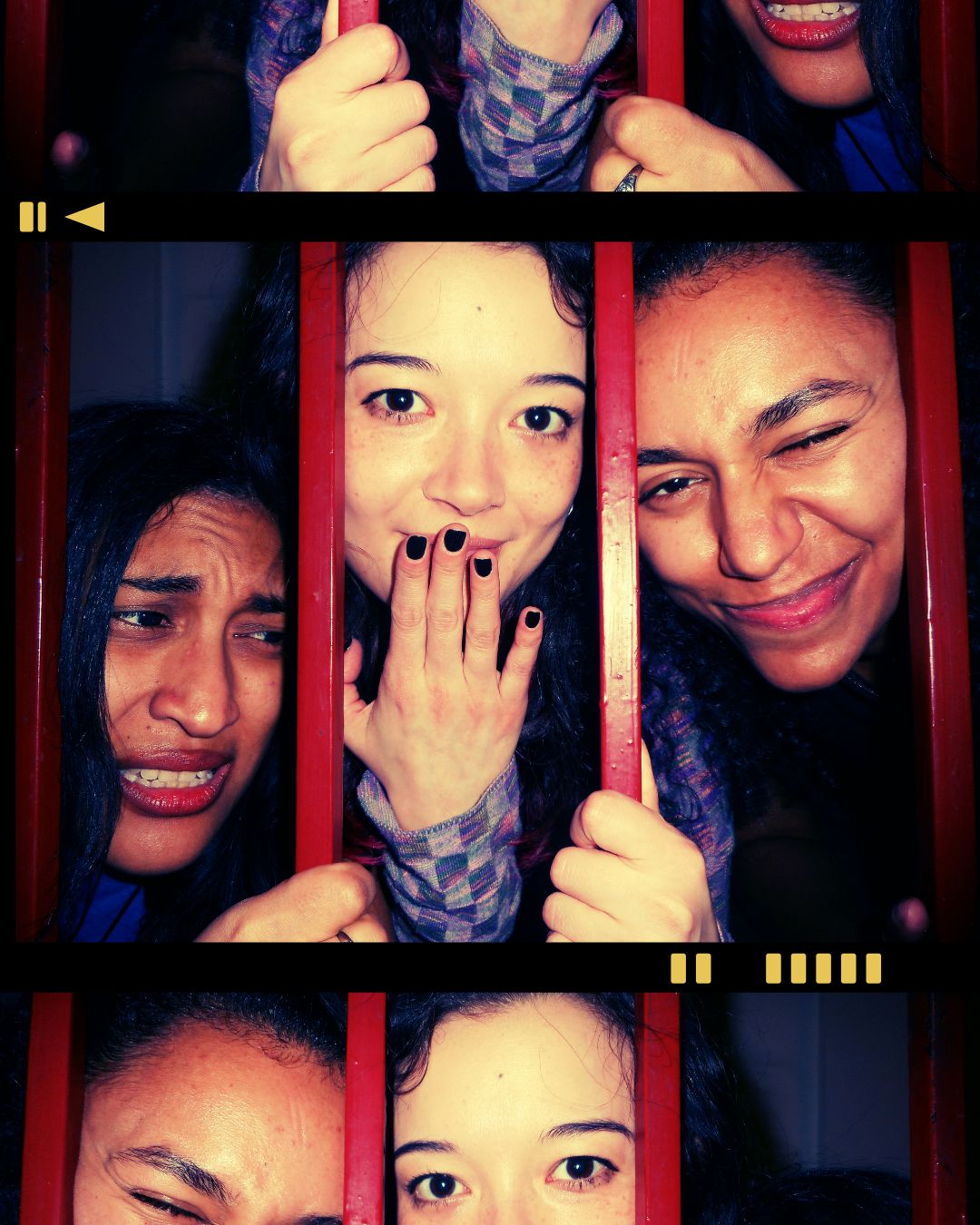
What did you get away with in college? In we’re delinquents.pdf, an acidic, darkly irreverent play about the fallout of three young women sending a lewd email to their entire student body, playwright Claire Tumey juggles troubled devising ensembles, college rape culture, and classroom angst with the wisdom one can gain only post-grad. I recently had the pleasure of conversing with Tumey and director Luis Feliciano about their upcoming Brick Aux production of we’re delinquents.pdf.
This interview has been edited for both length and clarity.
LEAH PLANTE-WIENER: Claire, when you were writing we’re delinquents.pdf, what was in the soup for you?
CLAIRE TUMEY: This play is very loosely inspired by some trouble that I got into in college, in fall 2017. Some friends and I wrote a party email, and we got put on blast. There were wider conversations happening in our community around that time about how we party, how we gather, and sexual assault. The way I approached conflict in my late teens and early twenties was from this place of, you do a bad thing, you’re a bad person, we have to cut you off. I wanted to write a play where we interrogate this idea of punishment, and who and what it actually serves. I’ve been thinking a lot about wanting to find more anticarceral ways we can deal with conflict and harm.
LPW: I was taken by your investigation of art as a tool for remediation.
CT: I like to think that art can change the world and open up conversations that otherwise cannot be had. I’ve also been in situations where we have this idea of, we’re going to make this play and it’s going to do this, but being in the room and dealing with people where they are is more complicated. You see a lot of this in this play; people who have good intentions but are dealing with their own trauma and mistakes, and that gets in the way of them working as a collective.
LPW: Luis, what excited you about the play?
LUIS FELICIANO: I could not stop reading the play. At work, I couldn’t wait to get back to it. That first impulse brought me to the piece. I was struck by the struggle of the characters, the way they want to be in the world and the way they actually are, and the limitations of that. Also, the way the characters speak about sexual assault, the way they come to a whisper with some of these terms– I was called to action. How can I build resilience in having these conversations, and invite others to have them too?
LPW: What’s been new for you in this process?
LF: Our way of working. One of my first experiences in theatre was a monthlong devising intensive. I loved it. We could pass leadership around. Then I started doing more plays and saw the hierarchy that was created in many rooms, and the way it was used for power rather than anything healthy. I teach, and sometimes students ask, why are we doing this, and I have the impulse to say, because I said so. Through this process, I’ve realized how ingrained authoritative ways of thinking and communicating are in me. I don ‘t even realize how often I’m perpetuating these cycles of power that aren’t productive. In this room, with this group of people, I’ve been able to lean on everybody. My father’s in the hospital right now, and everyone’s been so kind to me. They stepped up when I couldn’t go to rehearsal. I’m excited that it’s possible to have a cooperative way of working that is flexible and fluid.
CT: Coming into my own as producer and playwright. I started out as an actor, and had all these ideas about myself that were ingrained in me by these experiences that I’ve been having since I was eleven. For a long time, I believed that I didn’t have the ability to be organized or confident enough to take on these other roles that in my heart, I knew that I could do. [Co-producer and production manager] Hannah Bird gives me a lot of confidence, and with the way that Luis created a warm, fun, welcoming space that is clearly about process, it was very easy. I had preconceived notions that were phantoms in my head, and I’ve said goodbye to them.
LPW: Tell me about making theatre for an unconventional space like Brick Aux.
CT: In college, if you didn’t get cast in the mainstage or studio productions, sometimes you would get cast in the classroom production.
LPW: That’s a conflict that comes up in the play.
CT: Right. The work I did in those productions was a lot more experimental. I got an education in what it means to be independent, rather than rely on institutional support. I’m excited to go back to those roots. I love how scrappy Brick Aux is.
LF: There are moments in which actors have to work with tech on the fly. In other spaces, they’re like, actors do not understand tech, they cannot work with any of that. I’m excited about returning power to actors, trusting them in all of their intelligence and capabilities.
LPW: Claire, this is your inaugural production as theatre company Middle Sister, but you’ve been collaborating with cofounder Hannah Bird for a while.
CT: Hannah Bird and I have been friends for ten years. We collaborated on a one-woman show I wrote that we took to Edinburgh Fringe, and we were like, we’re good at this, let’s keep doing it. We’ve done a couple shows and we love working together, so we branched out and got more people involved. Hannah is primarily the production head. She’s got so much experience in costumes and props and really good instincts. As she’s famous for, she’s really good at staying on budget and making creative decisions on low budgets, which is essential for our particular financial resources.
LPW: Who do you think needs to see this play?
CT: Any theatre faculty member over the age of fifty.
LF: Shitty men.
LPW: We’ve learned that the play is based on Claire’s experience of getting in trouble in college. Luis, did you ever get in trouble?
LF: 2014, 2015. Weed is not legal in New York. I had two friends over at my dorm. We must’ve not even had enough to smoke with, but my friend had weed in his sock, and it smelled bad. Then: knock knock knock, public safety, it smells like weed in here. They ransacked the room. Flipped the mattress. I had to have several meetings with the dorm head about weed. I work at the college where I went to school, so I’ll see the security officer that raided my room, and he’s just like, yo, what’s up man? I can’t tell if he remembers.
Leave a Reply