
I was once the originator of an email chain that, due to no incompetency of my own, resulted in my cultural anthropology professor receiving an email with the subject line, “fwd: bitch.” My friend and I would take turns doing each week’s homework, because that made sense at the time. One week, I wrote out our homework in one document, which I split into two, then emailed him his half with the subject line “bitch,” which he accidentally—he still claims it was the flu—forwarded to our professor. The next week, we were in her office, along with her department head, who decried a “coterie of young men” in the back of class that wouldn’t stop playing Clash of Clans.
I promised the professor that I did not think she was a bitch, that in fact I only thought my friend Ian was a bitch. She said she understood, but given the circumstances, she wanted us to withdraw. This wasn’t mandatory, so we stayed, and we shared a C+. That part of me—either in the past, or the present where I still carry a bit of it—is one of the “shitty men” that director Luis Feliciano says need to see this play.
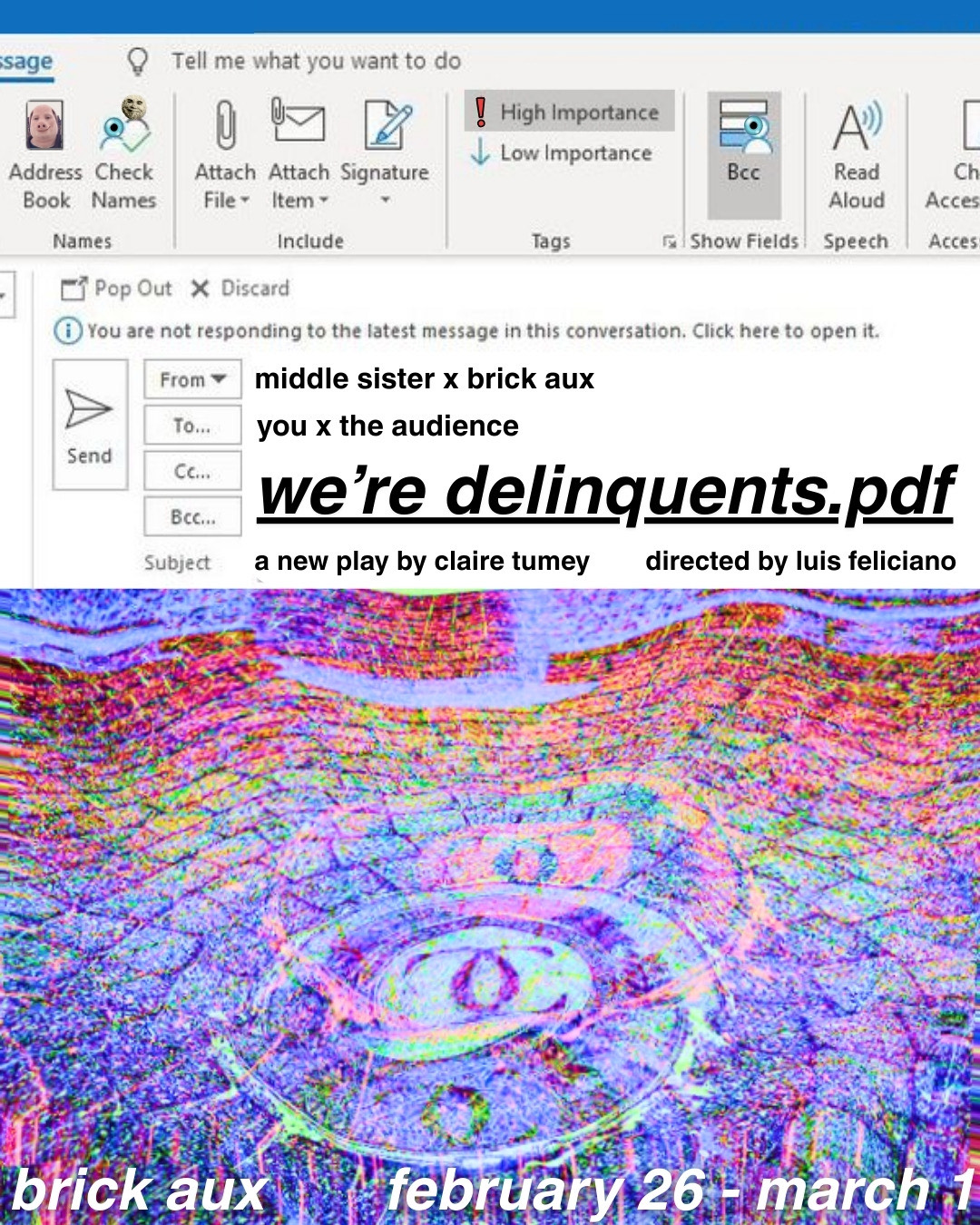
In we’re delinquents.pdf, by playwright and potential distant cousin of mine (see surnames) Claire Tumey, nothing is private and everything is sacred. All secrets—the party lives of young adults, their sexualities, their traumas—are rendered public knowledge. Every moment online and in life is “over and over announcing your place,” as Mary Oliver writes in “Wild Geese,” a poem mentioned in the play. All of this culminates in a cathartic humiliation ritual.
The main trio—theater students W (Izabel Mar), M (Lexie Waddy) and V (Queen-Tiye Akamefula)—are caught hosting a pig-themed college party. W had sent the invitation via her university email. Technology expands the public sphere’s capacity to enforce rules of civility. They refuse to write essays as punishment, but convince the professor (played by Ben Hard) to accept an alternative assignment: a devised theater piece that might absolve, if successful.
In Psychopolitics, Byung-Chul Han writes, “Secrets, foreignness and otherness represent impediments to unbounded communication. In the name of transparency, they are to be eliminated.” The trio made their secret too open, expressing incompetency in working around the social order, and they’re punished for it. Any social activity produces friction in the eyes of the professor, who sees college as a jobs training program that should produce students as circulatory and functional as emails.
This acquiescence to transparency gravitates around actor Ben Hard, who plays the professor, a cop, and the European exchange student Dunkirk, who’s initially the controlling object—ergo arbiter—of V’s romantic obsession and hidden sexuality. Dunkirk’s role as sexual object quickly dissipates. There’re themes of romance and sexual assault, but they don’t drive the plot. They resolve in comedy or the easy resolution seen only between friends. The driving force of this play is the debasement of one’s self in front of authority, the fruitlessness of the hustle, and the community found in punishment. The trio do not become emails, or subordinated to sexual desire; instead, they become better friends through shared struggle that produces fulfilling theater.
The stagecraft further illustrates the theme of transparency. All light is punishment: intermittent heavy strobes, lights in Starbucks cups used to shine spotlights on individual players in darkness as they confess and implicate one another. Technology doesn’t illuminate; it overwhelms.
Technology manifests in language, too: W says, “af” at one point, while “slop” (code for alcohol) is written in the party email. That language illustrates a world where there’s no longer a barrier between human communications and the technologies that stretch and extend them. Wordplay produces a suffocating effect: there’s no way to escape connection. Far East Movement’s “Like a G6” plays at one point, but its joy is washed out in reverb.
Concurrent with this pressurizing transparency is a collapse of the audience/actor barrier. There was no formal stage or approximation thereof in Brick Aux Studio. Action occurred down a catwalk between two sections of the audience. The audience could see itself in the background of every scene. This didn’t lend a sense of audience involvement, only that everyone was being watched by everyone else. At the beginning, a projector emanated the damning email onto my section of the audience. To read it, I had to turn around and look over and at others. No secrets, no hiding: life is a battleground of embarrassment and entertainment.
we’re delinquents.pdf depicts a world where we cannot escape observation. There is no possibility of not being someone in the eyes of others. But it’s a play that affords some hope: that it’s possible to grow closer to others, to discover new avenues of self, to perform versions of ourselves that are something close to true.
Aaron Tomey is from Georgia, lived in St. Louis, and now lives in Brooklyn. He helps edit Grime Square; his essays have previously appeared in Hobart, among other publications. He can be found on Twitter @ecstatic_donut.
Leave a Reply