
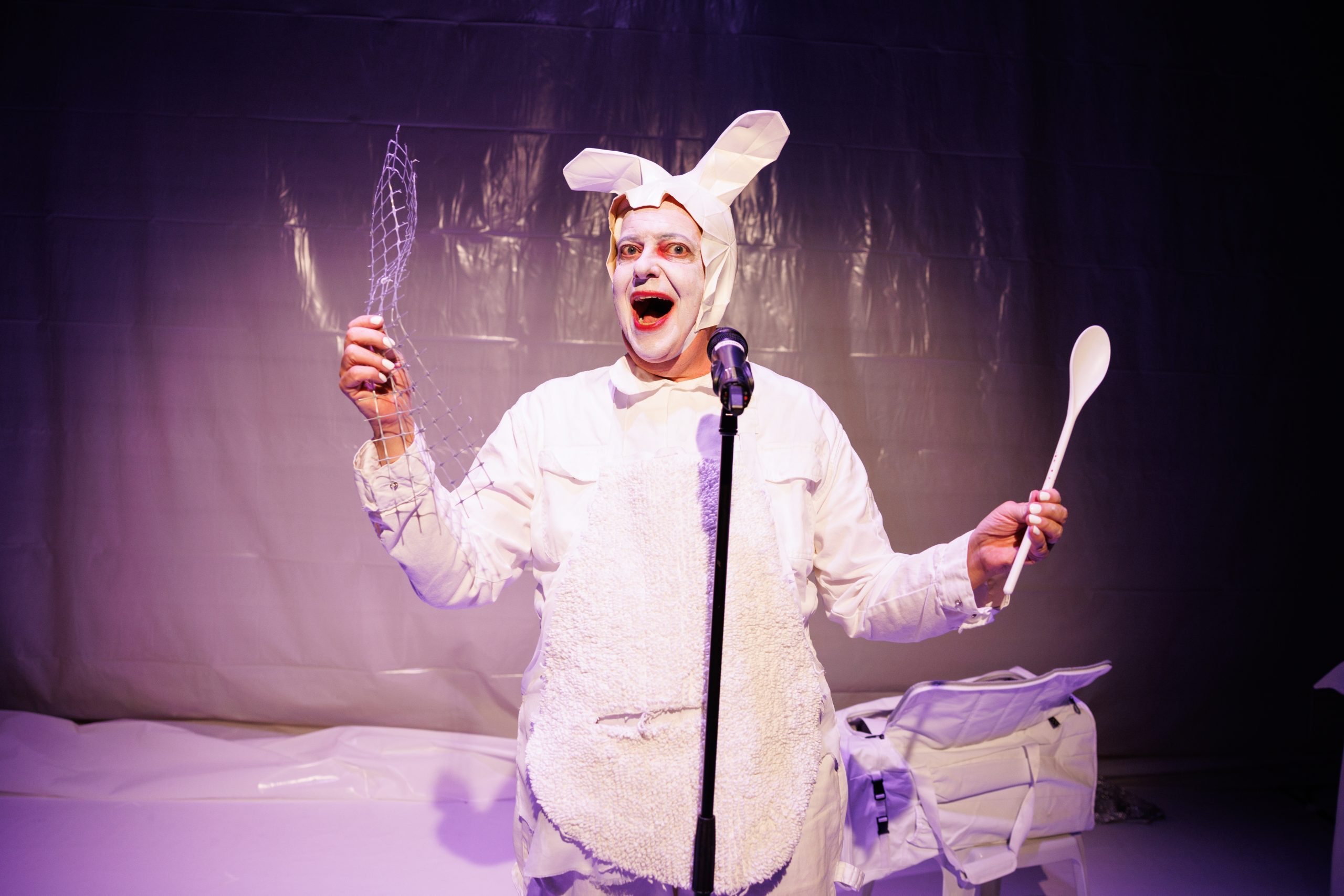
Tony Torn is Spider Rabbit. In this one-man show, he wears white bunny ears and white furry shoes. He introduces and then re-introduces himself to the audience numerous times. In a set that is all white– its walls and its props– Torn moves around in a way that makes him seem like a patient in a mental hospital. He tells us he likes carrots, and displays different items from his white duffel bag–a spoon, an electric saw, grenades. Spider Rabbit hates war.
Causing mirth and pity during this 50-minute play, Spider Rabbit frequently goes for humor which is both crass and crude (chewing the carrots with his mouth open, plus an extended sequence of watching him respond to his own epic flatulence). As he dotters around the space, repeating what he says and does over and over again, it´s like watching a broken mind struggling to find its way out of a maze. Sometimes Torn alters his vocal inflection with each new iteration of familiar dialogue, but much of Spider Rabbit is the same, intentionally. Rabbit’s existence is mundane and repetitive. His is intended as a meaningless reflection of our own.
About midway through, Spider Rabbit unspools his “web”–a long metal wall extended left to right, which will separate Torn from the audience for the rest of the show. The theatrical space becomes a cage, and Spider Rabbit a prisoner. Are we watching an experiment? If so, who (or what) is pulling its strings?
The script, by poet and playwright Michael McClure, has the Beat Generation written all over it. This is both good and bad. Originally staged in 1971 as a protest against the Vietnam War, Spider Rabbit prioritizes simple messaging over dramaturgical intricacy. McClure’s writing is direct and easy to understand, like a sign at a No Kings march that none of its participants could find fault with. Its current revival at La MaMa is a grim reminder of how little the United States has learned over the past half century about the futility of war, made especially apparent under our country’s current deranged leadership.
Director and choreographer Dan Safer is a master of craft. He has expertly fused dance and theatrical vocabularies for decades, fusing post-modern aesthetics with Gen X irony. Like his numerous productions with his company Witness Relocation, Safer’s performances border the legible with abstraction, creating a kind of stream-of-consciousness. Scenes abruptly shift into different moods, which are further underscored by light or sound cues. Dialogue is broken down into unconventional units, revealing hidden or new meanings. There’s something almost hallucinogenic about watching Safer’s work, and in Spider Rabbit he has deconstructed McClure’s script so thoroughly that each line and every moment onstage has become its own discrete image, a rush of micro-performances unto themselves.
As an actor, Torn has no problem inhabiting the weird and the different. In addition to previously collaborating with Safer on Ubu Sings Ubu, Torn’s past collaborators have included JoAnne Akalaitis and Reza Abdoh, Annie-B Parson and Paul Lazar. Torn is at home acting in Beckett and Shakespeare as he is doing The Blacklist or Law & Order: SVU: a proper New York City working actor with roots in the downtown scene. Torn’s versatility as a performer perfectly compliments the kind of unusual theater Safer enjoys making.
However, I can’t help but think that this creative duo are a bit limited in demonstrating the show’s total potential. At times, the show felt like listening to Metallica on low volume. Part of this is McClure´s source material: while its basic message is inarguable, the repetitive nature of the script bludgeons away a lot of its total power. Particularly during a time of an utterly pointless and damaging US war with Iran, I was surprised at how overly-simplistic Spider Rabbit made the complex world seem. I mean, yes, of course “war is bad,” but is that it? Is that all?
I also wished that Torn & Safer went farther in terms of the Gross Factor. Early on in Spider Rabbit, they get us accustomed to increasing levels of lewd jokes, crude sounds, and disquieting visuals (the open-mouthed chewing, the prolonged fart, and so on). So when Spider Rabbit pulled out a plastic bag marked “food” with a bloody kidney inside, I was surprised when Torn didn’t eat it. Then, when Spider Rabbit drinks a “quart of blood,” flakes of red paper fall out of the glass and onto his mouth. Later, when eating spoonfuls of a soldier’s brain, the effect is again undermined by the use of paper for blood. Give me the blood! And if it isn’t real, at least show something liquid! When doing an anti-war play, especially one as visceral and provocative as this one, the whiteness of the set and Torn’s costume ought to be defiled.

Is Safer pulling his artistic punches? Or is this aesthetic restraint the point: that our screens and multitudinous distractions have distanced us from the gore and the carnage of reality?
If one enjoys absurdist theater, Spider Rabbit will likely be an entertaining experience. The night I saw the show, there were many audience members laughing uproariously. In the face of incomprehensible horror, sometimes what else is there to do but laugh. But there were others who sat silent throughout the show that night, too, frustrated by the play’s crassness, vulgarity, and lack of a clear or deep narrative. This production is more Artaud than Brecht, a snarky kind of anti-theater that refuses to go down easily. Some audiences won´t like how Spider Rabbit tastes, while others will commend the obscurity of its mouth feel. Open up, and swallow at your own risk.
Photo by Maria Baranova.
Leave a Reply