
If you were to survive an apocalypse, what do you think would most help your chances at survival: being alone, or living with other people?
This question lies at the crux of Sarah Groustra´s Radio Man, an ambitious and bold new play playing at the intimate Paradise Factory in the East Village. Audiences sit packed on either side of the basement theater´s narrow stage, appropriate for a story which takes place somewhere in the midwest 7 years after a mysterious radioactive explosion. While we never quite learn its origins, this cataclysmic event sounds like a nightmarish combination of Chernobyl and the early days of Covid. Before the actors enter the mulch-covered stage, scenic designer Ningning Yang shows us how grim things will be in the future: a flimsy tent made from a patchwork of towels and blankets, a meagre campfire, a dead tree stump.
There’s also a beat-up boombox, from which a lone voice intermittently floats whenever the dial is turned on. The play´s titular character, The Radio Man, (Mike Iveson) recites poems by Frost and Shakespeare, plays old folk ballads, and even occasionally muses about how he is surviving the slow end of the world. While we never learn his name or where he is sending his broadcast from, this “radio man” provides a bit of comfort to those few lonely and scared souls that survived the first and second wave of the explosion.
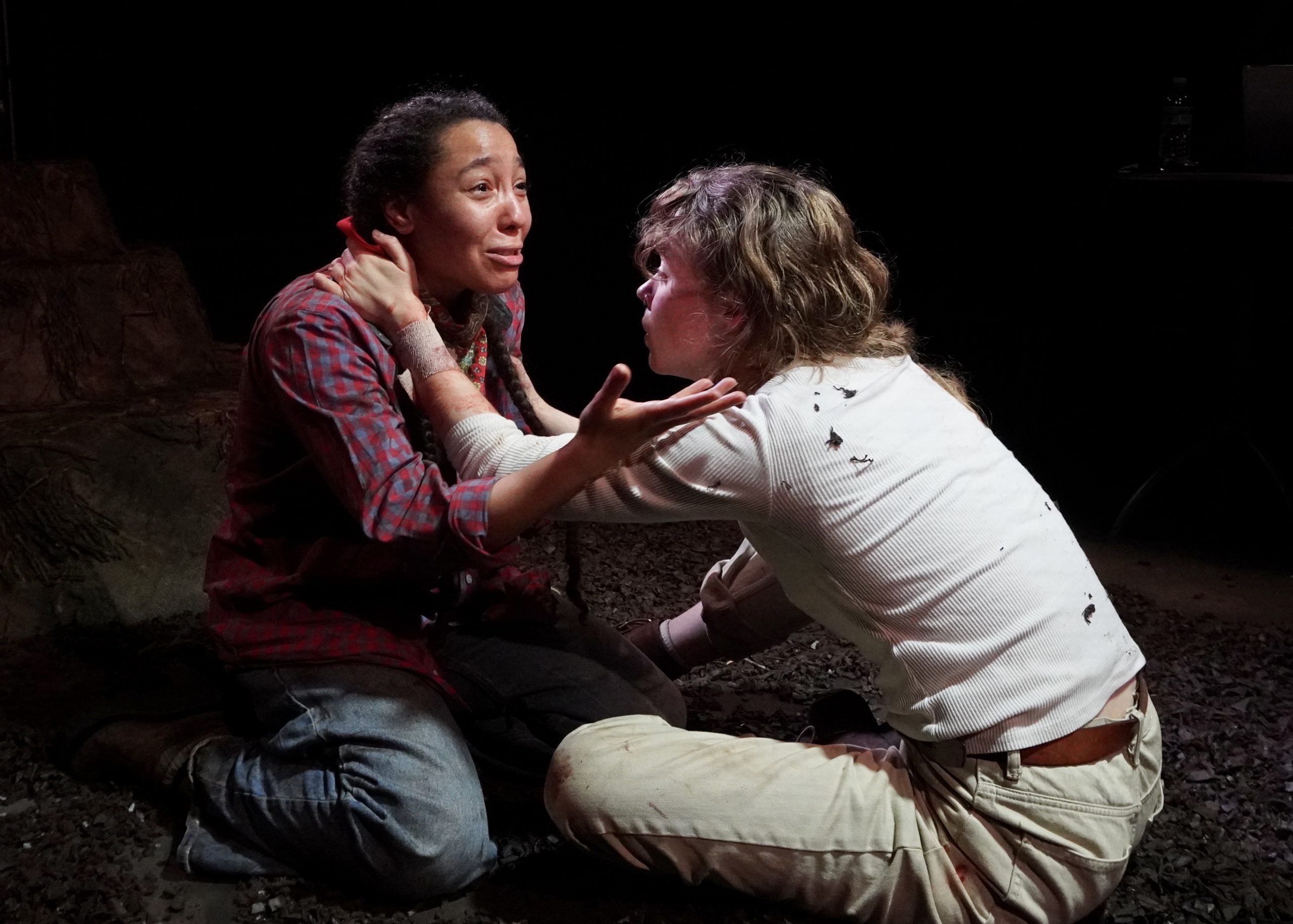
One of these is Mary Grace (Rachel Arianna), a 14-year-old who longs for company and for someone to talk to. She used to get that from her older sister Helena (Mia Angelique), 21, but things have been different since they made this new campsite a few weeks ago. After befriending a man in this wasteland, Helena killed him after his attempt to sexually assault her. Mary Grace saw the whole thing, though she doesn’t quite understand what happened– her big sister doesn’t want her to nor does she want to talk about it–her instinct is to attempt to protect Mary Grace’s innocence for as long as possible. All the 14-year-old knows is what Helena tells her. When her big sister warns, “If anyone does to either of us what he did, what you saw him do, what are you going to do?” Mary Grace responds, “Kitchen knife.” The brief exchange will become consequential later.
When Vera (Sophie Falvey) stumbles into their camp with a bleeding arm, the sisters´ reactions are discordant. Helena is suspicious and defensive, while Mary Grace yearns for a new companion. The stranger gradually earns their trust, helped in no small part by Vera’s guidance in resetting Mary Grace’s dislocated shoulder, as well as the contribution of a can of cherry pie.
Director Tatiana Baccari expertly leads this talented cast through various emotional frequencies, from tentative signs of trust, to guarded interdependence, to actualized physical intimacy. The setting of Radio Man is quite intense, and yet no passages within Groustra´s script feel sentimental or maudlin. With good reason, these three women are, to varying degrees, guarded. Opening up and letting down one´s defenses in such a world of death and danger has a price: are they willing to pay for it?
When Mary Grace begins coughing relentlessly, Helena’s greatest fear comes true: her baby sister is dying, probably from the radioactive “third wave.” Should she tell her the truth? Vera, who lost her younger brother earlier, thinks so, but Helena is uncertain. Wouldn’t it be better to offer hope? Shouldn’t she continue to protect Mary Grace from the darker sides of existence? In a world this grim and so full of pain, how can one bear to live on with more than a few distractions–whether it´s remembering going apple-picking in the family orchard during the time before the explosion, or just listening to whatever the “radio man” has to tell them on the one solitary station. Sometimes, even the strongest of us cannot bear nothing but reality.
I won’t give away Radio Man´s powerful climax; audiences should experience it for themselves. I will say that the play´s ending is inevitable while still being surprising–which, for me, is always satisfying. Underbelly Theatre Company is a talented cohort of bold young artists. Radio Man is the kind of edgy experimentation I seek when I go to see “downtown theater.” The questions it poses will creep under the skin, and linger long after leaving the theater.
Photo by Trey Sullivan
Leave a Reply