
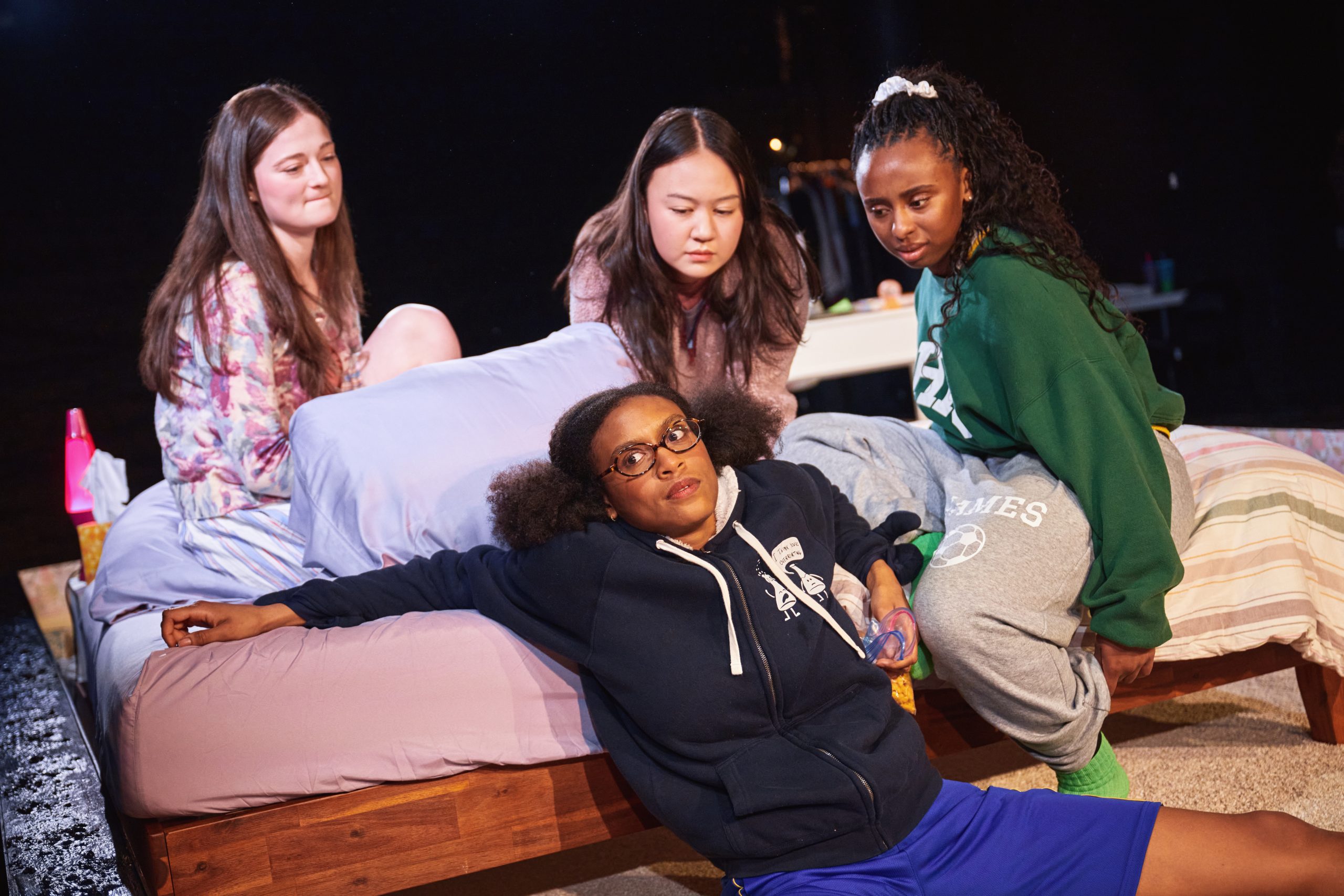

I first heard the Simlish from the lobby. The sound design (Mitchell Polonsky) of the preshow serves as a sonic encyclopedia of youth; avatars babbling, coded breezes, artificial emotional bursts. The latter to come is, thankfully, nothing fake. Eliya Smith’s Dad Don’t Read This is a mid-2010s jaunt through teenage girl-dom, specifically, a moment in the sixteen year old lives of four girls. Their Ohio setting and upbringings have the archetypal plot relevance you would expect; there are desires to leave, there are inclinations to stay. All is contended with to varying degrees. Nothing really changes, no conclusion is reached per se, and yet the action alone holds so much pubescent power, the stakes don’t necessarily need to be raised. This could be said for the play as a whole.
The production is staged in St. Luke’s Theatre, forever haunted by decades of parody musicals and immersive Italian theatrical experiences. The jet-black offspring of the glistening white Theater Lab pillar stand tall and strong throughout the space, working collectively, with might, to block as many sight lines as possible. I salute them. I wonder if the orientation of the space could’ve been made differently within this space. I wondered this more and more as the show went on. I think the answer, honestly, might be no, but I wish there had been a moment where I turned my head somewhere unexpected, had something new revealed to me. The wide space between Mal’s bedroom (our protagonist, the play is set primarily on her turf) and the stars (beautiful when lit, a mess of fairy lights when not, both meaningful) felt empty in a very literal sense rather than the metaphorical one it, textually, represented. For a play so deeply rooted in a specific time and place, both digital and analog, there was something uncannily liminal and straight up wrong about it.
What was correct, though, were the four performers cast to inherit the spaces, the domestic and the marginal. Amalia Yoo, reigning queen of the onstage teen, leads as Mal, a Sims-addicted theatre kid riddled with anxiety and the presence of her parents’ inexplicable unhappiness. She’s flighty, fighty, and, at times, brutal. There’s no pretext to her seemingly sudden cattiness, it simply arrives, just as age does. Yoo’s performance is inherently confessional yet subtly surprising, especially in multiple monologues that are mostly about the humiliation rituals and torture tactics she enacts upon her Sims. Her best friends, who we get to know over the course of many sleepovers, are Sophie (Sophie Rossman), a Christian girl questioning the world, Noelle (Renee-Nicole Powell), on the cusp of becoming cooler than was previously thought possible, and Lida (Kayta Thomas), who dreams of being a NYC alt-comedian and making gay Sims have children naturally. None of them are very similar to one another, and yet they hold a mostly common view of the(ir) world, one that never fails to keep them together, even through the worst. For example, Mal’s friends have been getting close with an enemy by the name of Louann Foster. This irks Mal, she creates tension as a result. And yet, it’s as if there’s this unspoken promise, this trust like a rock. Mal performs distance, she isolates as a tactic the same way I did at that age when I didn’t feel important. I stuffed my nose in classics such as Little Women to feign intellect. Mal digs herself into her computer screen, as tangibly close to her Sims and the control they allow as possible. We both blast showtunes. And our friends usually came back. Even if they didn’t, we thought we knew who we were, and that was enough.
Out of this portrayal of pure self came the most thrilling moment of the piece. At the top of the one-act’s second act (as denoted in the script), following a blow-out confrontation between Mal and Lida (with an extremely shocking light change by Abigail Sage), Sophie performs a stirring tap solo to Bobby Womack’s “California Dreamin.’”. Choreographed by Lena Engelstein, it is relentless yet controlled, automatic but strenuous, simply a feat. Truly shocking! It’s dramaturgically random until the next scene, as Mal informs Sophie that she has been making her Sim, Hilda, practice a tap dance repeatedly to the point of exhaustion (“again ho”, Mal rotely exclaims. I really appreciated the use of the term hoe without the e.) Mal’s friends and her Sims are almost interchangeable, their only difference being in autonomy. One form is meant to be controlled, the other has the choice. And yet, a reverence to the malleable is shown throughout the play, whereas the autonomy of the organic is the one questioned, most unsettlingly when Noelle tells Sophie she should change herself to avoid the attention of perverts. “the sims know when you’re embarrassed” Noelle informs Lida with a faithful certainty, as if the claim comes from scripture. There’s complete trust in the avatar. Whether that’s because they can be easily manipulated or due to their ability to manipulate our perceptions of ourselves and the world we inhabit I think is up to the consumer.
There are attempts within this staging to represent said digital othering, but they tend to fall flat.
For example, I could not tell at certain points where the girls were at given moments, even though the set was unchanged. Mal’s room (sets and props by Forest Entsminger) had a genericism to it that was maybe intentional, maybe not. Either way, it was often confusing, sometimes odder than the empty space that lay on the outskirts. On top of this, an ‘ultraspeed’ transition function that Smith utilizes in the text to show the passing of time does not land in Chloe Claudel’s direction. There is, seemingly, no time, but that could honestly be the point. The stories told in this space have played out in countless suburban bedrooms, and the spaces in between those and the rest of one’s life. Smith’s prose remarks on the unkindness of childhood, the downright cruelty of young adulthood, and the destruction in between. Perhaps the spatial plotting can be seen as a representation of such. I’m curious to see how its new home, Greenwich House Theater (running in a transfer from June 17-July 11), affects said plotting.
Following the performance, I returned to Legacy Russell’s Glitch Feminism, a sprawling manifesto that affirms the unique relationships marginalized women and trans folks have with the digital, and the idea of “glitch” as a revolutionary act of abolition and advocacy. One facet of the manifesto, “Glitch Is Anti-Body”, states the following:
“If to be recognized as a body that deserves to live we must perform a certain self—look a certain way, live a certain way, care for one another in a certain way—we strike against the body altogether. We will hold mirrors up for one another, hold and care for the reflections seen. We will see one another and the selves we become, recognizing those selves as real, loved, and so very alive.”
The avatars of Dad Don’t Read This are instructed to, and do, perform exactly this; a complete deconstruction of the self that is only reformed when the other is recognized. “I don’t like myself, but I like being alive,” Mal states. She is a young woman living amidst a societally enacted and, as a result, self-inflicted rejection of the self. By the end, as the girls choose to simply talk rather than construct a spontaneous-looking experience, the mirror is held up.

Leave a Reply