
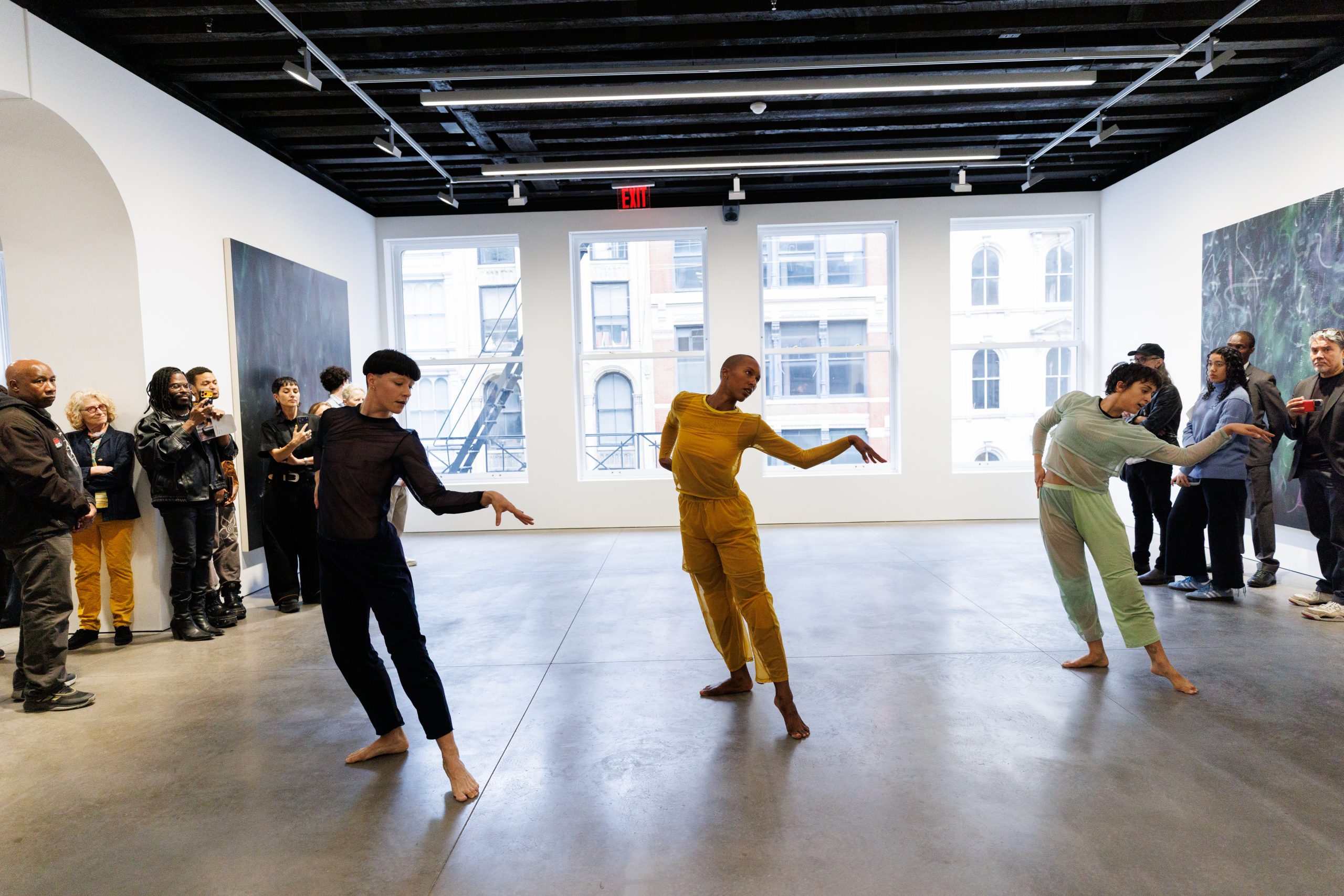

I’m in Marian Goodman Gallery, expectant, wandering a bit myself, encountering the paintings of Julie Mehretu and her exhibition Our Days, Like a Shadow (a non-abiding hauntology). I hear scratches, hums, vibrations, distortions, angles of amplification across drum surfaces, and a violin. I’m listening to the sound-scape of multi-instrumentalist, composer, and producer Hahn Rowe, who stands with his set up between two paintings in the second room of the gallery’s main floor.
Some of these paintings are wall size monoliths, some are smaller (titled TRANSpaintings/Upright Brackets) and placed inside metal structural frames by Nairy Baghramian that hold them in the space like Shoji Screens. All the surfaces are flat polished and the imagery, the gestures on them, provide texture, like a rubbing or transfer through a screen of mesh, pushing a blown up pixelated feel. I have spent decades looking at Mehretu’s work, and have watched it get darker in color, more densely layered, and finally with these works, zoomed in so the marks are larger, less precise, like she has been focusing the lens closer and closer to the interior of the work. Her Shoji are opaque, though shadows of movement can be seen through and now we get to see her from both sides, a thing we were told she engaged with for years, but didn’t see.
I’m here to see Wandering. The John Jasperse Projects dancers enter and take their places scattered like discarded pieces of fabric down the short set of stairs that lead to large windows overlooking the street. They are each their own color, pink, blue, light green, etc. in the costumes of designer MX Oops. Part solid fabric, part mesh arrangements on the bodies, short sleeves, long pants. After some slow faint movement from them as though they are all waking, dancer Cynthia Koppe enters and suspends herself in mid flight, a carefully balanced crane, with long lines, and slow even développé. There are clapping bursts of sound from the other room we will find out are mattresses hitting the floor. As the dancers on the stairs bend, squirm, lift, overcorrect, rise, Koppe remains fixed. Then, sort of at once, they are all moving in front of us, pacing the space in different linearities, and finally one of them slowly heads towards the wall where I’m leaning with a few others. She doesn’t stop and we get shuffled out of the way so she can arrive against the surface.
This will remain a theme throughout the work, although this first section sort of trains us for the rest. I like the confusion. Everyone whispering apologies, shuffling around, looking behind them so as not to step into another person or a painting. Gallery guards reaching to keep us away from the work, and all the while the dance goes on, the mattresses hit the floor, Rowe’s score hums, ticks, pulls at and bounces over everything in the room. There are large pieces of cardboard being manipulated through the doorways and across a space, dancers standing, crawling, rolling underneath them, reaching out, peering out from under the material.
As the dancers pull away from this first level and head upstairs, we are motioned to follow them or take the elevator to the second floor. The work continues to develop there and eventually on the third floor. Each space a new construction of Mehretu’s work, and each space asking different things of the dancers and the viewers. At the third floor it switched from the soundscape Rowe had built to the mixed stylings of Bronx born multimedia artist and composer Will Johnson. His work ramped up the energy of the piece helping, or encouraging, or pushing the dancers through the last portion of the work, which built to a repetitive frenzy before a slow quiet exit.
John Jasperse’s choreography had a casual and causational play to it that kept it feeling fresh and improvised while building repetitions that showed you over time just how set the work was.
The dancers would lean, wait, stretch, roll over, walk, sit, stand, collapse, fold, fall, wilt, and tumble. There were stillnesses and pauses, and partnering that was contact improvisation -coded, while keeping their faces held in a post modern neutrality. We partner with them in a way, a part of the shuffle, adjacent to the paintings, as they are. They pile on layers of simple repetitions, framing the head, the body, the chin, the space – bodies in Canon. The spines are liquid lines, the duets and solos washing through the space in waves, and undulations, and implosions, leaving the dancers behind the TRANSpaintings/Upright Brackets to be seen through the screen in shadow form, or falling and rising around the mattresses. It builds and builds, the repetitions more closely timed, the cannon getting tighter and tighter until all of them in unison on the floor roll through the space and rise one by one to leave.
The dance was neither for or about the paintings. It was in conversation with, offering gestural, ephemeral explanations and unpackings of, adding tautological referrals and overloads. The consistent and measured dance vocabulary throughout allowed for some sinking in and leveling with the work, letting me look past the movement to the paintings in the room. I could start to pass ideas between the two. And I liked that I had to choose where to look, that I couldn’t be greedy, couldn’t have all the images at once, and had to miss some things. Although once I realized that repetitions were building, I felt I was catching everything, just in different spaces. And as the gallery emptied I got to spend more time with the paintings, that were now somehow encoded or exposed in a way with the afterglow of the movement.
I have one dramaturgical critique of the work and its impact occluded my ability to see it as whole, or inclusive, or about identities and interstices the way it was described. It was a dance that included so much raw interplay of identity and relation, as long as you were able bodied in the space with them. On top of the structure of the piece and the shuffle of viewers, cameramen wove through the action, adding another layer of quiet chaos and frustration. Because neither they nor the dancers slow down, adjust, or allow time for response — even when moving to take the position of someone using a cane, or visibly struggling to get out of their way. The work ignores basic conventions of accessibility, treating different mobilities as unseen rather than conditions to account for. This is an easy fix that I hope the artists and Marian Goodman Gallery will consider for future works.
Leave a Reply