
When I was a junior in college, I studied abroad in London. It offered me an excellent slice of theater education, with one drawback: I wasn’t around to audition for my school’s student production of Legally Blonde the musical. While this is not the end of the world, it is universally (to me) regarded as an exceptional musical, and I was sorry to miss it. That production was directed by my classmate, Sarah Connolly, who directed Scarlett Grace McCarthy’s The Betrothed at WP Theater. As it’s 8 (eek) years since Legally Blonde took Wesleyan University by storm, it was great to learn about Connolly’s path since, and her work on this “outlandish” comedy of manners.
This interview has been edited for length and clarity.
This interview is published in partnership with What I Liked This Week

Emily Chackerian: So we both went to Wesleyan, and I know we overlapped there, but what has your journey been since then?
Sarah Connolly: I was actually a government major at Wesleyan, not a theater major. To this day I’m still passionate about politics and try to incorporate that into my work in a lot of ways. I grew up acting and I’ve always loved theater, but I knew I wasn’t an actor, and so I felt I’d pursue something else, but when I was a senior at Wesleyan, my best friend and I put up Legally Blonde through Second Stage [the student theater group at the time], and I directed it. We were like, “Let’s just do this senior year, swan song.” I fell in love with directing. I think I had never put it all together that I could do things in theater that weren’t performing. The experience was so powerful to me that I was like, “You know what? I’m gonna move to New York and try to figure it out.”
I started out PA-ing and ASM-ing. Any chance I could find to get in the room, I wanted to take. When things opened up after the pandemic I was like, “I really gotta hone in and focus on directing,” so I started looking for assisting opportunities and also trying to cultivate relationships with playwrights. Now I do mostly new work development. I love working with playwrights and seeing a piece from the early days through to a full production. That’s really exciting to me.
EC: Are there any specific projects that you’ve loved working on over the past couple years?
SC: Besides The Betrothed, I have a really close friend and collaborator named Evan Brodsky, and we’ve done a bunch of projects together. I love working with him because we’re such close friends and have such a collaborative relationship. It’s always fruitful when we’re in the room together. I also just directed a show in February called Appetite at The Maker’s Space. It’s by a playwright named Katherine Alberta, and it’s a black comedy about a retreat where a bunch of influencers have to compete to market an upcoming trend for the year. But this year the trend is the use and consumption of human meat. It’s a commentary on how far you’d go to sell a product.
The Betrothed is a comedy, and it was my first foray into working on comedy. I do a lot of more realistic dramas. Appetite was stylistically different, but another kind of comedy. I’ve fallen in love with making that kind of work. And to flex those muscles again was really exciting.
EC: How did you and Scarlett initially get put in touch?
SC: In December 2023, I zoomed with a director who had moved to Chicago and was out of the industry. They were like, “I have this playwright collaborator who’s still in New York. I used to direct a lot of her work. Would you be interested in connecting with her?” So they connected us, and we found out that we lived in the same neighborhood, so we met for coffee. We talked about theater and our work, and realized we had a lot of overlapping interests – we hit it off as people and as friends. Then she sent me a very early draft of The Betrothed and I read it, and loved it, and I emailed her, and I was like, “Hey, this play is great. I love it.” We got coffee again later in the year, and she was like- “I have an opportunity to do a workshop production of this at the Tank in November. Would you want to direct it?” So that’s how it began. We honestly didn’t know each other that well, but thankfully it worked out.
EC: What’s most exciting to you about Scarlett’s work, and specifically within The Betrothed?
SC: Scarlett has a really strong sense of how to make something funny, and interesting and relevant/ There is a baseline level of comedy that is very fun. You can peel back the layers and there’s a lot of commentary about gender and power and expectations that are placed on us, but it’s very approachable. Something I love about this show is that it feels like a play I can bring my non-theater friends to and they’ll still love it and attach to it in a lot of ways. I’m very much interested in making theater that I think a wide variety of people can resonate with, andScarlett’s work in general really presents a great opportunity to do that.
EC: I’m always excited about accessible theater–what do you want audiences to know going in? What is the premise?
SC: The Betrothed is an absurdist comedy of manners. It takes place in the late 19th century, but it’s in a modern dialect for the most part, and there’s a line in the, on the title page that says, “It’s the late 19th century, but it’s also not.” In the rehearsal process, we’re finding ways to straddle that line between period and contemporary and asking where those things meet.
The play is about a wealthy family in New England. Their son is supposed to get married but his fiancée writes him a letter calling off the marriage because she finds out that he’s done something very bad. His sister sets out on a quest to find out who is trying to slander their family name. I sometimes compare it to Twelfth Night because of the missed connections; this person thinks they love this person, but really they love this person, and as the play progresses things get more crossed and people get more confused.
Another big part of the piece, which is something that Scarlett and I developed for The Tank production, is that all the characters are played by women and/or gender non-conforming actors. It wasn’t initially written into the text, but is now there: our cast is made up of all women, and there’s three male and three female characters in the play. We’ve been talking a lot in rehearsals and with designers about the idea of performance and gender as a performance. We’re not trying to hide that these are women playing men. We’re trying to add something to the text and ask, “How does that change the way in which you interpret the text and interpret the characters’ actions?”
EC: It seems like you also have a majority female and gender non-conforming creative team as well?
SC: Yeah, our creative team is all people of marginalized genders which was important to us. We wanted to make sure those were the voices we were uplifting throughout the process.
EC: What’s the energy in the room like?
SC: The energy has been really fun. It’s a great group. Everybody’s really open, and we all have a shared vision that we’re trying to achieve, the world we’re trying to build. Whether that’s through working with the actors and finding the characters, or through the designers and figuring out the aesthetics.I love being in the room with women. I love telling stories that center women, so to get to be in a room where we get to do that all together is exciting.
EC: And this is your second time mounting the show. Has the play changed? As someone primarily works with new plays, how are you guiding the ship, and how is this new run shifting?
SC: The play has changed a lot. It’s the same basic plot. But there’s a whole new subplot now, and a couple of the characters’ identities have shifted a bit in a way that adds to the comedy of the piece. When we were doing it at the Tank, it changed a lot throughout the process. I remember we blocked the whole show and then Scarlett came in and was like, “I rewrote all of Act Two,” so then we re-blocked all of Act Two. Now, we also did a week-long developmental workshop of the play at IRT Theater in April. We were in table work land, figuring out who these characters were and what their arcs were, and Scarlett rewrote throughout that process.
We are still changing the play in rehearsals. Scarlett brought in a new scene last week that expands the world of one particular character in the play, which is exciting. It’s really fun, and a challenge for me. But that’s part of the process, and that’s part of making new work. I welcome that challenge, and I know that it will help me grow as a director and a collaborator.
EC: Yeah, I was just thinking about working on pieces by really iterative and generative writers, and it’s certainly tricky to keep adjusting and resetting where you are, but it’s also so thrilling to watch a playwright respond to what’s happening in the room and then put that into the piece.
SC: A big part of directing is keeping a bird’s eye view and knowing when to be focused on the details versus the big picture. If the big picture is making the show better and the story clearer, then that’s the most important thing at the end of the day.
EC: Yeah, absolutely. I think that, like answers my next question, but if there’s anything else you wanna share, I’d love to know about your approach to directing?
SC: I am a very actor-focused director. When I moved to New York, one of the first things I did was start taking classes in an acting studio. It truly is the best thing I ever could have done for myself. I took classes for a couple of years, and then I ended up evolving into a more leadership role in the studio, where I was sometimes doing scene studies in class with the actors enrolled in the studio myself, and also developing outside projects and full productions with some those actors. I learned so much and I’m so grateful for that. So my approach to directing is digging into “who are these people? What are these performances we’re creating?” The two biggest questions I always ask myself are “What do these people want? And what kind of willpower are they deploying to get it?”
What’s great about this play is that we’ve had some actors who have been attached to it for multiple years. These characters have morphed around them and they do things that I never could have thought of, but they’re so perfect and amazing that I’m like, “Yes, let’s keep that in.” Directing is not about trying to always have the best idea in the room, but about being able to identify the best idea.
EC: I love how there’s so much alignment with this question of where the character’s agency comes from. Allowing this cast of female and gender non-comforing actors agency and allowing them into this space is really wonderful.
SC: Yeah. That’s aligned with the themes of the play too, because the characters in this play are learning how to take their own agency and think for themselves.
EC: I wonder if for the uninitiated and for the sake of this piece, if you wanna just explain the classic marriage plot or a comedy of manners?
SC: Someone is about to get married, something goes wrong, and then you have to bring it back together. A comedy of manners as something that pokes at norms and expectations of what we expect people to do in any given situation. This play queers that. A comedy of manners or a marriage plot is often focused on heterosexual relationships, and this, in the end, flips that.
EC: It’s so exciting to see these plays that take classical stories and historical settings and modernize or queer them. I just read Ava Pickett’s 1536, which is a quite modern and relevant play about the early 1500s, and it feels like it is in a similar vein, as does Sarah Ruhl’s In the Next Room (or The Vibrator Play). All of these kinds of plays feel very feminist and rooted in queer people and women’s stories. It’s very fitting that The Betrothed is being put up at Women’s Project Theater, and is the first in the WP Theatre Space Residency program. What has it been like entering into this collaboration with WP?
SC: I’m such a fan of WP’s work. I’ve seen many shows there, and I love their mission statement as a company. The work that they put up is so strong and relevant to society today; they always pick really great stories to tell. To be part of that in some small capacity is a huge honor. I’m used to doing scrappy downtown indie theater work where I’m like, “Okay, we have zero dollars and two chairs and a table and the air conditioning doesn’t work, and the stage manager can’t really see the actors and how are we going to make this work?” This is a step up for me in that we have more resources. It’s still very scrappy; we describe this production as an indie theater production with an off-Broadway credit attached. The residency provides us with the space and rehearsal and a lot of other resources, but we’re still funding the whole thing.
EC: So often self-produced plays can only have super short runs, maybe one or two shows, and this gives you a few weeks, which means that so many more people can see the production. Do you have a target audience?
SC: There’s been this big resurgence of bringing young women and girls to the theater. There’s a through line of a lot of plays, and I think this play is stylistically obviously different from plays like, John Proctor is the Villain and Dad Don’t Read This, but I think it can appeal to that same audience in the same way. As a director, I’m interested in reaching that audience through my work, so if I’m sitting in the back one day, and I look out, and there’s an audience of a bunch of different teenage and college-aged girls, like that’s honestly my dream.
I think this play holds up a mirror. These characters are so ridiculous, but they’re under constraints that I think we all feel, and I hope that it allows us to look at ourselves and be like, “Oh, actually I’m only doing that thing because I feel like that’s what society expects me to do.” Throughout this play a lot of the arcs of these characters are about stepping into their own agency, and doing things because they want to do them, and I think that’s a lesson we can all learn. I’m at the age where my friends are getting married and I’m okay with that, but sometimes I feel that pressure on myself, even though I know that’s not what I want right now at this moment. Working on this play, ironically, because it is about marriage, has allowed me to take a step back and say that the fact that I feel this pressure is ridiculous. Stop letting society dictate your own life. Do what you want to do.
EC: That’s so real, I feel like everybody’s getting engaged, and frankly it can be overwhelming. But people move at their own pace, and it’s nice to have a funny, approachable piece of theater that affirms that.
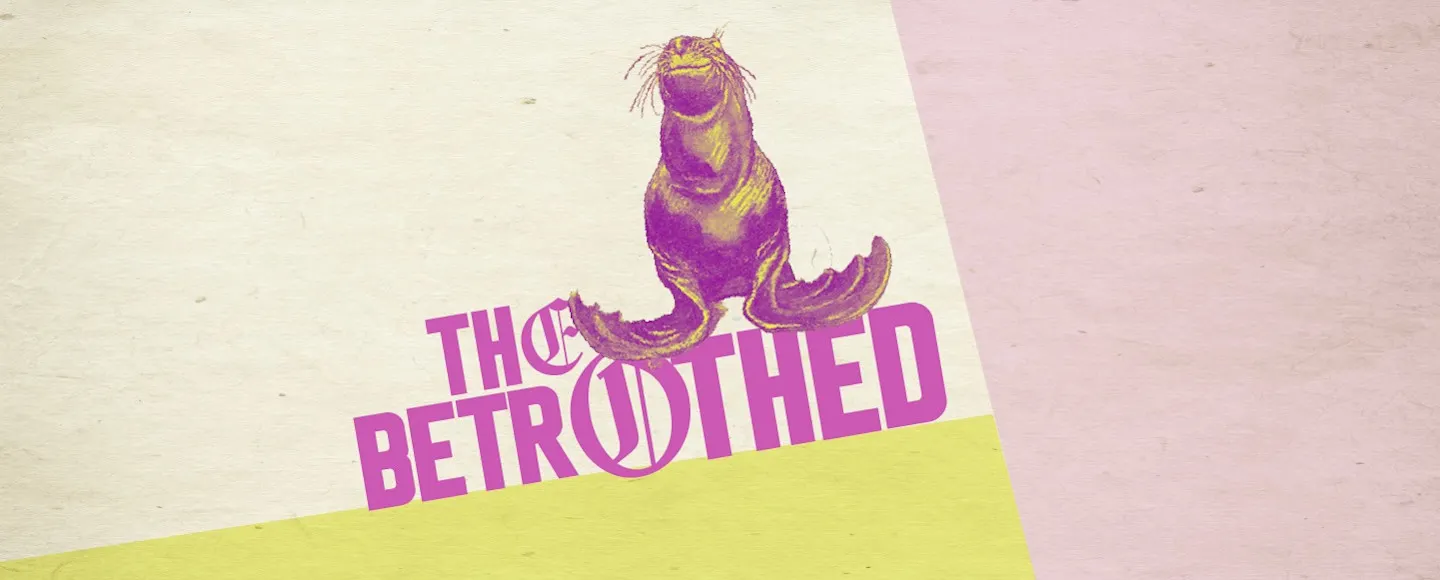
SC: I said this earlier, but I think The Betrothed is accessible to everyone. Partly that’s because of the humor; there’s a talking seal, and it’s very outlandish, but something I’ve learned from working on more comedy in the past two years is that humor is a really great way to bring people in, specifically people who aren’t necessarily like, “What am I gonna do this weekend? I’m gonna go to a play on the Upper West Side.” So I think, honestly, it’s a great summer show. If you wanna have a fun time this is the place to be.
Leave a Reply