

Whilst one is in their early 20s living in a major metropolitan city with some type of art bachelors degree, they may be asked to attend a performance in a slightly inaccessible and/or inconvenient location with a curtain time of 10pm. At this point in a human being with these credentials’ life, the task is unavoidable and nearly insurmountable, and no one is better for completing it. And yet we do it anyway, because it’s what a good person would do for the sake of the arts, even if they shouldn’t. The venue I was heralded to on one such night reminded me of the public schools I attended in Brooklyn; lighting too bright and piss yellow, walls and floors so clean they feel dirty in the same way that hospitals are maintained. The actual theater was only accessible by a skinny hallway that seemingly became tighter and tighter the further you walked, until you reached a door leading to pitch black nothing, also known as a theater.
The venue, IRT Theater, is in the same building the New Ohio used to be (RIP DIVA.) Said building is The Federal Office Building, which formerly held archives, records, shipment processing systems, etc. It is now home to Tap Dance Central Inc. and a Narcotics Anonymous meeting, because that’s the New York way. Lydia Riess’ Going Away Party, staged as a part of the ALab Theater Festival in said haunt, is most generally about the elusive New York way; forced desensitization to constant stimulation and reminders of the failings of humanity as a result, and how individuals choose to cope. The girl at the center of this play and the culture she operates within copes through self-centeredness; not maliciously, but as a survival tactic. For example, at the piece’s opening, she narrates her morning routine for us. A man is her closet, which she clarifies for us, stating, “It’s interesting that a man is playing a closet because men are not often asked to be vessels. By asking this vessel to be a man, by asking this man to be a vessel, I am being interesting.” This type of declaration is littered throughout the play, as the protagonist uses Little Ivy-borne language to state away personal and worldly problems.
The set-up is deliciously rudimentary. Alicia (Fiona Tarses, nailing the Tavi Gevinson thousand yard stare/inquiry) is getting over Derek (Felix Teich, wonderfully disaffected) and seeing Someone New (Ian Edlund, earnest and warm). Her best friend Sarah Anne (Madison Hu, so good you could’ve told me she actually was that person) supports her but always has to run, and Derek’s new girlfriend Paige (Anna Lei Negrin, appropriately, confidently naive) is enviably perf. This web of relationships and their ups and downs culminates in the titular party, meant to celebrate a botched move to Houston that sort of happens and sort of doesn’t, and ends up being more so to recognize Alicia’s mental illness, “how your head is becoming your home” Sarah Anne states before unfurling a fabulous banner.
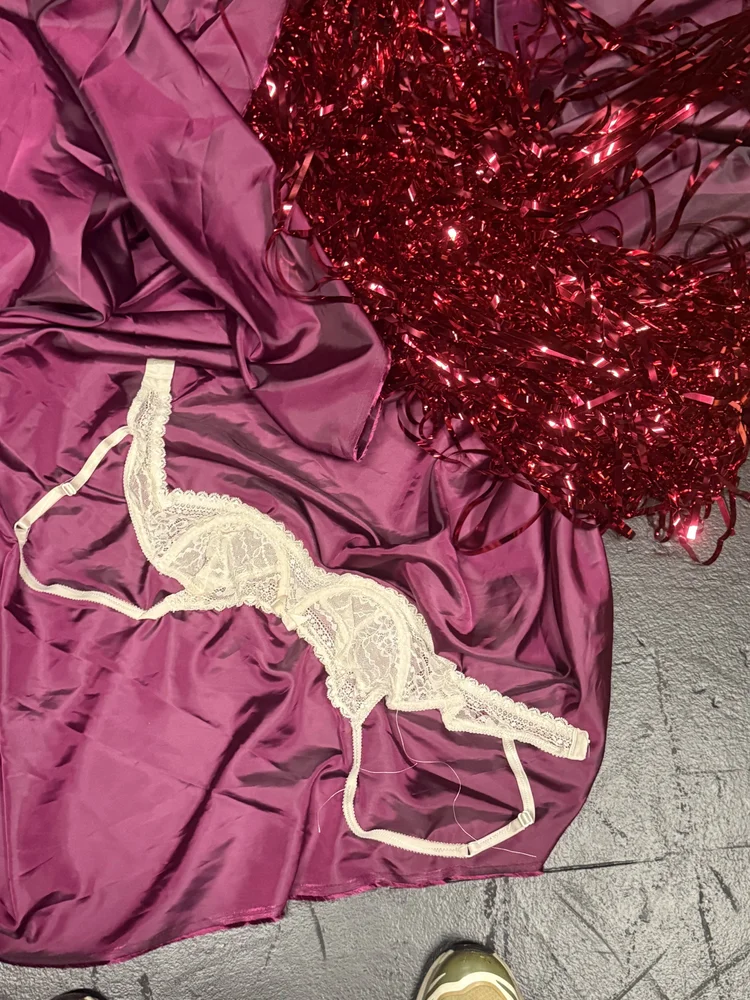
The play’s production design, by Madeleine Rubin-Charlesworth, had a Rookie Mag-esque charm and craft, with patchwork curtains and mismatched garments of bright and pastel hues that are staple to digital natives. I saw Petra Collins’ gaze in the disaffected gazes of the female actors, as they rotely described things they knew or had men explain to them things they knew more about. Vivian Farahani’s direction precisely matched this estranged outlook that contradictorily cares too much, though the spatiality (or more so the lighting or stage itself) often failed to communicate the temporal and geographic shifts Riess’ script so strategically lays out.
The play speaks greatly on and to the “baby woman” identifier, women young and spry who operate sometimes, usually in moments of miscommunication and stress, with the emotional intelligence of an elementary schooler, often as a result of generational wealth and the neglect that comes with that, amongst or alongside other Adverse Childhood Experiences. Alicia has unhelpful phone calls with her Mommy (Katie Honaker in a hysterical voice over), who would rather climb Kilimanjaro than parent. And yet, Alicia lives off their dime. This inherent financial security almost enables her neuroticism. After all, capital enables disorder by attempting to set a rigid structure of expected behaviors. Said rigidity almost always creates discord. Whether rich or poor, we aren’t wired for the culture our economic system has laid out, and everyone suffers as a result.
The thing I most appreciated about Riess’ storytelling and Farahani’s direction was not only their recognition of this state, but their critique borne out of the countless types of interpersonal failings that come as a result of this state. Young adulthood, at its core, is often the point in one’s life when one is forced to truly accept that one has no control, and to have any inkling of control one must sacrifice autonomy. Our economic system makes living inherently transactional, to the point that we must sell ourselves to be taken seriously. At one point, for example, Sarah Anne tells Alicia she’s feeling “fully saturated…Like you’re saying stuff but it’s like I’ve dissolved all I can possibly dissolve. Kind of on this topic and subject and kind of about you for the moment. I’ve reached full saturation and so as you’re sort of like throwing more solute my way it’s not like dissolving into me.” Sarah Anne’s point is fair, if not subtextually telling Alicia that to get the reassurance and relief she seeks, she needs to make a transaction, if not with a counselor than with her. This isn’t wrong, as a friend is not a therapist, but it is telling, as it confirms what many refuse to believe about capitalism; for it to work for us, we must allow it to take from us. Going Away Party explores how humanity is harmed as a result using a microscopic lens. This miniscule viewpoint reveals a much larger picture, one that often seems insurmountable but, seen through this fable, feels processable, an almost Shamanistic act for the troubled demographic that is one’s early-to-mid twenties in New York City.
The play’s conclusion, which I was relieved to witness at 11:30pm, is wise; Alicia nobly chooses self-reliance and a commitment to attempting to deal. She says (or maybe she didn’t, as the press script notes this line might’ve been cut) “I think my body is a vessel inherently capable of handling what comes its way.” Of course the body is a literal vessel tasked with carrying a variety of fluids, but are we truly, from birth, imbued with some quality that makes it all manageable? This conclusion takes a spiritual turn, as is often the type of turn that comes after turmoil, which, even though I do not agree that we are inherently capable of handling this world, makes the statement all the more true.
Leave a Reply