

Even after a multimillion-dollar renovation, with a new building promising improved circulation and improved exhibition space, the New Museum doesn’t seem to want to welcome the public. As I approached the building, I saw an older woman yanking on the front door, which would not yield; I saw a door on the side and held it for her as she shuffled around to it, passing an unsettling Sarah Lucas sculpture that evokes both a balloon animal and a female nude. Despite the labyrinth of stanchions to navigate in the lobby, I was the only person in line for tickets; the three people sitting at the desk seemed engrossed in something on their computer desktops, barely looking up to sell me a $25 ticket.
The inaugural exhibition, titled “New Humans,” promises to explore “artists’ enduring preoccupation with what it means to be human in the face of sweeping technological change.” Across four floors of galleries, we see upsetting amalgams of humans and animals, utopian urban imaginations, cyborgian wearable technology. It all feels very bleak. From a video installation by Hito Steyerl about the hidden and undercompensated labor that undergirds AI models to two galleries tracing the legacies of nuclear radiation in Japan, the show seems to show us a bunch of ways that technology dehumanizes us. Perhaps technology has transformed us all into something subhuman.
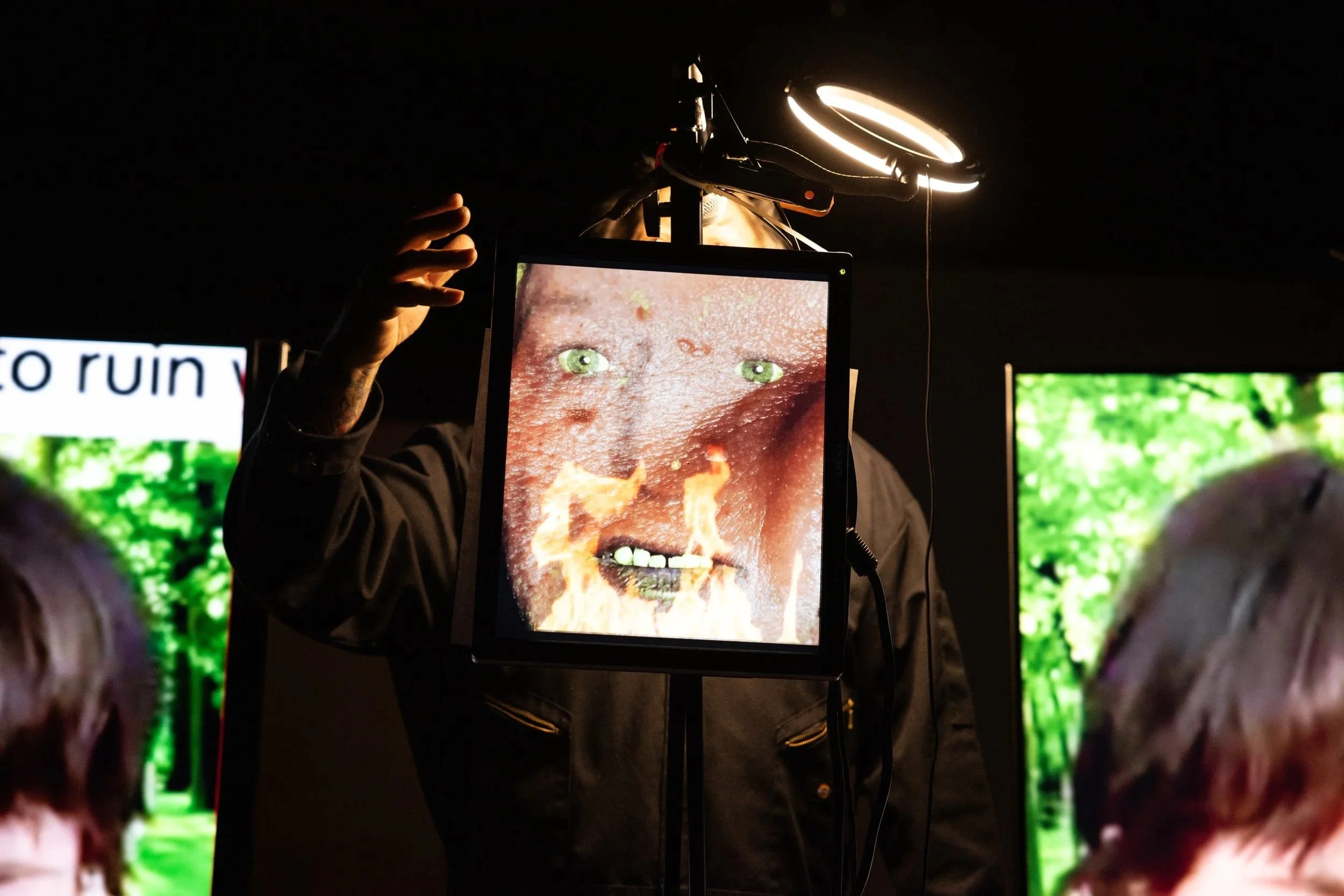
Later that afternoon, I walked over to Westbeth to see a show. In David Commander’s new show, Idiot Void, presented by Immediate Medium at the Collapsable Hole’s dank venue, one lone figure inhabits a post-apocalyptic bunker. Surrounded by a panoply of video monitors, he obsessively retells stories of a world teetering towards an untimely end. A landlord rents a laundry room out as a studio. An agoraphobic woman obsessively documents the noises her neighbors make. A frightening mold creeps along the walls and ceilings of an apartment complex.
Commander reenacts these stories with Barbies and Kens and a Calico Critters dollhouse, streaming their dramas onto the monitors. (Glowing blue before the show, they reminded me of my trip to the optometrist earlier in the day.) But just as soon as he introduces a GI Joe as a husband who lives near a lake or an elderly figurine as a person who dwells next to the building’s washing machine, he violently throws them across the room — one doll even got stuck in the ceiling rafters. The switch between human and object is flipped so quickly.
When not telling tales of civilizational decline, our lone hero tries to make contact with the outside world by filming TikTok reaction videos, a genre of engagement bait where “creators” point and make facial expressions alongside preexisting viral videos. He begs other survivors to let him know that they’re around by reacting to his reactions, but no one responds — excepting a meter maid filtered through AI.
It’s a bleak vision of a future where all that remains is plastic and digital detritus. At the end of Idiot Void, slowly the tech falls away: monitors go black, cameras power off, and we’re left just with the performer, screaming and crying — haunting, guttural, and pre-verbal.
In early press for the New Humans exhibition, articles usually led with a photograph of the Hall of Robots. The room has a magenta carpet that lends a cheerful futuristic pop of color to newspaper pages and website layouts. By the time I saw the exhibition in June, the months of visitors traipsing across its low pile had given the carpet a dingy brown undertone. As much as cultural commentators catastrophize about the “post-human” future of robots and agentic AI, there’s another side to that coin: something perhaps proto-human, constructed from flesh and breath and dirt, that must always linger alongside the sheen of our chrome-plated avatars.
Leave a Reply