
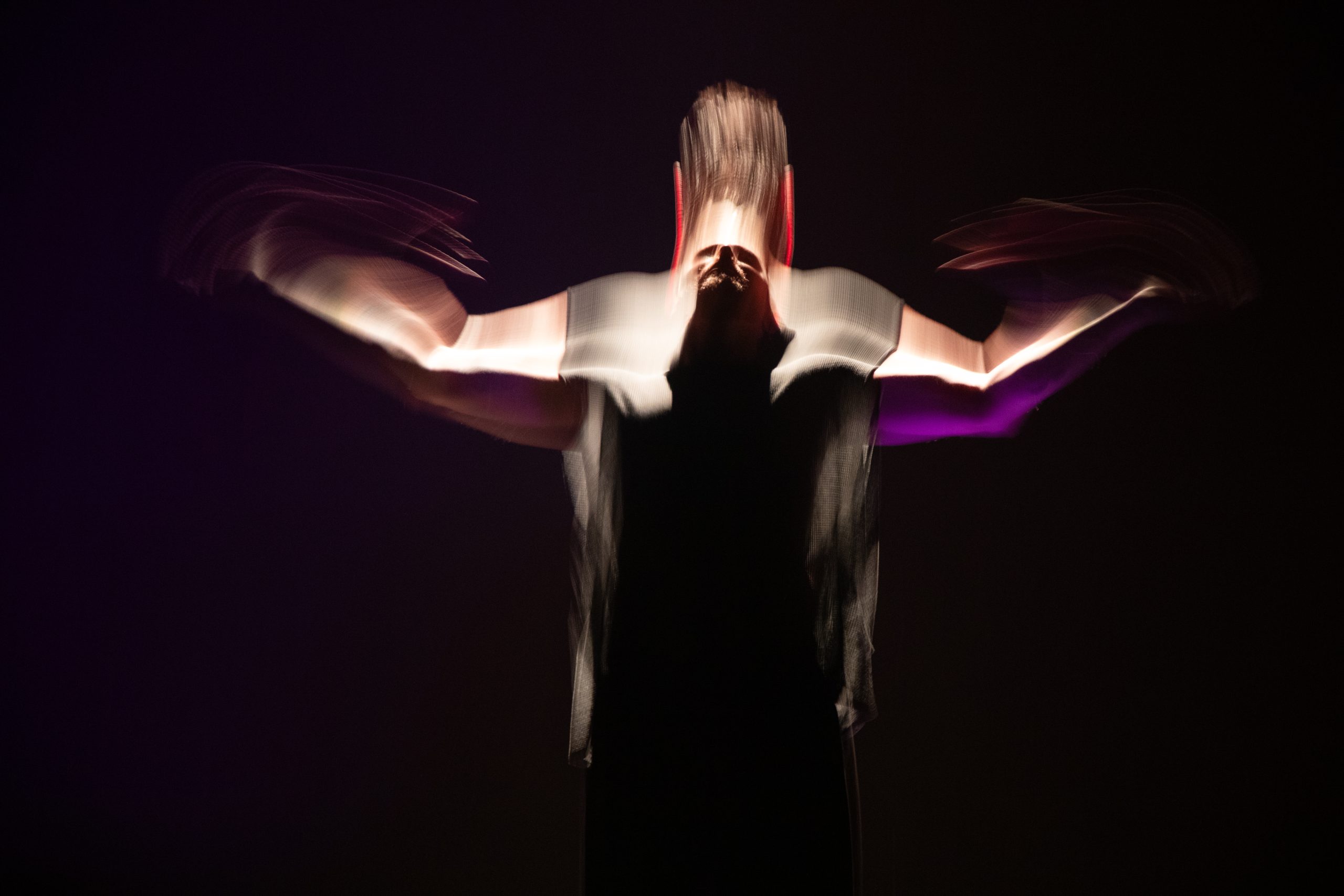

A blow of glitter initiates cheers from the audience. Silver confetti flies forward. Three inflatable kiddie pools of rainbow stripes occupy the center. Multi-colored followspots flash the stage corners in garish hues of emerald and pink as if summoning Cynthia Erivo’s aura. A thorny crown with battery-operated lights glows in the dark. It is as serious as it is camp. The cast of seven dancers prances into formation, moving through an exaggerated warm-up, dropping into splits, casually bringing the audience toward anticipation as tension builds. But toward what do we climax? Gathered in the intimate theater of Dance Place, a community-rooted performance venue in Washington D.C., the audience awaits the coming of this prodigal son–the inaugural recipient of DC Dance Network commission and the director, choreographer, and performer of Ceremonials, the latest evening-length work by dance-theater artist Brendan Drake. This maximalist opening foreshadows the hedonistic themes of the performance; Bakhtin would have much to say.
We arrive at a tableau of renaissance debauchery. The performance is not subtle. An ominous and oversized wooden cross takes center stage. Careful shadows refract it twice more onto the exposed upstage wall–a triptych of crucifixion, martyrdom, and celebrity acumen. The cast wears individualized fits: natural fibers with tailored pleats, athletic streetwear in iridescent sheen, purple cloth draped overhead à la the one and only diva, Martha Graham, remade as the holy Virgin Mary or perhaps Mary Magdalene, a double-strap thong featuring Javi Padilla’s exposed ass cheek. The scene is unmistakably a Grünewald remix. Dancers recline in disinterested postures, ensuring we absorb the offering. Absent is the lamb, however, in this Isenheim altarpiece. The sign of innocence and sacrifice, denied in Drake’s adaptation, hints at a refusal to cast the ravaged body in a premature victory of moral doing.
Ceremonials is not the first work to overlay Catholic iconography with queer, erotic, or debased imagery. My mind leaps from the recent hoopla induced by the drag reenactment of da Vinci’s The Last Supper during the opening ceremony of 2024 Summer Olympic Games in Paris including official condemnation from the Vatican, to Andres Serrano’s Piss Christ (1987) which featured photography of a urine-submerged cross and outcry from U.S. congress on the use of public funding from the National Endowment of the Arts, to the more vintage Sancta Susanna (1921), a one-act opera by Paul Hindemith and August Stramm that featured a scene in which a nude nun clutched a crucifix and spawned debate on the competing themes of religious devotion and erotic acts.
But from within this saturated landscape of sacrilegious art, Drake emerges with an edge: his thesis, it seems, is not simply to expose the queer desire laden in the homophobic veneer of Christian dogma, nor to fingerpoint at its violent exclusions. Rather, Drake invites viewing into the private ceremonies of pleasure in our lives carried out in semi-public spaces. The pacing is slow, confident. Drake does not apologize, gleefully creating as if to say, I don’t see anything sinful, do you? By tasking the queer body with supplanting iconic Catholic imagery, Ceremonials is not (simply) overwriting a long history of erasure. When the queer, vulgar body occupies the central cross, Drake nudges us toward a more nuanced question: whose pain, whose martyrdom, whose bodily expense gets to be celebrated, made holy?
Elsewhere I ponder the distinction between nakedness and nudity before the law, a distinction that art historians appreciate for the Eurocentric aesthetics of Man but that legal frames ignore when addressing cases of obscenity and indecency. Drake provides a partial rebut. What tumbles from this overt tableau are scenes of undeniable pleasure, virtuosity, and exhaustion. The cast descends into twerks, undulations, violent but beautiful ripples of the spine on all planes. In one moment, Drake vibrates alone, his spine surging with quiet precision as he performs an understated and virtuosic hand-job on a ghostly partner. There’s a spit slap upstage that you miss if you blink. Jaws fall open wide. Distorted, abstracted, and performed through the disciplined bodies that concert dance technique inevitably produces, these gestures arrive without sexual charge. Instead of fetishizing a world of hypersexualization, we’re invited to view these rituals with the reverence of an oil painting that similarly presents exposed genitalia, proximate bodies, and divine moments of ecstasy.
A duet between Drew Scammell and Sydney Goldston arrives just as we think we might be watching ill-made dance-theater where anything goes. The quiet unison holds just enough formalism to force the audience to view in awe. A third body begins to shadow another dueted movement in an upstage doorframe. If the clunky “I didn’t see you there” first announced a soliloquy recited by Amanda Hameline, Drake reveals himself as otherwise fluent in soundscapes through the movement tableaus he richly offers. Choral voices climax and fall away to a repetitive beeeeeeep. Heavy breathing from the dancers’ exhausted forms replaces an organ’s pipe sounds. In a rare solo moment of the evening as the lights dim toward a magenta halo, Drake expands his belly as if pregnant, then sucks in as he undresses. The silhouetted moment sears, ripe with implication.
In the final scene, the inflatable pools return. Ceremonies are cyclical, are they not, made to be done again? In the return, however, the bodies find new extremes. A singularly exposed nipple is drawn toward the audience. A performer drinks a milky liquid from a bowl while crouched on all fours; perhaps we all pleasure in lapping at the edge. The cross, again center stage, is turned upside down. Two masc dancers, now nude, are tied to this altarpiece, and perform a subversive intimacy as they caress and violate. Their bare abdomens press into the stake, lips to the wood in a slow make-out session. Others lie prone in the pools, including Drake. Our savior Padilla, still in the thorny crown with cheap lights, drapes a string over him. He carefully ties one end to his choker, the other around his cock, to be led submissively away. In the end three performers rise to their feet, full frontal, one in each pool, only to be bathed in femme sanguis. Crimson fluid streams down.
When society is quick to crucify pleasure, what is left to stand?

Leave a Reply