
Stacy Grossfield in conversation with Leah Plante-Wiener

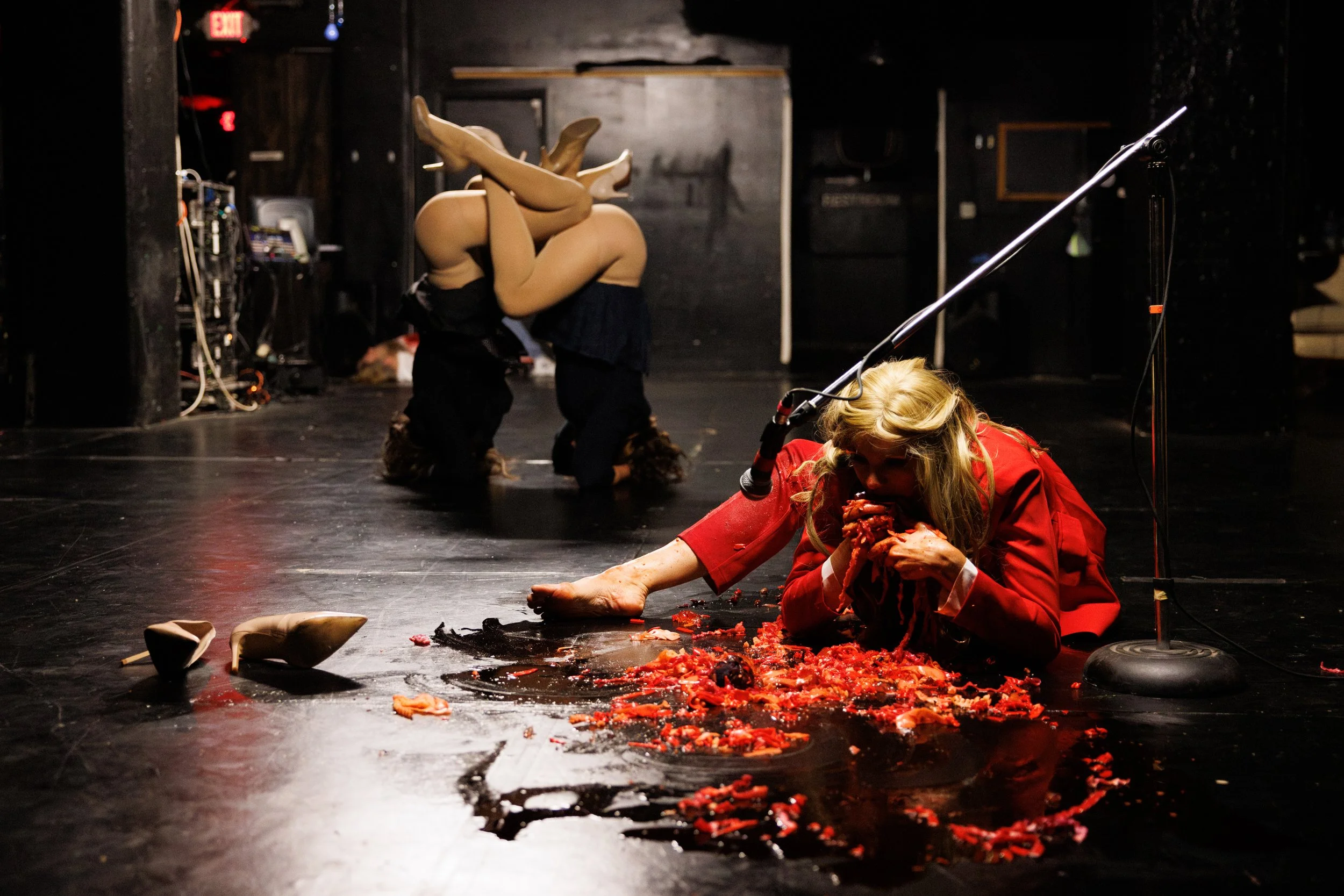
metamorphosis III burrowed into the Collapsable Hole with gnashing teeth and scraped knees. The freaklet brainchild of choreographer Stacy Grossfield, the dance theatre saga unfolded in four episodes between August 2025 and February 2026, wherein dancers Alexandra Albrecht, Nola Sporn Smith, and Hannah Franzen crawled, tumbled, wrestled, and dragged one another through a blood-slick landscape mutating into increasingly surreal versions of itself. metamorphosis III rapidly accrued a squadron of dedicated pilgrims eager to witness Grossfield’s dream logic concoction regenerate, and thus became a periodic communal ritual for many of the downtown set. The final episode brought about the end of a brief but mesmerizing era. To me, the loss was palpable.
On the occasion of the first anniversary of episode one of metamorphosis III earlier this month, I revisited a conversation I had with Grossfield in the spring.
Leah Plante-Wiener: We are two months out from the last episode of metamorphosis III, and I’m haunted by it. I want a crash course in metamorphosis. I know that you did metamorphosis 2 a few years back at the Chocolate Factory, and you were working with the same dancers, for the most part.
Stacy Grossfield: I didn’t know I was going to make a trilogy. I had no idea, but even just the word metamorphosis– this thing is going to keep transforming. I feel like this happens for a lot of people. You keep on working on the same thing, and it keeps metamorphosing.
We started metamorphosis at the Kitchen in 2019. I had started working on whatever that was going to be with Alex and Nola in 2016, but then I got pregnant with my first. We ended up doing metamorphosis in 2019, and then we did a bit of it in January 2020. Everything was looking very exciting, and then it stopped. It was awful.
I had been talking about a Chocolate Factory show with Brian [Rogers, artistic director of the Chocolate Factory] for years, so that was finally happening in 2024. I had loved working with Alex and Nola, but I didn’t want to do that same 2019 piece. We had kind of done it, but we didn’t do it, and I wanted to do something that felt in the mindset of where I was, and of the time.
LPW: I was at the last episode with Laia Comas, and she said that metamorphosis III “feels like the world”. That was something I was thinking about every time I saw it, especially with the last one, where it’s like, and the lady in the red pantsuit was Erika Kirk! It’s a fever dream distillation of what I see on my phone and the way it makes me feel crazy. The discombobulation, the violence, the fetishization and commodification of bodies, it’s all there.
SG: With the Chocolate Factory show, I was feeling a lot of sadness. I was feeling that in the next project there was going to be anger. One of the first things we did for metamorphosis III was the fight.
LPW: What’s thrilling about watching Alex and Nola whaling on each other is the tension between how highly choreographed the work is and the constant feeling of danger. They’re slamming into each other, they’re slamming into the walls, everyone involved is covered in bruises.
SG: I didn’t want to rehearse it.
LPW: Awesome.
SG: It wouldn’t feel right. Alex and Nola also didn’t want to rehearse it, and I was glad that they were fine with that, that they felt safe with each other. We set a couple of moments to define the end of that part, like, you throw her to the floor and get on top, and she kicks the wall. I also didn’t want to rehearse it because I didn’t want them to be getting hurt in rehearsal. I was like, if you’re going to get hurt, let’s make sure that people are watching. Make it worth it, you know?
LPW: [extensive laughter] Oh, man. Yeah.
SG: I didn’t want them to actually get hurt, but I kind of knew they would, and they did. They got hurt the most after episode one, when there was the most adrenaline, and then they understood a little more, and it didn’t happen the same again.
LPW: You really trust and honor the agency of your performers, who, as dancers, are people whose entire careers are based on this hyper-focus and vigilance of the body. That’s something that’s so present in metamorphosis III–the damage these bodies are enduring, especially Hannah Franzen, who is throwing herself down the stairs over and over again. It seems like there was a teamwide understanding of the physical pain that was going to inevitably happen.
SG: I would ask them to try things, and I got lucky that they would do it without having any hesitation. I chose people who know how to take care of themselves but are interested in pushing themselves beyond what’s comfortable, which is what’s interesting to me. I’m obsessed with discomfort. I think that life generally is uncomfortable on so many levels. I’m aiming for life in between the art, and art between life, where they have that sameness of sensation.
LPW: You also create that in your audience, especially in the pre- and post-show moments staged outside in the Westbeth courtyard. I’ll never forget the first time I arrived, and these two women in wigs and sunglasses were fighting and smoking cigarettes, and there was an inflatable pool, or the moment when Hannah first sprinted at the audience at full speed and we found ourselves folded into the show. You’re defying regular audience expectations of showing up and being told where to go, being told where our bodies belong. Talk to me about these outdoor preludes and epilogues.
SG: I was interested in not confining the whole piece to the black box. I love that outdoor area. It started looking worse and worse as the months went on. All this scaffolding went up between episodes one and two, so I just had to go with it. I had this vision of the kiddy pool and how crazy it would be to have a fight in it. I liked that it was harkening to the fight that you would see inside.
For each of these episodes, I was trying to create more information while staying in the same world; expanding the worldbuilding. Like, next time, I want Hannah to be outside, and I had this vision of her with this blood on her back, and I made up this story that she fell from one of the higher places because she was shot—but she’s not real.
LPW: She’s a machine.
SG: She’s Westworld.
LPW: The episodic nature of the show means that every new detail recolors your understanding of the prior episode, like the knowledge that this woman is a machine. There is something machinelike about her the entire time: the blank stare, the way her body moves like no other. Then, we hear that whirring sound coming from her at the top of episode two, and she’s walking into walls like a glitching video game character, and it’s like, of course she’s a machine. She’s this fembot, which, on the topic of having your finger on the pulse, feels so of the now. I mean, we have sex dolls with artificial intelligence programmed into them now.

SG: metamorphosis 2 had twelve performances, and I was there every single time. After a certain point, I was thinking, I love this piece, but I also wish I could change it. Add in some other information. Right when I was thinking about making the next project, David Lynch died, and I was thinking about him. I wanted to make an homage, and something that’s in episodes. He is such an inspiration.
I’m glad that Jim Findlay at the Collapsable Hole said that I could do this crazy bit where I do four different shows. Then I thought about it: how am I going to add information to make four evening-length works? I think that to make episodes of a dance piece, it doesn’t need to follow logic like it would for television. I needed to have things repeat, knowing that not everybody was going to see all four episodes. I had things repeat, but then they would change, and how they would repeat would change. Things would begin to overlap, which offered really interesting information into what you were seeing. The first time you saw pieces of the original metamorphosis in episode three, that was overlapped with Hannah eating the internal organs.
LPW: That was legendary. You’re looking at the organs, like, what is that? Hannah told me what it was. There was purple sweet potato, tomato sauce, cold noodles. I have a particular obsession with grotesque eating onstage. I felt really seen watching Hannah eat. Like, this is for the girls who love to go onstage and reckon with their eating disorders by eating some nasty shit in front of everyone.
I have to ask you about using dialogue from Industry for the Alex and Nola fight, which I didn’t realize was the case until we received that piece of paper with all of your references at the end of episode four. That felt like a reward, to be able to track the references throughout the series. You have Industry, that one video of the Russian guys doing the dance. I’m interested in your media consumption habits at large.
SG: I’m on Instagram too much.
LPW: This is the work of a woman who hangs out on Instagram Reels.
SG: I’m interested in making work that is a collage. I don’t think about collage as, when you’re sitting down with pieces of paper and fabric and all these different objects, you’re handmaking your material.
LPW: You go to Materials for the Arts and you pluck it out.
SG: I’m arranging these found pieces, and the way that you arrange them brings the meaning. It still feels like visual art to me, in the way that the viewer can make their own meaning. A lot of the times when things are arranged in time, especially if you have text, the meaning becomes extremely clear; it is one thing. I’m not trying to do that. I’m trying to make something that is free to interpret.
LPW: This refusal to spell it out for your audience also speaks to a trust in your audience’s intelligence, which I think is absent these days.
SG: In metamorphosis 2, I brought in ballet, which I actually choreographed. For metamorphosis III, I wanted modern dance, so I found the modern dance material. It became this thing where I’m like, I want these things to happen, but it’s not important that I actually make them. The thing that’s important is that they exist, and that they’re very pure. I’m not going to make my own version of them. Then, I was interested in having you feel like you’re in this kind of performance, then it gets completely interrupted. You’re experiencing different kinds of performance, and they start to overlap, and overlap more as the episodes move forward.
LPW: The destabilization of recognition, of giving your audience something that is familiar like ballet and classical music, and then interrupting it with the piece regenerating itself before our very eyes plays against what we get so often in performance. We’re lulled into a sense of familiarity, and then the audience gets to rest on their laurels the entire show. They know the form and what to expect, but you’re denying them that.
At the same time, though, you are creating your own form that audience members who are able to attend every episode become very finely attuned to. I asked you after episode two about the difference between the first and the second episodes, and what you said to me was, we did it backwards. You’re creating this form, but then you’re putting it on its head. You’re building this familiarity and scrambling it, breaking it, rebuilding it again.
SG: Between episodes one and two, I had very little time, and then I thought, let’s just try this. It’s in reverse, but the music order stays the same. When we tried it, that was it. It changed everything. Even though it’s all the same, it was completely different.
LPW: It’s very Lynchian, the pairing of time going forward with action going backward.
SG: At the end of each episode, something new gets introduced. At the end of episode two, we introduced Hannah in the red suit, and she only had two lines. For episode three, we picked up where we left off. I told the performers, we’re gonna act as if you never left the theatre. So, Hannah has been stuck there, and her character took it to the extreme.
LPW: The implication is that she ate Gordon [Wells].
SG: Yeah.
LPW: A girl’s gotta eat.
SG: That’s why his body was shoved up in the back.
LPW: Because he’s disemboweled, and that’s not nice to see.
SG: Episode four, in February, starts with Hannah in the front window of the Collapsable Hole. I couldn’t use the outside, but I could use the lobby area. The idea was making Hannah more of this inhuman female figure, which is obviously also a mannikin. The inspiration for that came from this window I saw in the Upper East side. I took a picture of it and showed it to Hannah, and I was like, I think this is you in your underwear. I had to find a fur coat. I was obsessed with her wearing a fur coat.
LPW: It’s all so Epstein. Young woman wearing a fur coat, almost naked in a storefront for everyone to ogle at. Again, it’s the finger on the pulse; this is what we’re seeing on the news, the conversations we’re having, and here it is become flesh.
I think that for a lot of people, discovering Hannah Franzen for the first time was an event. She’s incredibly talented. She’s hypermobile, she’s got crazy stuff going on with her joints. She commits so hard. How did you find her?
SG: She was in metamorphosis 2. I held an audition, which I’d never done, because I needed ballet dancers and I needed them to be different ages. When I did the audition, there weren’t that many people who had ballet training, even if I wrote it in the listing. Hannah was the opposite. She had a lot of ballet training and stood out like a sore thumb. She was incredible. She was unbelievable. I emailed her, and it felt like forever, but I realized it was just a few hours before she emailed me back. I told the woman helping me run auditions, I don’t know what I’m going to do if she doesn’t want to do this. I need her. Then Hannah said the exact same thing. She was still in college, so she wasn’t even supposed to be doing outside projects. We didn’t work together very much for the Chocolate Factory show, but I immediately knew that I could try things with her and that she’d take it to the next level.
LPW: She will throw herself down the stairs.
SG: It was the same with Nola, when we first worked together. She just did an extra part, in a piece where I had a herd of twenty-something people crawl across the stage half naked, and I remembered her.

LPW: Having Dead Tooth be part of metamorphosis III was awesome.
SG: I knew that I wanted to have a live band. That’s also a David Lynch thing, in some of his work. If I could have had this as a multi-million dollar production, I would have a different band for each episode, but I love working with Dead Tooth. They’re so smart and they ask such great questions. I had them learn “Damaged Goods” by Gang of Four.
LPW: [singing] Sometimes I’m thinking that I love you…
SG: I had them only play Dead Tooth songs when the audience wasn’t in the room.
LPW: The aural experience of waiting in the Collapsable Hole lobby and hearing this rock concert going on behind the door–the work that that did to create physical anticipation was really crazy. I’m standing there, and I’m like, why is my heart racing already? Let me in!
SG: There was a lot of excitement in that. There was also some intimidation. I feel intimidated when I hear that something’s really loud before I’m about to go in.
We didn’t have the band for episode three. It was originally scheduled that way, because they were going to be on tour in October. My fun task was to figure it out with Jeremy [Kadetsky], who did sound design for all the episodes, and I loved that change.
LPW: In episode three, the music that we had heard live the first two times being piped in through the speaker was such a particular sensation. There it is, there’s Dead Tooth doing Gang of Four. That was a special moment.
In a funny way, the band is the most quote-unquote “real” element of the show. Their degree of reality is closest to the audience’s. They end up having an anchoring purpose, but then they leave.
SG: In episode four, I felt like I needed to acknowledge that they weren’t there in episode three. I wasn’t sure if the band came back, but I did want to have a feeling that things ratchet up for episode four, and that if I wanted to have a rock sound, I didn’t want it to be recorded. The acknowledgement is that they’re in episode four a little bit. They play before the audience comes in, and then the doors open, and it’s just silence.
LPW: It’s scary.
SG: It was dark and quiet when you actually walked in.
LPW: The expectation isn’t only that because you’re hearing rock music behind a door, you’re going to walk in and Dead Tooth will be playing live, but the expectation is also that that is what will happen because it did in episodes one and two. That’s the reality you created for the show. In episode four, it’s like… Where did they go? We’re just thrown into the work. It was striking.
SG: We didn’t talk about Erica Kirk at all.
LPW: We didn’t talk about Erica Kirk!
SG: She was in there.
LPW: The second I realized Hannah’s monologue in episode four was the Charlie Kirk eulogy, I gasped. I was so shocked by that, but here’s this blonde woman with the Erica hair and a pantsuit. Of course it’s her.
SG: I wasn’t intending it to be her from the beginning, but once I realized that was the text we were going to use, it completely fit, because the piece is going through time. It’s showing you Erica before, who she was in her past.
LPW: A robot from Westworld, famously.
SG: Going out on the town scantily clad.
LPW: There’s this corner of the Internet where people get a kick out of pulling up Erica’s Instagram pictures from 2014, when she was a party girl.
SG: I’m totally into that. Like, why are you pretending? The pictures aren’t going anywhere.
This interview has been edited for clarity and length.
Leave a Reply