
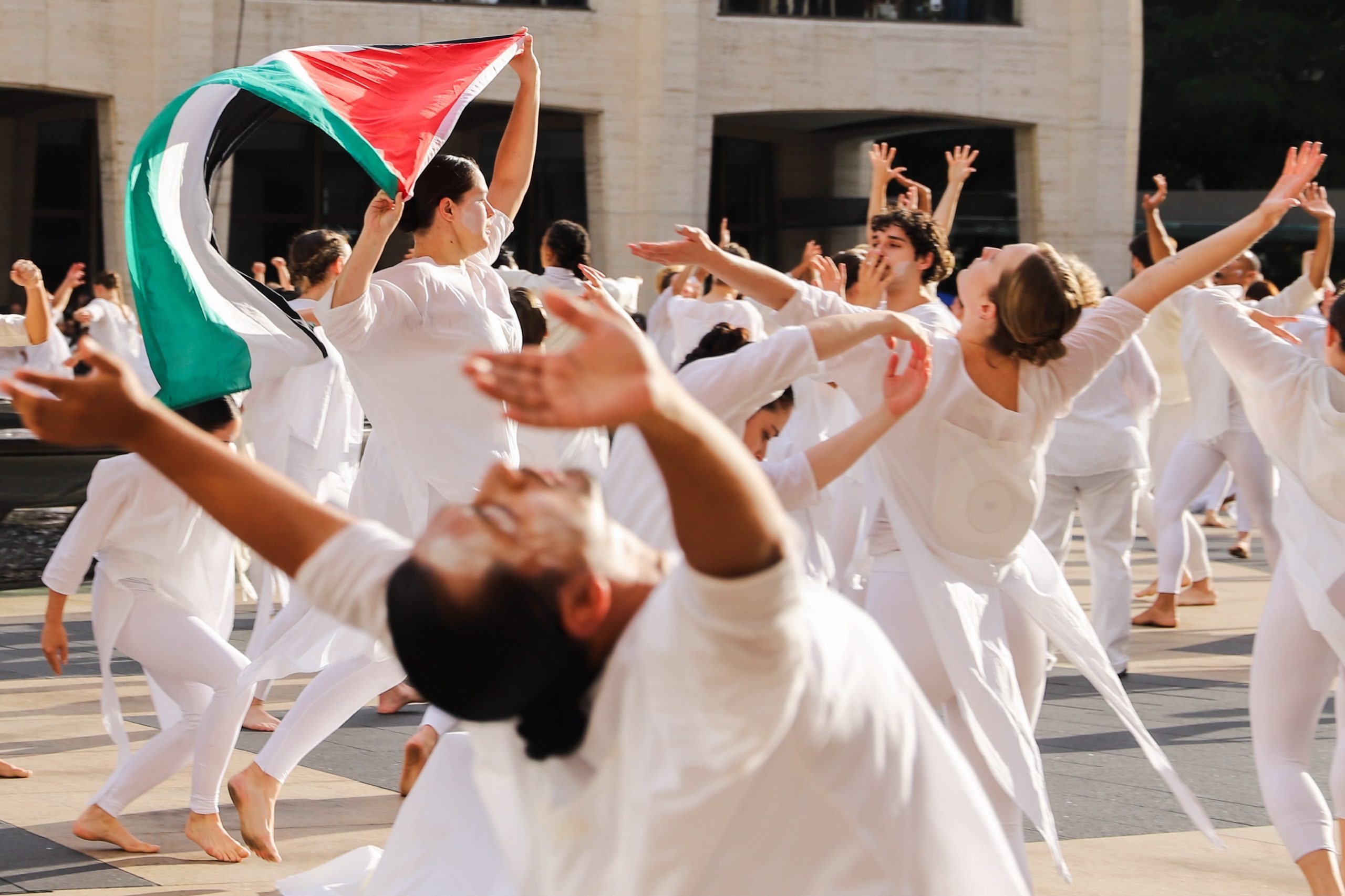

Since 2024, Dancers for Palestine (D4P), the autonomous organizing group advocating for a dance field that is more in solidarity with the liberation of and less complicit in the oppression of Palestine, has appeared, uninvited, at Table of Silence Project 9/11 (ToS). ToS, for the uninitiated, is a dance work choreographed by Jacqulyn Buglisi and performed every year in the Lincoln Center Plaza on the anniversary of the September 11th attacks. Everywhere that ToS is marketed, it is described as a “global call to action for peace.”
As D4P makes clear in its Instagram posts, the activations are not exactly a protest, but they seek to recognize the “lives lost to war, colonial violence, and genocide, rejecting how the trauma of 9/11 has been weaponized to justify US military violence for the last 25 years.” D4P actively and publicly opposes specific imperial war and violence, going beyond the general message and aesthetics of “peace” that ToS offers.
Were ToS solely claiming to be a tribute to the lives lost on 9/11, D4P wouldn’t be showing up, and I wouldn’t be writing this article. But given the performance’s stated goal of “commemorat[ing] the loss of life and honor[ing] the bravery of all individuals affected by acts of terror, war, and oppression,” I thought it was time to analyze this long-running performance ritual on its own metrics.
“Worldwide peace” without Palestine
The scale of suffering in Gaza for nearly three continuous years would be unimaginable and unbelievable had it not been thoroughly broadcast to the world. Israel’s indiscriminate destruction of infrastructure, including hospitals, has made it impossible to accurately count the dead. Palestinians who survive Israel’s aerial attacks are subjected to what Amnesty International has described as a “slow, calculated death” produced by Israeli-imposed starvation and disease. The United Nations, Amnesty International, and the vast majority of genocide scholars agree that Israel is committing genocide. Crucially, our American tax dollars have and continue to fund these atrocities, making each and every American taxpayer, however unwillingly, complicit in unspeakable violence.
Since Israel’s current onslaught began, Buglisi and her team have gone forward with ToS as in all previous years—claiming to seek peace while offering no acknowledgement of specific wars or violences in the current world. The cognitive dissonance required to call for peace while systematically ignoring global calls for solidarity with Palestine is shocking.
Some explanation for Buglisi’s broader conception of “peace” comes out of a specific political framework based in 20th century US foreign policy. In a 2019 episode of the podcast Movers and Shapers, she speaks fondly of her time as a dancer with the Martha Graham Dance Company participating in State Department-supported tours. These Cold War-era tours were an explicit strategy of the US to establish cultural dominance abroad, especially in countries with growing communist movements, and sometimes following CIA-sponsored regime change.
Buglisi enthusiastically endorses this project, celebrating how she got to share “the beauty that is America: liberty and freedom for all people.” Perhaps admirable in theory, these values are not an accurate reflection of America’s behaviors now or then, when they readily supported authoritarian governments deemed strategically helpful in undermining the USSR.
Also in that podcast episode, Buglisi highlights a key historical moment as her peacebuilding inspiration, and it’s one that specifically and tellingly excludes Palestinians. She recalls the Graham company’s connection to the 1979 Camp David Accords, the US-facilitated agreements between Israel and Egypt that normalized relations between the two countries, outlined the future of the Palestinian territories without any Palestinian presence, and neglected the establishment of a Palestinian state and the long-promised Right of Return. These decisions were rejected by the UN General Assembly and widely considered an abandonment of Arab solidarity around the Palestinian cause.
Buglisi recalls the Graham company having dinner with Egyptian president Sadat and traveling “on the first AirForce jet that went from Cairo to Israel.” She remarks uncritically, “it was an extraordinary time to be cultural ambassadors… from America to the world, and advocating peace, just what I continue to feel strongly about.” As a “peace advocate,” it’s remarkable that Buglisi seemingly has no critical analysis around America’s historic or current role in global war and violence.
Lincoln Center’s Institutionalized Complicity
Lincoln Center’s highest dollar donors and sponsors include many individuals and organizations deeply complicit in the genocide in Gaza and in imperial violence worldwide. As researched and catalogued by the New York Counter Film Festival in 2024, those individuals include David Rubenstein, founder of the Carlyle Group, which invests in defense contractors manufacturing the aircrafts carrying out air strikes in Gaza; Stephen Ross, founder of Related Companies which has sold $1+ billion in bonds to investors in Israel; and David Geffen, Kathy and Mitchell Jacobson, Bill Ackman, and Steven Swartz, all major donors, material supporters, and outspoken advocates of the Israeli government and the Zionist project. Corporate sponsors include Bank of America and Morgan Stanley, with over $10 billion in shares and billions in loans to U.S weapons manufacturers including Boeing, Lockheed, General Dynamics, and Northrop Grumman, all of which produce weapons for Israel; and BNY MELLON which houses the fund for the Friends of the Israeli Defense Forces and holds $11.6 million in Elbit, Israel’s biggest weapons supplier.
Lincoln Center also has a rich history of aggressively removing peaceful protestors from their grounds, as in December 2023 when over 30 protestors of Lincoln Center’s complicity and financial ties to Israeli war crimes were met with violence from Lincoln Center security. Protests of these same complicit board members and financial ties during the Occupy movement resulted in Lincoln Center instructing the police to completely clear and barricade the plaza, with protesters reporting police aggression and violence as they forced them out.
D4P’s presence at ToS has been met with similar antagonism. At 2024’s performance, D4P organizers laid paper poppies, a symbol of Palestine, around the plaza fountain to tie the performance’s message to Palestinian lives lost. When these individuals put on keffiyehs, Lincoln Center security approached and removed them, including by grabbing and forcibly moving D4P members who were voluntarily complying with their instructions.
In 2025, D4P created a silent dancing memorial for Palestinians killed, much in line with the symbology of ToS itself. As they voluntarily exited the plaza with ritual movement, Lincoln Center security followed, physically handled some dancers, and barricaded the space to prevent their reentry.

Requirement to stay “apolitical”
As anonymously shared with me by a member of the 2026 ToS cast, this year’s dancer contract includes the following language:
I agree that this performance is a prayer for peace for all people, and in regard to Lincoln Center’s privatized space, cannot be used as a platform for any political, ideological, partisan, extremist or purportedly apolitical agenda. I agree to respect the sovereignty of Lincoln Center.
In the context of Lincoln Center’s political and financial ties, it’s not surprising that Buglisi is demanding neutrality on behalf of the center. However, the bizarre phrasing of “The sovereignty of Lincoln Center” makes it sound like a UN-recognized state instead of an institution that, like any nonprofit, should be accountable to the artists, audience members, and communities who it claims to serve.
The statement confirms that the only “peace” this event advocates for is an entirely apolitical one, making it entirely ineffective since ending violence requires political action. The phrasing of disallowing “purportedly apolitical” agenda is particularly ironic given that Buglisi and Lincoln Center themselves are purporting that it’s possible to run an anti-war, anti-violence event that somehow remains totally apolitical.
“Peace” without politics/vibes without analysis
The dance field, and the arts more broadly, often eschew critical analysis in favor of aesthetic comfort. A peace-related symbology and atmosphere may be pleasant, but how does it actually contribute to a more peaceful world? I don’t think the reason we haven’t achieved world peace is that we haven’t realized how pretty and calm everything would be without war.
Vague advocacy for “peace” that explicitly rejects and disallows analysis of the power structures, inequities, and histories that create violence has no material impact on the world other than to soothe the largely safe, comfortable audiences who encounter it. ToS does not raise money for anti-war causes, spur its audience to any specifically peace-striving actions, nor engage with any ideas about the causes of war or its potential ends. Not every dance performance needs to include these things, but surely one that, through its timing, ties itself to a specific legacy of US/Middle Eastern conflict and, through its public messaging, claims to promote some sort of resolution, should not categorically reject the possibility of material advocacy.
The philosophy of ToS is a common one in dance and the arts more broadly. Gatekeepers and long-time powerholders simultaneously claim the power of art to “unite all mankind into a single force with common goals and aspirations regardless of race, culture or religion,” as Buglisi’s website phrases it. Then, in the same breath, they reject the idea that if dance and performance really are that powerful, then they have a sacred responsibility to educate and advocate.
At D4P, we agree that dance can be a force in the world that cuts across lines of difference. But not every force is beneficial. From the US State Department Tours to Israel’s current artwashing efforts, dance and art can be a force for imperialistic propaganda. Dance can also be a force for complacency, as ToS models, bringing together over 100 mostly unpaid dancers, scores of audience members, and countless resources over the years so everyone can ultimately pat themselves on the back for creating and watching a pretty show.
As Kwame Ture said in 1969, “there’s a difference between peace and liberation… You can have injustice and have peace… so peace isn’t the answer… liberation is the answer.” And how about this, from someone that I imagine the Buglisi-adjacent reader would view as the pinnacle of activism, from Martin Luther King Jr.’s 1958 memoir Stride Toward Freedom: “true peace is not merely the absence of tension; it is the presence of justice.”
If we truly want peace, we must be rigorous and clearheaded in identifying those worldwide who suffer at the hands of imperial, colonial, criminal war, violence, apartheid, and genocide, and in condemning those who cause it. The aesthetic silence of Table of Silence does not necessitate the political silence that neuters the work’s potential as catalyst for peace in the world. That silence, on Palestine and beyond, echoes loudly.

Leave a Reply