
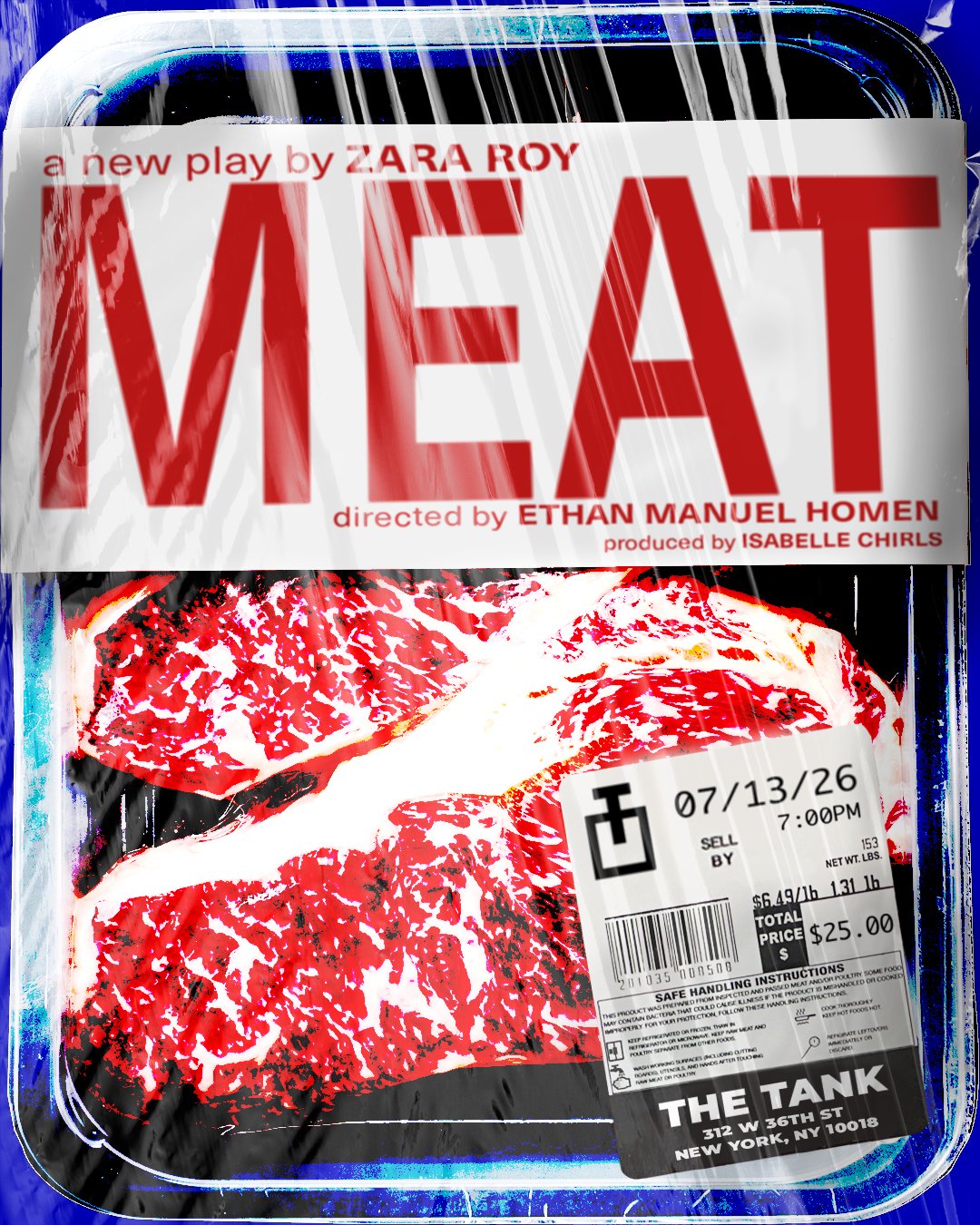

Just when I thought the 9:30PM curtain time was simply a distant tiring memory, I was heralded to its motherland, The Tank, to receive its curse. Once again, thankfully, it was a blessing in disguise. The performance that Thursday night was set in and around West Texas meatpacking in the mid 2000s, a time during which said industry in the U.S. came to be controlled by the “big four;” Cargill, National Beef, Swift/JBS, and Tyson. Said conglomerate control cost countless individuals nationwide their jobs and livelihoods. In 2013, the Cargill plant in Plainview, Texas shuttered its doors, leading to two thousand jobs lost and 15% of the city’s workforce taken out.
MEAT tells the story of Ham (Leo James Osborn), a meatpacker at a similar plant in his early 30s, at a crossroads in his life, forced to review the cards he’s been dealt whilst striving for something more. He works with Jim (Carolyn Best, an emergency cover for this role), a veteran in his fifties quite satisfied with the sum of things. Ham’s escape is Diane (Kate Benson), a woman in her sixties who is exceedingly normal yet entirely free-spirited and unselfconscious—everything that Ham currently lacks. Through Diane, he sees a motivation to get what he wants, whether that’s a promotion or a new job, but is so stagnant that he struggles to overcome and break out of the cycle he exists within. And it’s not like he’s the first in his bloodline with this problem; his mother (also Benson) died giving birth to him on the same factory floor he now works twelve hours a day, working right up until her last moments.
The spatial design of said floor, by Sean Lillis, was a feast for the eyes—fake meat carcasses made canny beyond the fourth wall thanks to precise fabric detailing and the arranging of buttons, zippers, and other textures to give the impression of veins and fat, signs of life lived. When Ham and Jim work, they pull sheets of red fabric from a carcass, snipping with the precision of a seamster, just to let the pieces pile up, even fall to the ground. It made me think of the ways in which the materials Lillis and costume designer Jack Wallace assemble and disassemble are destroyed globally, entirely disposable, along with those who create them and their conditions for existence. It made evident the disposability of those inhabiting the space, a sense that drives the plot of the play.
As Ham, Osborn is always morphing, constantly surprising but strategic in tackling a modern tragic hero, especially one who is not necessarily a hero for what he’s done, but rather what’s been done to him. As his bothersome yet well-intentioned coworker, Best is extremely funny.
There’s a lived-in, well-crafted imagination enabling Best’s performance, one of necessity and affection, that sincerely moved me, especially in her last moments onstage; the juices of a fake pink steak dripping from her hands, hands of a jaded libertarian with a good yet wily heart. Kate Benson is comfortingly uncanny as two very different women coming from similar circumstances—in her more fleshed out role as Ham’s eHarmony lover, she is quick and pointed, at times warm and disarming even as she slips into interrogation and dread.
When googling meatpacking plants and related factories, they are usually termed in maps as either “meat processors” or “chemical plants,” which both sound very different from packing meat. Director Ethan Homen (also artistic director of the producing company Write Club, a fruitful hub of and for young dramatists) seems to have staged the play with these descriptions in mind. The story itself is a process of remembrance, revolt, and reconciliation, compounding in a way that is unexpected and confounding. Its most absurd moments come off as most truthful to the lived experiences and circumstances of the characters, and Homen stages their moments and memories with a risky care that often pays off, most clearly in a quite cleverly staged sex scene that hysterically utilizes Lillis’ set. It is all very human and, most simply, fleshy.
Zara Roy’s script is an assemblage of purely American hopes, and the superstitions and rituals we’ve created to convince ourselves that they can come true. The regional manager (also Homen, funny yet earnest in the humiliation ritual that is acting in your own work due to unforeseen circumstances…who was his dialect coach?) reads off fortune cookie premonitions, as well as the Learn Chinese word and lucky numbers. About halfway through, the play becomes an allegory for the Abraham and Isaac story (Isaac’s name means laughter, Ham is often a ham), and the fortunes become all the more telling, quoting the Bible and Emily Dickinson in attempts to speak to and for Ham and his “weak constitution” and what he now must struggle through. Such choices were intelligent without gloating, a flourish upon what is already a well-researched, and deeply considered story.
MEAT is one of the few new plays I’ve seen this year made by a young team about much older, very different people, and yet its existence seems a result of a genuine ethnographic interest and, above all, a real empathy for those with decades of suffering under their belts—a suffering that many young people making theater at The Tank and in this current #NewYorkMoment could not possibly imagine let alone live. I genuinely believe that working with the unfamiliar and uncanny makes for better storytelling and more considerate art and I was once again relieved to see it used to create affect, to articulate a feeling most feel at one point or another in their adult lives, and how the inherently dehumanizing nature of industry extrapolates that feeling.
Leave a Reply