
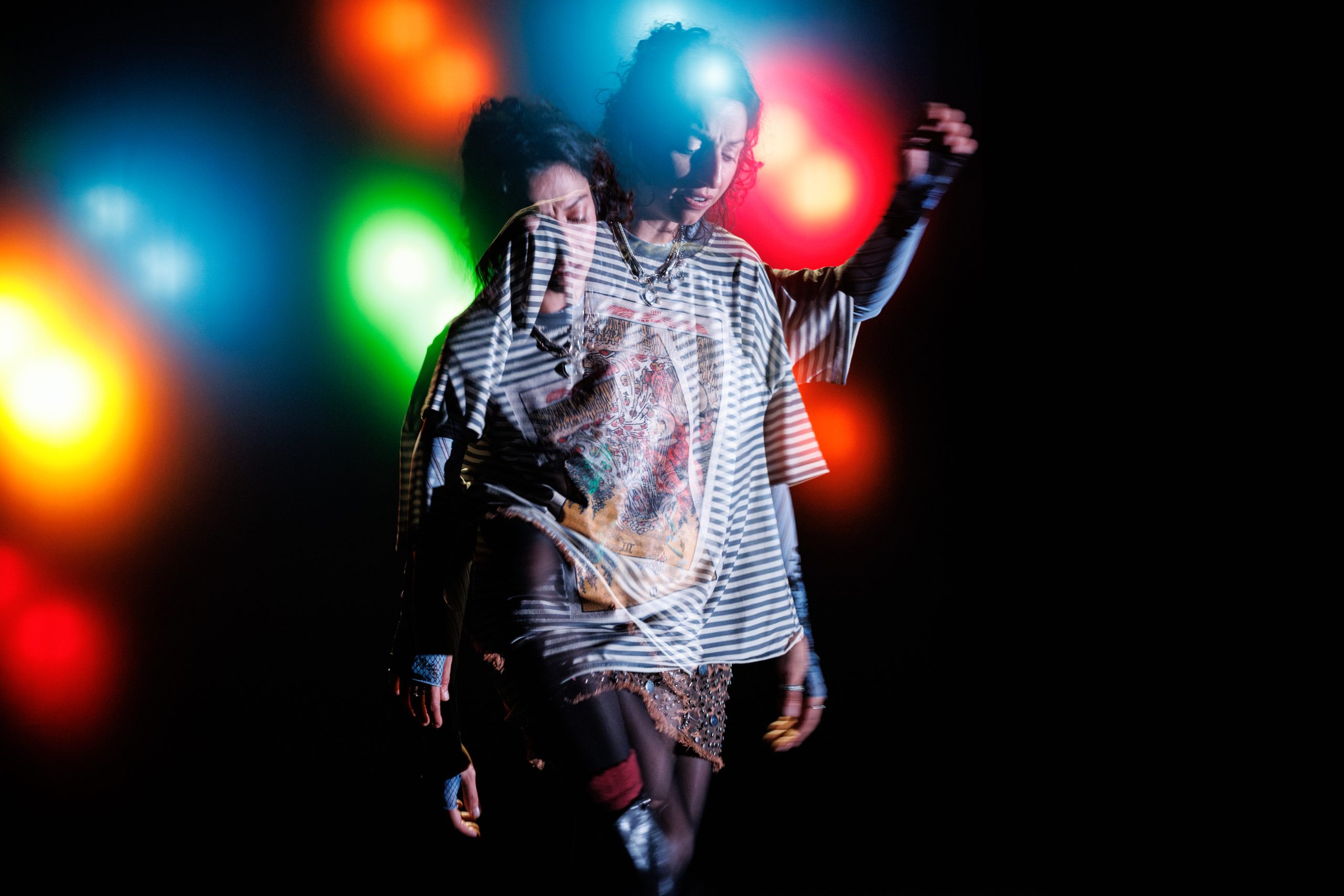

In I Am Not Even Half, the Iranian-American narrator, S, tells us she feels “split.” To split is to fracture. Fragment. This pulsating, glittering solo performance witnesses S in her fracturing: a soul split between two places, fighting its way to fullness.
S looks one way down the street – but not the other. She is half here, half somewhere else. To be specific, she is half on her phone, watching the “Women, Life, Freedom” movement erupt on the streets of Iran in 2022. Brave protestors took to the streets, in fury and despair, after the brutal murder of Mahsa Jina Amini, a young Kurdish woman, at the hands of Iran’s morality police. Amini was not wearing her hijab properly, and was beaten to death. Distracted by this revolution documented on social media, S is hit by a car.
Told over the course of a single, chaotic day, S embarks on a journey of confrontation: bodega guys and Uber drivers. Successful friends and shitty boyfriends. Religion and faith. Bravery and cowardice. What makes a victim? What makes a hero? What about an agent, an actor?
S is taken in an ambulance to the hospital. She postulates about the differences in head wounds: an injury caused by the impact of the pavement v.s. that of a baton wielded by Iran’s morality police. She wonders about her relative privilege and safety. She wonders, often, about her capacity for bravery, and her tendencies towards self-victimization. Her trip to the hospital, after all, is also an opportunity to grab the elusive attention of her on-and-off-again boyfriend, who is ‘deeply present’ in person, though rarely present in actuality.
S’s focus oscillates between Iran and New York; between herself and the world outside; between women and men.
The result is a mesmerizing theatrical experience. Layla Khoshnoudi, a powerhouse performer, transforms into a host of NYC characters, each played with subtlety and humanity. She has an ear for human rhythm and conversational poetry, and each character is funny, particular, and often unpredictably wise. “What does God have to do with me?” S asks a budtender in a weed dispensary. He responds, “That’s what everyone has to find out.”
And S is on a mission to find something out. We move in and out of self-awareness. She is self-consumed, and if not ‘boy-crazy,’ then ‘boy-conscious.’ She is also deliciously ambivalent, even about her most confident takes. In Brooklyn, S judges her friend Julianne, a successful musician, for her desire to moralize at the bodega guy after he comments on S’s appearance (“a dorky American tendency to police people, especially men”). But when he responds well to Julianne’s call out, S decides that she should be more like Julianne, who is shameless. But – S counters her counter – in Iranian culture, shame is a virtue, as is modesty. Which, she points out, sucks for capitalism. The piece is stitched together by these thought spirals: of culture-clash, political angst, human insecurity and projection. Anything goes, and any way might be the right way to live. Our narrator is split, but she also twists and coils. Every scene is explored from multiple vantage points: a kaleidoscopic lens, at times cerebral, at times visceral, always zooming in and out.
Held within S’s spirals are Khoshnoudi’s analyses, clear and honest to the point of provocation. Her writing has an unsentimental poeticism to it: funny, striking, and refreshingly unaffected. I Am Not Even Half is also so entertaining, it feels like a TV show (there have been Fleabag comparisons, of course). It’s also a deeply intelligent work. And a challenging one.
It is tricky, sometimes, to write about a diasporic character living in a ‘safer’ or ‘freer’ place than that of her origin or family. It can lead, I think, to a kind of apologetic or defensive posture, or a lamenting tone. A self-consciousness that can kill good art. Or an over-correction that erases subtlety. How do we confront real political stakes abroad – and real, relatable turmoil within – without just making a show about privilege, or identity?
But Khoshnoudi’s writing is so fresh and funny and weird. It’s honest, critical, and confident. Yes, she mocks her character – a lot – but she also takes her seriously. In one incredible scene, S delivers a diatribe on the female morality police in Iran: “Those morality bitches are pick me cunts. They’re gaming the system. They’re jealous of these women’s vibrant limitless beauty and wanna punish them for it. They condemn beauty. They’re evil. They are worse than the men.” It is fiercely delivered, and a little uncomfortable for an American audience (Julianne counters, in a more familiar take: “The men created that system.”) But this is a truly diasporic lens.
As the piece goes on, Khoshnoudi takes the show’s themes one step further. While S straddles these two realities, things also seep between them. There is a real relationship between Iran and NYC, beyond S’s identity–a sharing of people, ideas, systems, and practices. In both places, we witness violence against women. We encounter the power, allure, and threat of religion, and the expansive possibility of faith. We confront the cost of bravery, and the brutality and unease of victimhood. These are human things. Social-political things. Global and local. Painful and ever-present. Soul-crushing and person-making.
“I’m Iranian. Full! Both sides. I’m not even half,” S says. The show’s title contains within it that exciting paradox. Half. Full. Both. Split. Heart, body, and soul. Everywhere, nowhere, and alone. Fighting, fighting. Watch her go.

I’m Not Even Half
Created and Performed by Layla Khoshnoudi
Directed by Machel Ross
Produced by The Bushwick Starr in Association with ¡OYE! Group
Playing at The Bushwick Starr through October 30. Tickets HERE.
Leave a Reply