
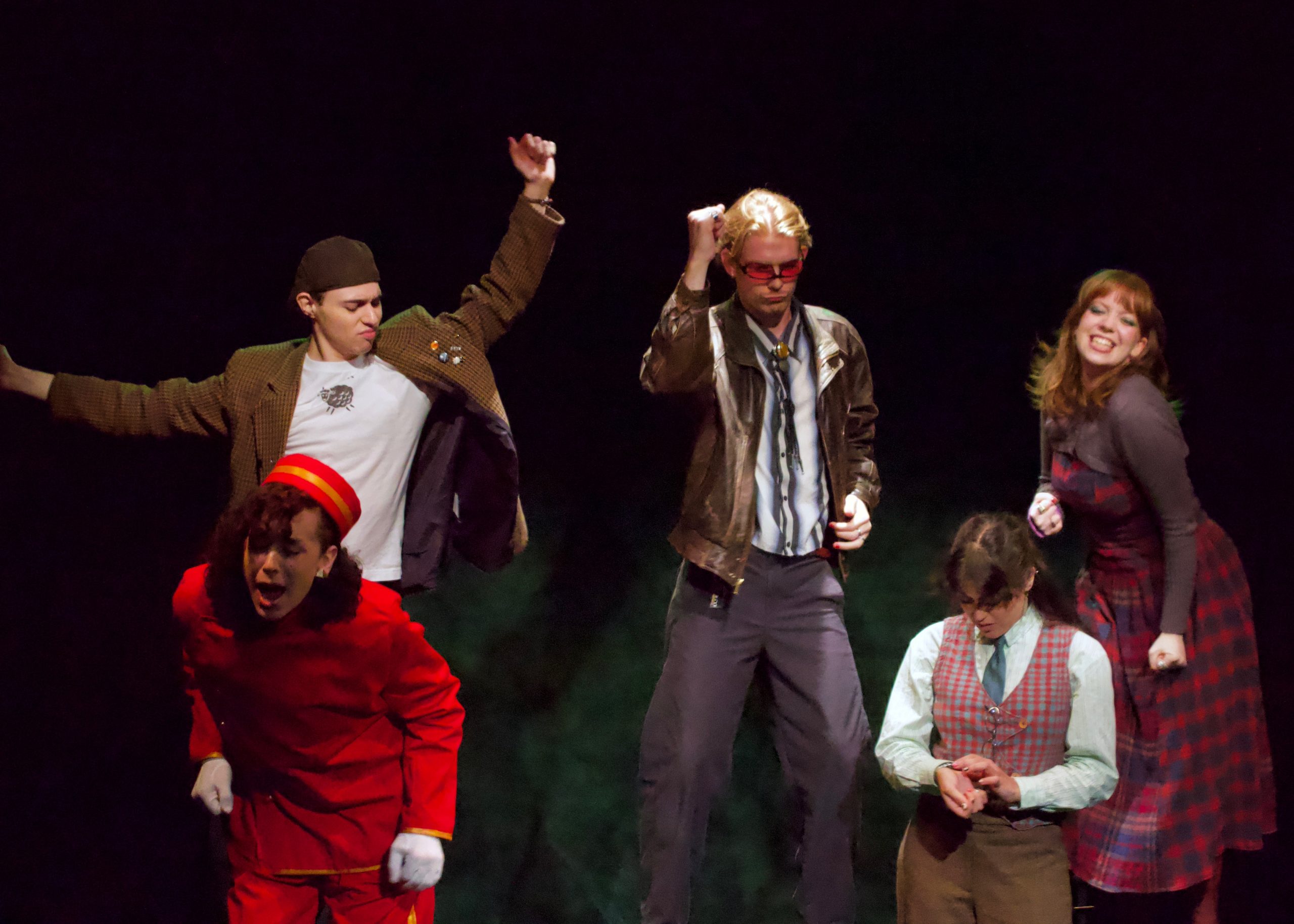

Where should one stage a play? I found myself asking this as I ascended once again in the small elevator that leads to the most horrible hallway in all of Manhattan that leads to IRT Theater. For the new twenty-something generation of theatremakers, there isn’t much choice in the matter. Our assumed and forced-upon generational precarity makes spaces such as IRT the only available, and perhaps the most appropriate, for the stories we are homogeneously drawn towards, often stories of young artists and their failures. Cori Diaz’s Carpal Tunnel is archetypal of this genre, though it packs a different punch.
Manna Benes (Stephanie Orta-Vazquez, quirkily embodied and subtly, fascinatingly controlling) is a Tisch graduate with a successful line of YA fantasy novels flying off the shelves. She insists that her tales are “magical realism,” but money talks. She has gathered her four closest writer friends, two from college, two from rehab, to the Roxbury Motel for, well, no one is sure. Perhaps a writer’s retreat, maybe the first movement of a burgeoning collective, probably just a bender. Their time together is all of this and something more, we find out. And the ragtag bunch Benes has assembled more than fits the mold.
Aldene Bender (Michela Murray, sad and scary in the most sympathetic manner) is a playwright by accident, a former non-union stage manager who got into writing out of obsession, an unnerving adoration for an actor she worked with named Polly (Saige Larmer, marketing the exact brand of lesbian this role requires), who is coincidentally staying at the motel for the duration of a regional Titus Andronicus. Ziggy Zeta (Sahar Lev-Sharmer, beautifully tortured here) writes weirdish children’s books about consent as a means of attempting to connect with his seven year old daughter and process harrowing childhood traumas. He has a quiet sincerity, a care in his words and actions that, though sometimes to a fault, conveys wisdom. Cash (Connor Riordan, so sweet in this role, especially in a scene shared with Sharmer that could melt ice, what a rare surprise to be endeared by men in a play) is a brain-injured “gonzo journalist” (he later quotes Hunter S. Thompson frenetically and sincerely) who gets by as besthe can. Kitt Schuster (Katherine Humes, frenetic and delightfully absurd) is a former teen dance star turned poet, taken from the former field due to chronic injury andnow debilitated by chronic hypochondria borne out of, don’t make me say it, trauma.
Trauma is an intentional catalyst and subtextual signal in this play, a mark of something that only the individuals gathered recognize in one another, something that forces them together by some default. Diaz expresses such traumas carefully and truthfully. One choice that works structurally but is not thematically concise, though, is a “to-camera” monologue component that allows each character to speak frankly about themselves and their lives. Though these moments made for beautiful writing, there was no indication as to why the characters break off into this and for whom. I wish such moments, especially Orta-Vazquez’s last minutes onstage, held more specificity, more context, as even the void the play is named after is at least given some set up, some dramatic build before being unleashed.
The costumes, also by Diaz, tell us clearly yet cleverly about the archetypes these people inhabit, their inner lives and the personalities they wish to project as a result. The set design by Bridget Lindsay is so simple yet curious, a symbol of nothing and everything, much like the eponymous carpal tunnel. The emerald green carpeting is reminiscent of Manna’s Wizard of Oz themed hotel room. An uncanny slit divides the middle of the backdrop. When special circumstances are stripped away, we’re left with a hidden life, one trapped in constant rehearsal, always trying but never accomplishing, never fully being there. There is something uniquely beautiful about the bright yellow spike tape lining the stage’s center, wooden boxes acting as so much more. And one girl left with it all, forced to bring it back to life.
There is one more character in this play, who has nothing and everything to do with Benes and company’s journey: listed only as 07 (Viola Albright, endlessly charming and ceaselessly funny), she manifests as a fabulous seductress bellhop, tasked with reprimanding the motel guests and, at pivotal moments, assisting them in carrying out their deepest, darkest desires. Her inclusion, one that brings to light the titular tunnel, provides both comic relief and an almost play-within-a-play line of spectatorship, a lens close to the audience’s but not the same, a means of understanding that further layers the characters’ lives while clarifying the audience’s experience, reminding us to mind our perceptions.
Molly Shayna Cohen’s direction felt realistic yet representational, somewhere between naturalistic and stylized, a muddled mode that worked aptly against the meta-commentaries and autofictional nature of the play. It did unfortunately include my least favorite blocking an actor can be given, to walk and hit a sharp turn upon each corner of a space. I do believe that actors are capable of walking normally, and should be directed to do so more often. Stylization is too often thrown into scenes, exemplified through discordant choices of movement and affect, as an afterthought, whereas true style comes off overt and clear. This production aims towards a reflection of an inherent style, but instead comes off disjointed at times.
Still, in certain moments it really shines. Nights at a bar that isn’t actually there, a campy themed hotel room that isn’t actually there, quiet rooms and TuneTouch and writing done and not done. These places are made real but removed, creating a tone that only bolsters the story, never removing the suspicions that bring the five old friends together in the first place. Carpal Tunnel is a moment in time that sinks straight into a void, and I believe this most directly sums up what Diaz and Cohen have created here: a time capsule buried too late, and the efforts to try and keep it underground. What happens when one wishes to excavate it?

Leave a Reply