
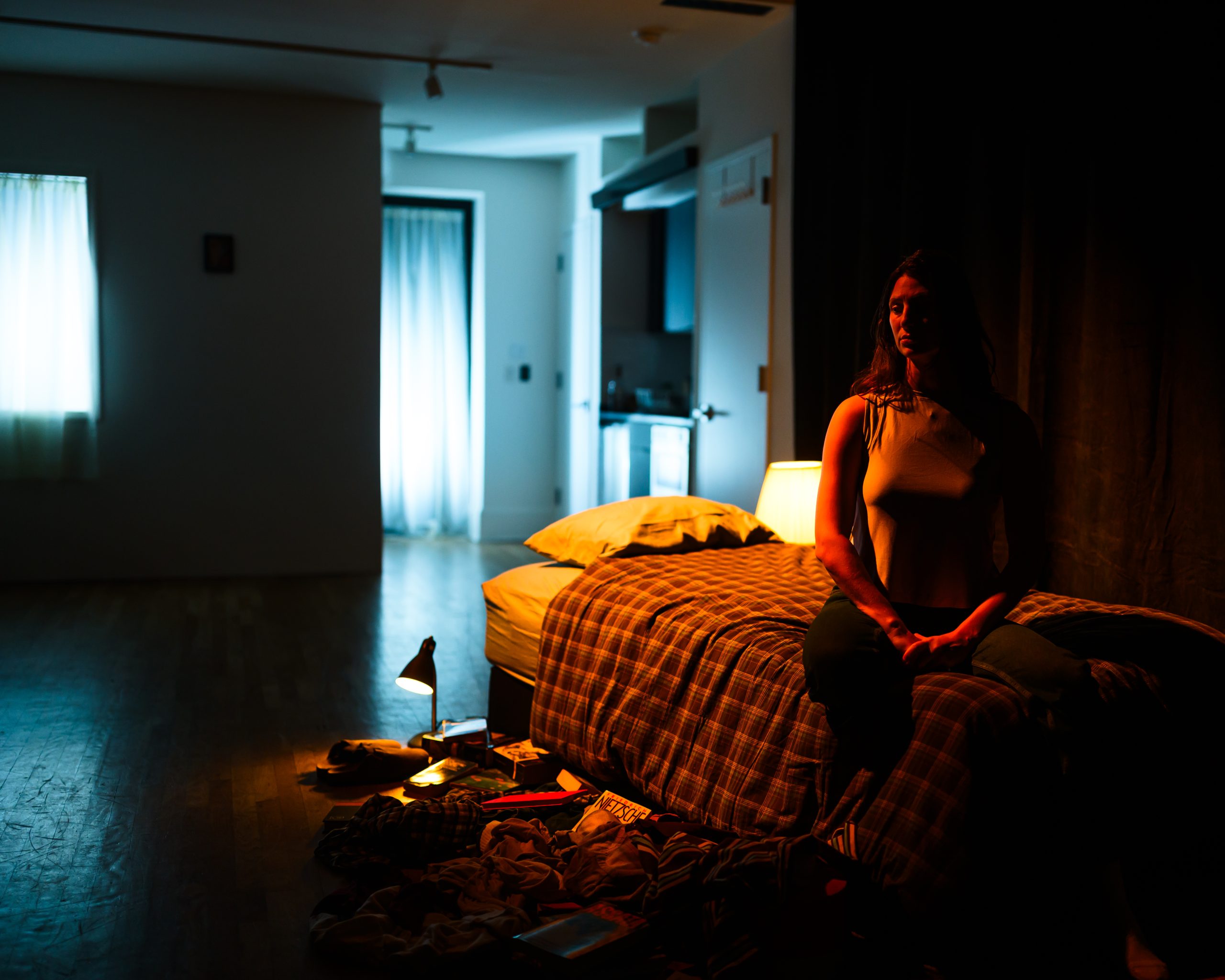
Dan Giles’ The Charioteer speaks on the Occupy movement, sibling angst, and foot infections. The piece exists, sometimes literally, in an unknowable void, creating an air of mysticism within an otherwise grounded story; a thin place of sorts. I was elated to sit down with Giles and director Matt Dickson to talk process, politics, and polemics.
This interview has been edited and condensed for clarity.

Tess Walsh: So how did the two of you come to know each other and become collaborators on this project?
Dan Giles: We first met through Youngblood, which is Ensemble Studio Theatre’s group for emerging playwrights, and they do this amazing festival. It’s my favorite ten minute play festival in the world, where the playwrights pick a director and a bunch of actors out of a hat, and then you pick the title of the play, and a prompt.
Matt Dickson: That’s so psychotic that that’s how we met.
DG: Yeah, so we met doing that. I just picked Matt’s name out of a hat, and I was pretty excited. I was also really struggling with writer’s block that week and I was really, really burnt out. I think the first time I met Matt before our first rehearsal, I had like two pages. Like, I truly had barely the start of a play. It was so embarrassing, I was mortified. But then Matt was just really game with those two pages. He was like, don’t worry about it. We’re going to find it. We got into the room and he was very chill, kind, had smart things to say about those two pages and generative, prodding questions, he just set the tone for the actors. It was this instructive moment for me early in my writing life of like, oh, this is how to be a generous, thoughtful, responsive collaborator.
MD: So funny, because my version was seeing the pages and being like oh, we’re so fine, this is not going to be a slog. This is somebody who clearly has a very distinct voice and is exploring a form, one that definitely activated my curiosity as a director. I think we fortunately have similar tastes when it comes to muscular plays and what sort of turns us on.
DG: Something that’s kept us working together for years is that we really bond over all kinds of craft stuff, we’re a bit obsessively rigorous about the same things, and we both kind of enjoy that. Sometimes when we hang out, we just talk shop the entire time. We’ve been friends for a long time now, but sometimes we just talk about little dramaturgies.
MD: Like Dan’s takes on movies. I mean, I like Dan’s takes on a lot of things, but they make me laugh because they’re always surprising, but it’s never surprising that they are so bonkers. And so, you know, I love it.
TW: Well now that you’ve brought it up, what’s one definitive take?
DG: Oh, I just thought The Odyssey was bad.
MD: Yeah, things like that.
DG: These are just normal takes.
MD: No, no you have great ones.
TW: Dan, when did this play become conceivable to you? Specifically the sibling dynamic the play is shaped around, as well as its nods to the Occupy movement amongst other student groups, I was wondering if you could talk about how those facets came to you.
DG: It’s funny, I feel like there’s kind of a core of this play that has gone through multiple forms and actually a few different stories, but these characters have always been there. I first started playing with it about ten years ago. I tried different forms and storylines, and they kind of almost coalesced and then didn’t really. I was interested in questions surrounding climate change and activism, I think it just came from being alive. It’s just a crazy thing we’re all living through and it’s like we can’t talk about it, there’s such a psychological resistance to it. The way we live has to change, and it’s something people don’t really want to deal with. So I was getting deeper and deeper into climate literature and I became interested in dramatizing that, but I couldn’t crack it because it felt very unemotional. I don’t love talking head issue plays. I really need a play to have a heart and guts, and the thing that made the story become human to me was visiting my family. My sisters have little kids, and it’s kind of funny being an uncle and being around your sisters when they’re parents. It kind of realigns your family in a beautiful, fun way. And then it made me miss being back home and being around these people I love, and I felt this emotional desire to spend more time with them. I thought about the shape of my life in terms of that. And then it kind of made me think about the way your family shapes you, in ways you don’t have any control over, but in ways that really get inside you. Like ideology, but not exactly, more of a spiritual thing. What parts of you are immutable, what parts of you change, how the world moves through you, how you change the world. These questions felt related to family, something that could be dramatically activated in a sibling relationship. So when I started to think about it that way, I was like, oh, this feels right, this relationship feels like the right container for these questions, and I got excited about that. The play kind of came from there.
TW: On the topic of that sibling relationship, in rehearsing this piece, what has it been like to put that relationship on its feet, and what has changed? Or have either of you discovered anything new in staging this relationship?
MD: I’ll speak to the challenge of the play, which is that these are siblings who know each other intimately, right? And then this change comes that is both scary and inevitable. I think Dan’s writing is deceptively formal. Even on the page, as well as I feel like I know him, it still surprises me. He still has to guide me at times. Like, no, this is a silence, the silence is not a pause, and this pause is not a beat. This silence, you don’t need to fill it. I mean, it needs to be filled with guts and charged emotions, but it doesn’t need to be filled with any kind of physical excess, right? When you’re afraid as an actor, you want to eat something, because it grounds you onstage, it anchors you. I think Dan’s plays are really naked of said filling, so it requires rigor. And so I think the challenge of the play is both to find this sibling relationship that is fun and spontaneous and impulsive, but still let the language be as, dare I say, poetic as it needs to be. That requires really specific actors who are smart, who have guts, and can hurl themselves into the material, but also understand how punctuation serves moments. I think that has been the fun.
TW: Matt, I’m curious if you have any certain approach to working on new plays. What do you try to bring into that process as a director?
MD: Curiosity. I think that Dan’s really good at filtering out my bad ideas. He has this ability to ask a question to my question or reframe notes. He’s also a really visual writer, and I value his presence and design conversation. What I would say generally though, as a new play director, is leave no stone unturned, take nothing for granted, and don’t assume that you know what’s best for the play. And don’t assume that the playwright always knows what’s best for the play. Sometimes it’s an actor or designer, and whether they know it or not, they intuit something. I just like pulling on threads, you know, I like scooping people out, if you want a really romantic description.
DG: I think Matt just pays really beautiful attention to the play. The curiosity is really important to me, but there’s also a generosity, a kind of fearlessness to it. Matt is really unafraid to let the play be the play.
MD: It’s a weird fucking play.
DG: This one’s really weird.

MD: I mean, it’s weird in an exciting way. It asks something of the audience, it challenges. I think that this play is gonna cultivate really complicated conversations, I hope.
DG: I think about how you can treat a play like a machine or you can treat it like an animal. And I think Matt is really good at treating it like an animal. There’s a lot of respect for it, a lot of care for it, an appreciation of its complexity. I feel like we’re taking care of it together and that feels great.
TW: I feel like such a large throughline of this play is ethics, our personal dialectics of right versus wrong, and what happens when someone you’re close to diverges from you in belief. I especially think of the character Owen’s speech about moral injury. Dan, what was your impulse in including that theme? And what do you both think it can tell us about sibling relationships in particular?
DG: It actually didn’t really occur to me that this was a play about speaking to people you love across political differences until Krista Williams, who is a brilliant dramaturg, described it back to me that way. And I was like, oh, that’s actually a good way to talk about this play because we all kind of feel that right now. There are people we love and want to be close to, but we also are trying to bridge really meaningful divides. And siblings are kind of a special version of that where you often come from the same place in the same world and you can become different people and live different lives, but you still have this part of you that is the same. That relationship just feels very particular.
MD: It’s crazy that I’ve never met your siblings.
DG: You will, I love my siblings. People keep being like, is this play about your sisters? Like, no, it’s really not. The character Owen, specifically, is a very particular person who kind of thinks all the right things, like has really strong principles and morals and convictions, but doesn’t always do the right thing, his actions don’t always line up with his ideals. I feel like a lot of us live in that gray area, maybe not quite the way Owen does. But I was really interested in that contradiction and putting that at the heart of a character. And then this question of moral injury, which I think is a James Baldwin coinage, feels like this profound contemporary question in a way that it wasn’t years ago, just because we had a different kind of access to other people’s lives than we do now. When you write a play, you’re trying to speak to the moment and you’re also trying to think, like, if people see this play years from now, what will resonate with them? My tiny actions actually affect the world in this ripple effect way that I don’t understand and am responsible for but not accountable for. This realization felt really profound and scary, and it’s something I feel deeply in my life and don’t know how to deal with. It feels like the kind of question at play can actually wrap itself around really effectively and kind of help people think through.
MD: It is a sort of living, breathing, eternal document. That’s a gorgeous image.

Leave a Reply