
One of the peculiarities of being parent to a small child is being mostly checked out from things that used to take up all of my time and imagination. It takes a lot to get me out of the house, honestly.
So, I had no information about, or foreknowledge of, Back to Back Theatre’s The Shadow Whose Prey the Hunter Becomes at REDCAT before I arrived for the show on Saturday night. I knew a little bit about Back to Back from their previous Stateside appearances with Small Metal Objects and Ganesh versus the Third Reich, neither of which I had seen. Word of mouth from people I respect was that the company’s work – created by and with neurodivergent artists – was brilliant and not-to-be-missed. So, I wasn’t going to miss it this time.
Obstacles presented themselves but were overcome. I arrived at REDCAT frenzied and frazzled, wild-eyed and heavily bearded, hair distractedly mussed in a way that might be mistaken for artful if you didn’t know the truth. I’m basically overwhelmed all the time, just barely managing to keep it together, hoping that, when I go out into the world, I can behave in a way that is socially appropriate even as my inside is chaos and despair.
But, as I have recounted at great length elsewhere, my happy place is an empty black box theater. My head is always abuzz – call it ADHD or whatever – and overstimulated with too many thoughts and too much stuff happening in the world. Merely sitting in the bare black space of the REDCAT theater had an incredible calming effect on me, even though the house lights were still on as the show began. The lack of stimulus, distractions and theatrical gack, the purity of an empty space with only three people onstage in street clothes and a few chairs, meant that I could focus only on that which was present, and that anything could happen. We weren’t subject to the unrelenting tyranny of the visual, everything that was going to happen was going to happen in front of us, between the performers and the audience, and, most importantly, inside our heads.
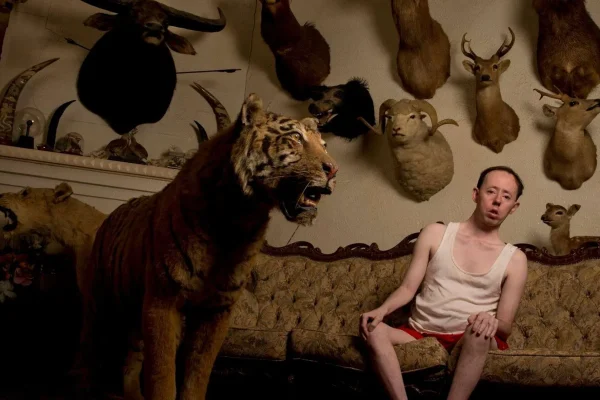
The basic premise of the show is this: three people with intellectual disabilities – actors Simon Laherty, Sarah Mainwaring and Scott Price playing versions of themselves – have called a public meeting, a community conversation, to engage loosely and peripatetically, with a wide range of topics ranging from sexual consent to civil rights.
The unspecificity of the meeting’s agenda, the inscrutable and dynamic hierarchy of the group’s structure, and the porousness of the relationship between the performers and the audience, create a generative space of ambiguity and possibility. The “instability” of the setting and characters, and thus the instability of the relationship between performer and audience – compels the audience to always be renegotiating our expectations of what is happening, who is who, who is being addressed and how the action is to be interpreted.
We, the audience, are called to be present in real time and participate in what is happening; not in a cheesy audience-participation way, but in a subtler way of intersubjective negotiation and co-creation. Sometimes what is happening seems clear, sometimes it is obscure, sometimes it is both at the same time. The actors’ lines are projected on supertitles above the stage because it is occasionally difficult to understand what they are saying. This, in and of itself, becomes a point of contention when Sarah protests that it is insulting to them.
The show is unexpectedly funny (Side note: Why is it unexpected? Why shouldn’t this show be funny?). A land acknowledgement sequence at the top of the show has a “Who’s on First?” quality with Scott – who is autistic with speech impairment – repeatedly correcting Simon’s pronunciation of an Aboriginal tribal name. The tribal name would be difficult to pronounce for anyone, but the exchange is quite funny. The audience at REDCAT didn’t laugh so much at that part. I don’t think we felt that we had permission to do so, maybe because of the politics of land acknowledgments or the politics/social contract of how we are supposed to engage with disability onstage? (See Jess Thom’s TourettesHero project for a great example of giving audiences permission to laugh.)
The actors have a keen sense of timing and self-awareness – a double consciousness if you will – of how they are in the world and how they are perceived by others. This is reflected in the text, which certainly has elements of the au courant declamatory issue-driven theater that garners so much attention and praise these days. The surface version of the performance was a “play about the indignities heaped on people with disabilities” and in lesser hands this would have been yet another exhausting exercise in didactic moralizing. But the text was merely sleight of hand for what was really happening in this clever, deceptively simple show.
The dramaturgical engine that drives the whole thing is the tension between the experience of being in the world as “intellectually disabled” and the “abled” world’s perceptions and assumptions of what that experience is.
The first brilliant move of The Shadow Whose Prey the Hunter Becomes is that it expects the audience to slow down and pay attention, to be present with the disabled performers as they are, on their terms. Yes, there are supertitles, but even that is a point of contention among the performers, they’re not all in favor of it. And later, when we get into a whole Siri/AI thing, the presence of supertitles complicates our expectations of AI-mediated human interactions.
Most didactic/declamatory theater doesn’t ask anything of the audience, not really. It doesn’t ask you to fundamentally change your expectations or challenge your assumptions of how you are perceiving another human being in real time as you watch the show. This is one of the ways Shadow Whose Prey the Hunter Becomes is truly radical and transformational – it demands that you, the audience, change. It demands that you slow down. That you pay attention. That you do the work of showing up for another human being on their terms, as they are in the world, not merely expect other people to show up in a way that is most convenient and acceptable for you, the “able” person.
[EXTRA CREDIT: There’s this super complicated idea from the world of taxonomy called the umwelt. Basically, it refers to an organism’s unique and particular experience of its perceivable world based in part on its biology. (For a deep dive, read Naming Nature by Carol Kaesuk Yoon). It is, I think, kind of the intersection of biology and phenomenology. The point being that the world is super complex and all organisms experience it differently and because of our tendencies to be self-centered, we neglect to honor, acknowledge or even consider other organism’s experiences of being in the world.]
The second brilliant move the show makes is, sporadically and surreptitiously, to turn the tables on the audience. This strategy kind of creeps in, as I recall, about halfway through the show. At a few key moments the performers look at the audience and ask each other whether we understand what they’re talking about and what they’re doing.
It seems gentle enough, and humorous, but it is a very profound thing. They’re not asking for empathy or sympathy, they’re not acting out some made-up scenario, they’re putting us in their place, literally. “This is what it feels like,” they imply, “to be talked about and talked over when you’re in the room. This is what it feels like to be minimized, dismissed as incapable of comprehension, to be judged and made to feel less than human, to be ignored and treated like you’re an idiot, or incapable, or less than, just because you don’t present the way ‘able’ people do.”
The third brilliant move – and honestly, I wish I had a copy of the script to recall exactly how they did this – was turning the tables on the “abled” in the context of AI. The actors recount various horrible ways that disabled people have been exploited and violated in different places and times, like Ireland’s Magdalene Laundries (it is pretty horrible, you might want to boycott Hasbro), and conclude with an overarching observation that people (society) tend to enact violence on others who they deem to be inferior, perhaps because they don’t see them as fully human. Seems self-evident, worth remembering, yeah? The script doesn’t do a deep dive into the why of it, just the fact of the violence and mistreatment. So, “able” humans do violence – physical and psychological – against “disabled” people.
But one day, in the not too distant future, Artificial Intelligence might well develop a level of agency. And human beings who currently imagine themselves as “abled” might present, to the AI, as being intellectually disabled. If we are building AI, if we are infusing AI with our values, ideas, biases and behaviors, it stands to reason that AI will treat “able” humans the way that able humans treat “intellectually disabled” humans today.
So, maybe we should change, if for no other reason than our own self-interest and survival at the hands of our future AI overlords.
Now, I have no idea whether all of these apocalyptic imaginings of AI are based in reality. It depends on who you talk to. But in the end, it doesn’t really matter. The essential takeaway is that everything humans create is, necessarily, infused with who we really are, not who we like to think we are. Our machines behave as we teach them to behave, the algorithms have biases, product designs reflect the designers’ biases; our economic systems, our financial systems, our buildings, the Internet, cars, highways, social safety nets – or the lack thereof – they tell us who we really are, what we really care about, how we really behave. It takes a shock to the system to actually start to see how much of the world is designed for the convenience and benefit of the few, and how much richness we excise from our world and our lives when we reject the differently abled.
Back to Back Theatre’s The Shadow Whose Prey the Hunter Becomes is that rare work of theater that actually changes the audience’s perspective on what it is experiencing. It literally puts the audience into another human being’s experience and says, “Now that you know, what are you going to do about it?” I found it extraordinarily powerful, and as the show ended I looked around the theater that I gauged to be at about 75% capacity. I thought about all the people I know with neurodivergent children, siblings, parents, spouses, cousins or friends who might have loved and appreciated this show but never heard about it because, well, it’s REDCAT, a super niche art space with a very limited audience and reach. Having spent so many years of my life working at, or seeing shows in, spaces like REDCAT, I am acutely aware of the limitations and challenges of expanding the audience for “experimental” work. But my (now many) years outside the experimental world have also made me appreciate how much of the problem is the milieu itself.
Back when I was a full-time cultural producer, curator and critic, I had some general guidelines about how to behave after a show. No matter whether my reaction was positive or negative, but especially if it was negative, I would wait until I was at least 15 minutes away from the theater before saying anything. Partially because I didn’t want to accidentally say something in front of the creative team that would be hurtful, partially because I wanted to give myself time to process what I experienced and see if my first impression was really the final impression, and partially because I didn’t want to color anyone else’s experience of the show.
Not every show is for every person and I learned the hard way that I just don’t want to stomp on someone else’s buzz with my negativity. In fact, on more than one occasion, by giving someone else the opportunity to tell me why they loved a show I despised, I have either changed my mind, moderated my opinion, or at the very least learned to see something in a new and previously unexpected way.
When the Back to Back show ended, a handful of people, myself included, rose to my feet. Eventually most of the audience joined us. I mean, almost everything in Los Angeles gets a standing ovation, at least at fancy places like Disney Hall, and I usually feel a bit coerced by the will of the crowd. In this case, however, I genuinely wanted to show my appreciation and gratitude to the artists and the company for this extraordinary work.
As I was standing there, I overheard someone behind me say, “Oh, so we’re doing this now?” and it pissed me off. Maybe this person was, as I often am, frustrated by the ubiquitous Los Angeles Standing O. But it felt dismissive, it seemed directed at the work. I turned around and they were already gone. Now, I happen to know this person. They are an experimental writer whose work is identity-based and frequently formally challenging and has also graced REDCAT’s stage. Their work comes with an expectation from the artist that the audience, or reader, will do the labor of meeting the art where it is, on its own terms. One would think that an artist who expects others to come to their work with an open mind and a willingness to engage with the deliberately obscure would be similarly generous as an audience member. But maybe not.
I hope that there will come a day when Back to Back Theatre won’t need to exist, when the world has been so profoundly transformed that it is completely unremarkable to see a show with differently abled performers and creative team. Maybe there will even come a day when the world has been so profoundly transformed that we truly celebrate all the magnificent ways that difference presents itself in the humans around us. A day when we will find in ourselves the generosity, curiosity, openness and patience to show up for each other with wonder, appreciation and, dare I say it, love.
In the meantime, we have artists like Back to Back Theatre, and shows like The Shadow Whose Prey the Hunter Becomes, to point us in the right direction.
Leave a Reply