
A Family Affair: Mare Nostrum Elements at the Tank for IHRAF 2025 featuring Heather Dutton/Middle Child Dance Theatre, Emily Tarrier + Emory Ferra Campbell, and Ke’ron J. Wilson

It’s SantaCon Saturday. I fight through the crowds of drunken revelers to The Tank alongside fellow dance journalist Emma King. We’re headed for a works-in-process matinee by three alumni choreographers of the Mare Nostrum Elements Emerging Choreographer Series. Along the way, we speculate on why this particularly boozy holiday—the December equivalent of Saint Patrick’s Day—exists. We settle on togetherness: the simple act of witnessing and celebrating each other’s humanity. Though the venue is thankfully Santa-free, we find ourselves participating in a similar ritual of festive assembly as we take our seats. The artists we’ve come to see are familiar collaborators, old friends, people we’ve grown alongside over the years. And watching their work this afternoon feels like a homecoming: casual, meaningful, and filled with unexpected delights.
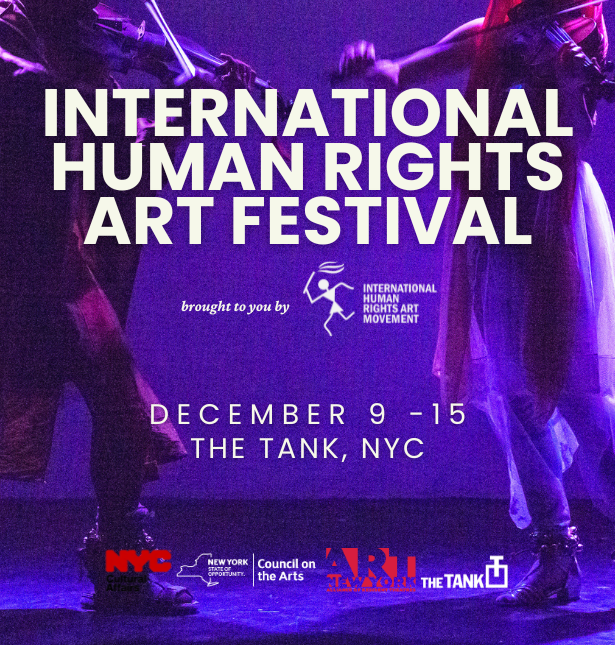
The triple bill offers what Mare Nostrum’s ECS promises to its participants: a familial environment celebrating queer embodiment where emerging artists can hone their craft. The show celebrates MNECS’s upcoming 25th anniversary, and is part of the weeklong International Human Rights Art Festival (December 8-14, 2025).
First on the program is a playful and adventurous duet for two dancers inside a gigantic fold of stretchy fabric. Two dancers, three holes—and one hilariously heartwrenching meditation on gendered feelings within the wayward meat sacks we call our bodies. “I’m Not Wrong and Neither Am I” has grown like my own body, continuously evolving yet always familiar. I say that because the first version featured me (!) and Tommy Gedrich in the fabric. Today, Heather Dutton holds Abbie Linnemeyer’s feet on top of her feet, their bodies obscured with yards of pinkish cloth, and shuffles onto the stage, making a big chunky monster body with four limbs pointing and gesturing erratically as distorted voices mutter from the speakers. The fabric billows and bulges and out comes a head, two heads, three legs, an arm—then four feet tiptoe out a crisp 5, 6, 7, 8 and they’re crushing a jazzy, sexy little petite allegro to Sweet Escape by Gwen Stefani.
The limbs and legs assemble suddenly into one giant body and Abbie’s head emerges with a manic expression. The confused tangle of bodies continues moving through its distorted routines with a mysterious coordination, trying to achieve some semblance of order. As the dancers’ bodies become more and more visible, attached at the hip by an umbilical cord of fabric, they begin to walk an imaginary runway. They’re mogging, flexing, and grinning, trying on cheesecake poses, ballet port de bras, macho man stances, and boy band postures. I smile with recognition. Inside and out, the piece still describes the achingly funny feeling of becoming gender-ful.
The second piece opens in a blackout, with three echoing gunshots. Emily enters the stage, carrying Emory over one shoulder as if she’d been shot, and deposits Emory onto a chair center stage. Emily arranges one of Emory’s limp, manicured hands into a cigarette shape at Emory’s mouth. A fanfare of spaghetti-Western soundtrack music reanimates the lounging corpse; Emily and Emory set about seducing and threatening each other in a dangerous tale of frontier femme-for-femme. Everything in “Velvet Pistol,” from the spare lighting to the dancers’ jewel-tone ruffled bloomers, evokes an atmosphere of saloons, tumbleweeds, and dusty trails. A sultry yet precise intrigue charges the work with immediate personality: “Velvet Pistol” feels like the dance (theater) version of a queer cowgirl bodice-ripper, a gasp of fresh air among ubiquitous too-cool Trisha Brown knockoffs.
Through passages of elegant dancing and dense, gestural interludes, the duet transports us to a secret, unruly landscape where sapphic lust flourishes. Against a sonic backdrop of minor-key strings and horns, each of the dancers’ movements unfurl with breathless tension. Emily pulls a finger gun on Emory and two fingers turn into a beckoning hand reaching towards a lover. Emory sticks out her tongue, miming death, while Emily hoists her by the waist. Emily sinks to the floor and Emory bumps her hips once, twice, grinning out at the audience. Emory watches as Emily swirls through a luscious sequence of contractions and arabesques, bending like the oxbow of a river through a dry canyon. Emily watches as Emory offers a yearning series of angular port-de-bras, punctuated with come-hither expressions as potent as gunpowder. Their chemistry burns a hole in the stage. The collaboratively-made choreography is crisp, flattering, and smart, with moments of welcome dramatic flair to underscore the campiness of a Western romance. And their use of the female gaze—literally, their eyes on each other—made this piece a joy to voyeur.
Ke’ron J. Wilson‘s solo work, “in small steps with courage,” closes the program on a poignant note. A smattering of recorded applause greets her, but she turns her back. Her small, contained movements, hands interlaced behind her back, indicate the start of something: she looks hesitant, unsure of what awaits her if she moves bigger. As she paces back and forth, a chorus of voices saying “no…nope, nuh-uh…” accompany her as her movement grows into whirling turns, long extensions, and swooping technical shapes from Ailey-esque classical modern dance. With flawless technique and graceful abandon, she coasts into pitch-turns and tilts, her braids suspended behind her as if recording the imprint of her shadow, all of her former selves flying behind her. Ke’ron dives to the floor, lifts herself on her elbows in a hovering plank as if, for a breathless moment, she’s suspended, airborne, floating in time.
Then, she stands, hesitant again, shrugging on a black dress. She smoothes it down over her hips, looks out at the audience with careful poise. A text about her transition process plays over the speaker. She continues smoothing the dress, feeling its texture under her palms, steady yet unsure, present in this moment with us, letting us see her. When she first created this piece for herself, I was in the same ECS cohort as a dancer: this was early 2020, right before the world shut down. A year later, I would go on my own gender odyssey, and come out the other side with a new name and a plan for HRT. As I searched for my embodied courage, I remember her conviction as she documented the first months of her transition through movement: setting choreography on her body about her body, tracking her experience of a personal metamorphosis, making herself the subject of her own research and performance. Seeing the work again, re-membered from a memory, it was just as affecting as it was back then. Since this piece’s premiere, Ke’ron has worked with other trans performers on a suite of dances that will soon become an evening-length performance at Triskelion. I look forward to an evolving window into Ke’ron’s process of becoming—as she displays the vulnerable details of her self-revelation, she allows others to do the same.
The Midtown streets, now dark, are still full of Santas as we exit the building. The goodbyes are plentiful and heartfelt, with promises of renewed connection in the new year. As Emma and I crowd to the snowy curb with Emily and Emory for a cigarette, we can’t help but smile: the Santas celebrate the holidays in their way, and we’ll observe it in ours.
Leave a Reply