
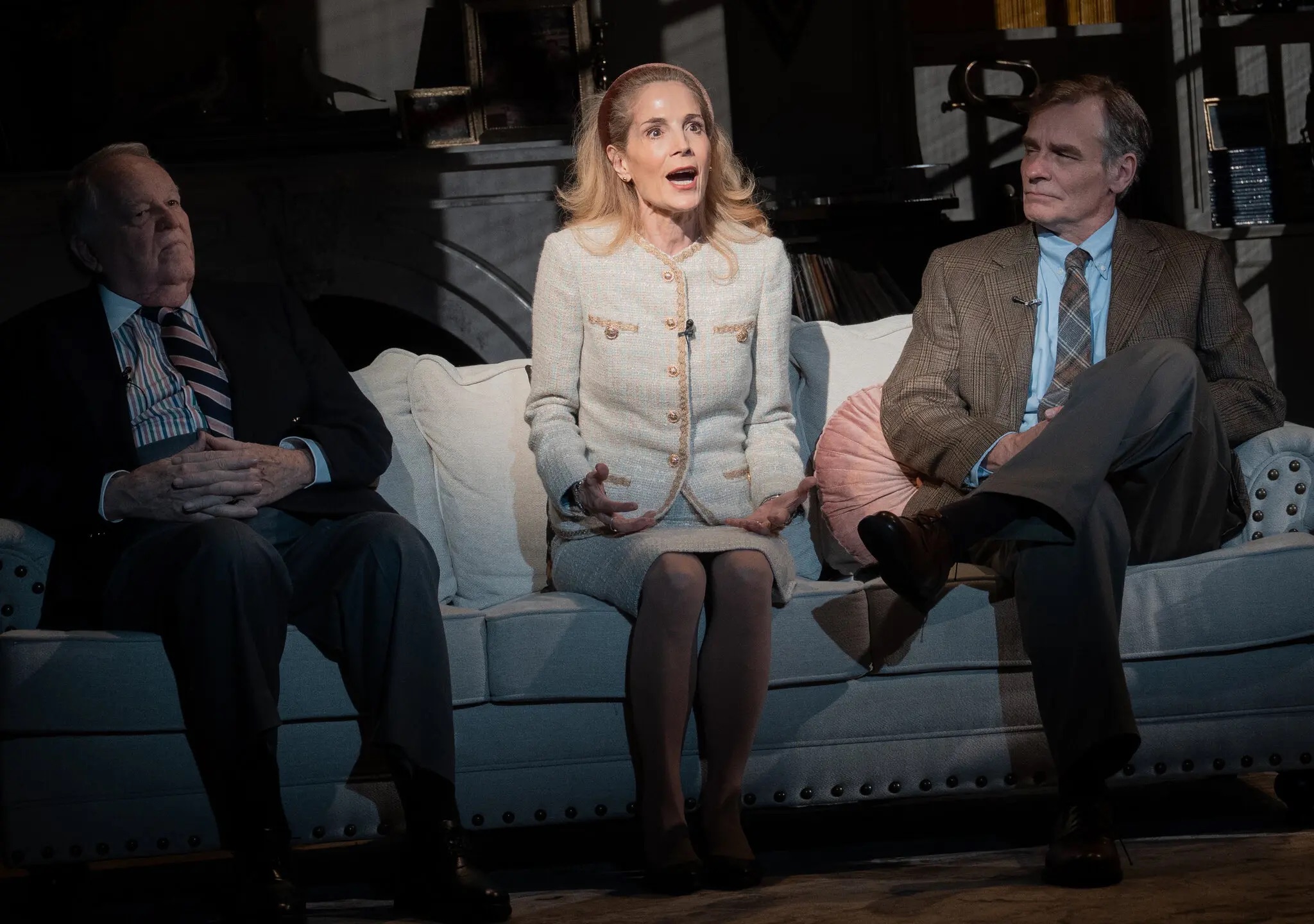
Dr. Lyssa Dent Hughes, a blue-blood descended from Ulysses S. Grant, as well as the daughter of a current Indiana Senator (a very likeable Dakin Matthews), seems to have it all. She lives in an opulent home in Georgetown with her family (though her twins never appear onstage, we´re told that a nanny looks after them) when not working tirelessly in her medical practice which focuses on women’s reproductive rights. Juggling it all at a nonstop pace, Hughes’ lifestyle is one many working women can identify with.
When the President nominates her to be Surgeon General, Hughes feels like this is “her time” (he’s never mentioned by name, but as the play is set in 1997, presumably this is Bill Clinton?). She’s excited at the prospect of significantly expanding her influence, and to help bolster the healthcare and rights of all women on a national scale. But when a chance remark during a television interview sparks a public scandal, her nomination is suddenly put into jeopardy. Dr. Hughes now has a choice: stick to her principles and calmly use facts to diffuse the controversy; or put on a smile, say all the right things a dutiful wife and mother should say for the rural women of America, and “play the game” to secure the nomination.
Do public figures face different levels of scrutiny, based on gender? Is there a glass ceiling for women in the pursuit of their careers? Are women held to different standards and expectations than their male counterparts? These and other questions float around this disappointing revival production of An American Daughter, written by Pulitzer Prize-winning playwright Wendy Wasserstein and playing until September 20th. Produced by La Femme Theatre Productions, Jean Lichty–the company’s Founder and Executive Director, who also gives a wooden performance as Hughes–earnestly wants audiences to draw parallels between then and now. The production’s primary message implies that the United States was on the rise back then, particularly in terms of gender equality, but was ultimately foiled by The Media, Washington Politics, and other faceless forces.
Comedy is often deployed to address salient political points here, but too often we get the set-up and miss the punchline. An interesting debate or conversation begins throughout the play, but then quickly fizzles out before ever getting into the meat of the issues. There are no stakes, only platitudes, such as “we rise and continue.” This makes An American Daughter more of a polemic than a play: most of its scenes come off less like dramatic exchanges between characters arguing for personal stakes than caricatures offering superficial snarks and quips about identity politics. Morrow (Ryan Spahn), for example, often arrives onstage unannounced and without any clear reason for being there, yet always immediately inserts himself into the action. Wasserstein makes it a point to inform us that he is a gay, Christian, anti-abortion GOP member, yet never reveals the basis of his friendship with Dr. Hughes, who is passionately pro-choice. Is Morrow even a character, or just a dramatic device?
Probably the latter: Morrow fans the flames of the play’s Big Scandal, that Dr. Hughes did not show up for jury duty once (gasp!). This is seized upon by television reporter Timber (a solid Chris Ghaffari), and swiftly threatens to de-rail her smooth path to confirmation. “4 to 1 women think Dr. Hughes is snotty and privileged, according to a recent poll,” he reports. “They want to know why they should show up for jury duty, but not her?”
Surprisingly, at no point does Hughes express outrage at Morrow for causing such havoc on her career ambitions, nor does he express any contrition for his actions. Timber refers to this incident, without irony, as “committing a crime;” is Wasserstein intentionally making this “much ado about nothing” to emphasize the double-standard women endure in politics. “Why are they doing this to me?” Hughes asks with frustration. “Is it because I am a woman?” Often I wanted to shout back, No. It´s because you’re a liberal and a Democrat. How can Hughes, the daughter of a Senator, be this naive about politics?
She gets a lot of unsolicited advice on what to do next. Lyssa’s husband Walter (interpreted with remarkable depth by the brilliant Robert Sean Leonard) urges her to just do whatever she has to win the position of Surgeon General. But Hughes´ initial willingness to go along is turned off after meeting Billy (Will DeVary), a strategist employed by her Republican father, who wants her to come off as more of a homemaker and frazzled mother, and less as an accomplished physician. The smile is more important than her smarts, because what will the rural women voters in Indiana think?
Why this Surgeon General nomination process is proving to be such a flashpoint for the President or his party is never clearly explained, but I guess that doesn’t matter. An American Daughter is more invested in virtue signalling than challenging its audience to examine the political complexities around gender. Wasserstein poses a series of questions about womanhood here, but balks before providing any answers, resulting in the play that feels afraid of nuance.
Women are portrayed as inherently heroic and virtuous in An American Daughter–that is, if they are of a certain age, such as Hughes and her friend Judith (a delightful Montego Glover), a fellow doctor who is Jewish and African-American. Distinct disdain is reserved for the younger generation of feminist thinkers, as embodied by Quincy (Carmen Zilles), an author and public commentator who disrupts Hughes´ personal and professional life on multiple levels. La Femme wants audiences to think fondly of Hillary Clinton as an example of how women should ideally be when exercising their agency and making independent choices, and not to consider other, more “messy” and more complicated figures, such as Monica Lewinsky.
In the end, this uneven play aiming for political provocation comes off as nostalgia for a particular class, and reviving this production in 2026 feels like a plea for the return of neoliberalism. While I too would like to see fiery theater which depicts debates over gender and politics, An American Daughter´s portrayal of women´s struggles in the 1990s ultimately feels quaint. Instead of galvanizing, this history play comes off as unintentionally privileged and with a pretty selective memory of the past.
An American Daughter
Le Femme Theatre Productions
The Irene Diamond Stage at The Pershing Square Signature Center
August 11 – September 20, 2026
Leave a Reply