
Part of the pleasure of watching a full-length play by Anton Chekhov, and why his work can so often be heartbreaking, is that they are often populated by characters who feel deeply, yet do not give voice to what storms rage on inside them. In scripts such as “The Seagull” (1896) and “The Cherry Orchard” (1904), there is a gulf between what is said versus what is felt, a disconnect between the simple or banal dialogue the characters speak and the torments raging on inside them. Who has not felt this way in real life? We laugh and cry at watching these everyday tragedies Chekhov portrays onstage as they are so relatable.
Many of Chekhov’s masterpieces received their premiere at the Moscow Art Theater over 125 years ago, and so it is understandable to associate the playwright with that of Konstantin Stanislavski, the theater’s director and one of the most influential thinkers about the craft of acting. From him we get the idea of subtext and naturalism as a distinct style of acting (relatively new, considering theater’s 4500+ year history), both of which were considered “experimental” and “avant-garde” during their initial productions in Russia and abroad. The ideas and techniques of both Stanislavski & Chekhov can also be credited for inspiring the Group Theater in America during the early 20th century, whose original members included Lee Strasberg, Stella Adler, and Elia Kazan. Not just “Method acting,” but most realistic acting training in the United States owes significant acknowledgement to these Russians of more than a century ago.
Director Laura Strausfeld said she was “punked” by Lincoln Center’s 1997 production of “Ivanov,” with Kevin Kline starring in the title role. For her, Chekhov’s 19th-century drama about a man plagued with depression struggling to recapture something of his earlier lust for life, revealed something to the future dramatist about her own struggles with despair. “Chekhov is scripture to me,” she says in the production’s press release. “It´s not overblown to say I owe him my life.”
Ivanov is a complicated character within a tricky play, and on a different level than say “Uncle Vanya” (1899) and “Three Sisters”(1901). In those later works, most of the major themes and ideas are below the surface; Chekhov doesn’t need to spell it all out for the audience, because we feel it, and therefore understand it (this is why we can both laugh and cry at their plight). In “Ivanov” (1887), however, the scenes are less subtle. These characters often say exactly what they mean and feel, and there is less of the “subtext” that we tend to associate with Chekhov’s other, more familiar plays.
Strausfeld has adapted this four-act drama into The Real Ivanov, a 100-minute “comedy about despair,” at the Lynn F. Angelson Theater. While its plot is pretty straightforward and basic, at its heart this production is a vivid portrait of clinical depression, particularly in how this mental illness can affect those around the person afflicted, as well as how depression is often misunderstood (something that is just as true now as it was then).
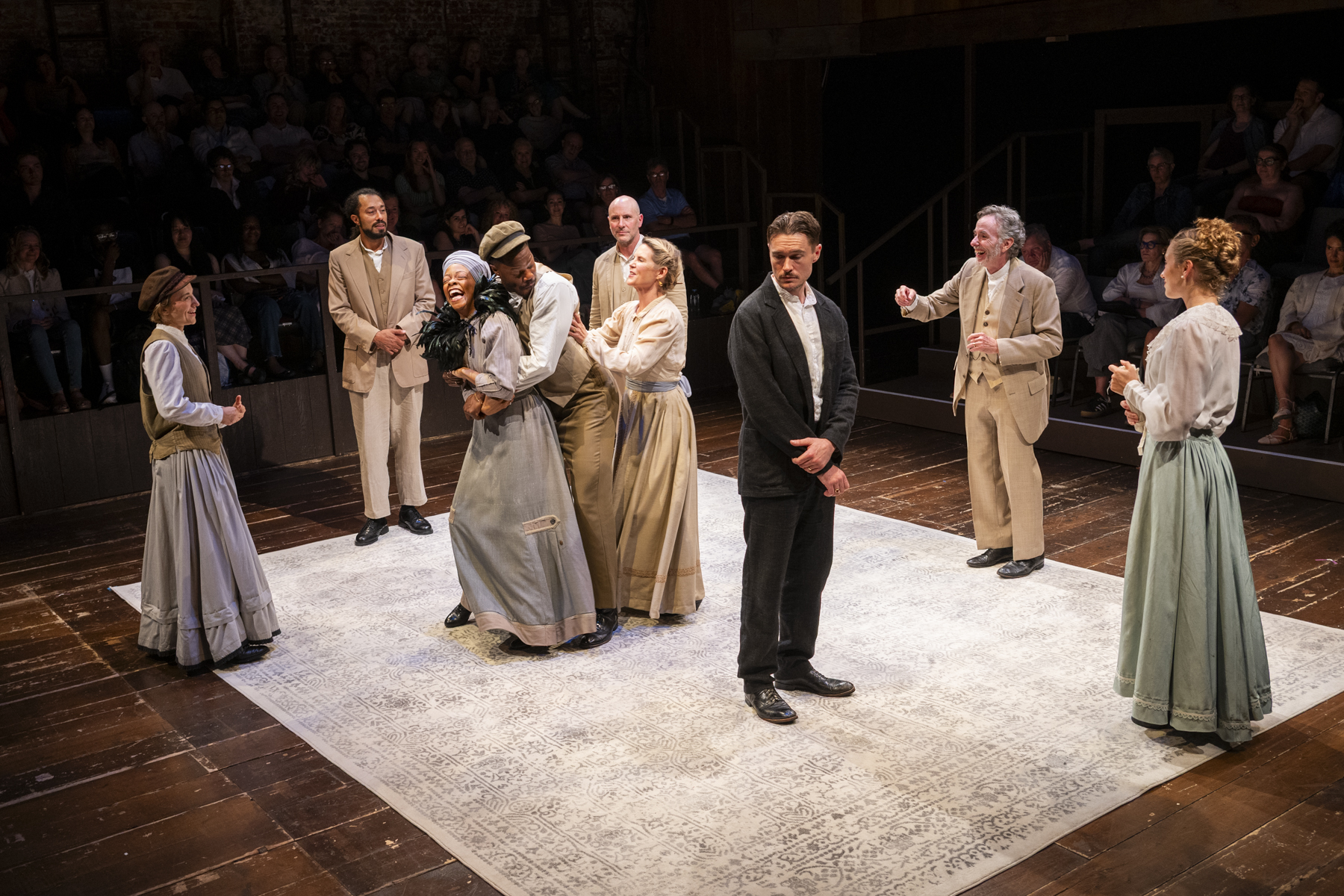
Strausfeld has assembled a diverse ensemble to bring this new adaptation of Chekhov to life, opting to frame this story in a more theatrical setting versus a presentational, naturalistic one. I especially appreciated her choice of putting the audience into the mindset of Ivanov (a brooding and sensitive Sam Underwood), which happened a handful of times during key moments of The Real Ivanov. The rest of the cast freezes as the stage becomes bathed in an icy blue light courtesy of Jiyuoun Chang, providing a chance for Underwood to walk amongst them in bewilderment, confusion, disorientation. This happens a few times in the play, but is quite effective at communicating how unmoored Ivanov is from the rest of his people, how disconnected from their reality.
The Real Ivanov is staged in the round, so that the audience always knows that we are witnessing a play. In addition, this arrangement made me think that we were all complicit in Ivanov’s glacial but steady slide into deeper emotional darknesses. The seating-arrangement also evoked a surgical theater, with the audience becoming a group of psychiatrists observing the subjects in the illuminated center.
Such non-realistic staging devices require an ensemble of actors up to the task of performing in a heightened theatrical style that will register to audiences at 360 degrees. In this regard, The Real Ivanov’s cast is mixed: none of the actors are terrible, but some are difficult to hear, even when their faces are clearly visible. Their acting style has genuine moments, clear logic, but is not being heard or understood by the audience, creating a kind of mix-up of approaches. On the other hand, a number of the actors are able to grasp the frequency that Strausfeld seems to be aiming for. Jordan Lage is excellent, for example, at embodying a rakish uncle, often stealing each scene that he is in. Amelia Mason, too, as the woman Ivanov longs for outside of his marriage, is able to be both believable and theatrical in scenes which are predominantly dramatic. Soph Metcalf transforms the minor character of a page into a whole person possessing an entire backstory (even if we only catch glimpses of it); and Spencer Aste proves expert in playing both comedy and drama, as his role as Mason’s father requires both.
There are many strong scenes in The Real Ivanov. Strausfeld maximizes the theatrical opportunities of the venue by having characters enter and exit from multiple points, as well as keep them on a narrow red carpet stretched out on a diagonal for the climatic fourth act. Some audiences may be surprised at the frequent anti-semitic beliefs held by a large number of Chekhov’s characters in this world, but depiction does not equal endorsement. Besides, this is secondary to Strausfeld’s singular aim: to stage this lesser-known classic in a fresh, often dynamic theatrical environment, and to probe the subject of clinical depression and its effects through contemporary storytelling.
The Real Ivanov
Adapted & Directed by Laura Strausfeld
Lynn F. Angelson Theater
August 17 – September 19, 2026
Leave a Reply