
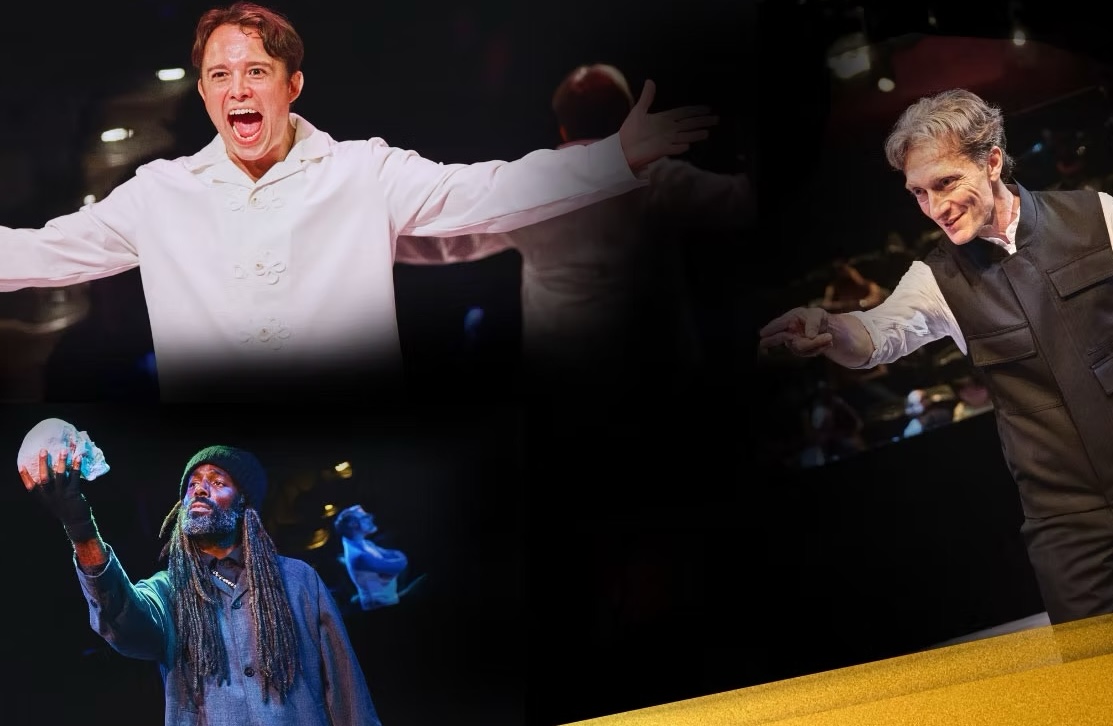
 Inside the theater, warped mirrors hang from the upstage wall, distorting my reflection and reminding me of being inside a funhouse. There’s still a few minutes before the show begins, and a few actors mingle with the audience. As I overhear one approaching my row, I note that they are addressing everyone as Hamlet. After a brief exchange with one of them, I am approached by a second who introduces themself as a Facilitator. Do I want to participate in tonight´s show by reading a line from the play? They go over some basic rules–that they will cue me by touch, and that I can say the line any way that I want.
Becoming Hamlet hasn’t even begun (or has it?), but already this is going to be a different take on a classical play.
Shakespeare’s story of the young Danish prince is so iconic, so famous, that even if you haven’t read or ever seen a production of the play, you probably know the basic plot. Fragments from its soliloquies have been floating around our collective consciousness for centuries, and the play has become the epitome of classical drama for much of the public. For actors, the role has it all: there´s ample opportunity to display emotional moodiness punctuated by moments of wit and levity; there´s a climatic fight scene; plus, the play has some of the most profound reflections about the nature of life and death ever written. Getting cast as Hamlet is like being offered a chance to climb Mt Everest: it might destroy you, but the adventure is guaranteed to be a once-in-a-lifetime experience.
This Elizabethan tragedy is also complex, inviting a wide range of interpretations–is Hamlet truly mad? What is the nature of his relationship with his mother? Why does he wait so long to act? Countless exceptional actors have taken on the part over the years, and excerpts from many brilliant performances can be enjoyed for free on YouTube. There´s also numerous full-length cinematic adaptations, from Sir Laurence Olivier’s black and white classic to the contemporary New York City version starring Ethan Hawke. With so many versions already in existence, it can be intimidating to even approach such a well-known script. How do you make Hamlet fresh in 2026? How can theater break new ground, and reveal something new?
In Becoming Hamlet, Damon Horowitz has adapted Shakespeare´s play into a minimal stage production that is interactive and participatory. While Horowitz plays the “primary” Hamlet onstage, he and director Sybille Bruun have democratized the Danish prince, so that he becomes one performed by various audience members each night. When the play officially begins, Horowitz approaches two audience members seated in the front row. “How are you feeling right now?” he asks them.
“Worried,” the first one answers.
“Excited,” replies the other.
“That’s Hamlet,” he says, nodding. “He’s worried and excited. And tonight, we want to put you into his mind, to feel what he feels, to go through his same struggles. Tonight, we are Hamlet.”
This participatory frame is a novel strategy; rather than compete with the many singular actors who have played Hamlet in the past, Becoming Hamlet makes him into a chorus. The techniques deployed by this ensemble are simple and easy to pick up, making the script accessible to new audiences and bringing this 425-plus-year-old play down to earth, so to speak. Plus, for anyone with a theater background, Becoming Hamlet might remind you of some exercises you did in a university acting class. Think choral work, with a few dashes of Augusto Boal and Keith Johnstone.
When Becoming Hamlet works, the production sparkles. Horowitz has trimmed down Shakespeare’s five acts into a brisk 100-minute version with no intermission, and while the action is mostly onstage, the dialogue ping-pongs throughout the space between actors and audience. Participants are encouraged to “echo” certain pieces of dialogue unfolding onstage, as well as perform some basic gestures–such as tapping on our chests (to create a racing heartbeat, during the infamous Hamlet/Gertrude closet scene) or to pretend to shiver from the cold (for when we go to the parapet to first meet the Ghost of Hamlet’s father).
There are limitations to this participatory approach, resulting in uneven results. For example, I couldn´t always hear some of the audience members who volunteered to speak their lines. But then other times, there were moments when audiences interact with an actor onstage–or, as happens more often as Becoming Hamlet progresses, when audience members leave their seats and join the cast onstage–that these volunteers steal the scene with their spontaneous natural ability. Sometimes, a scene is weakened by this convention of “fragmenting” Hamlets lines between the audience and actor–such as when Ophelia (a talented Jude Feingold) is playing off of Horowitz and another audience member in the famous “Get thee to a nunnery” scene; or when
Horatio (a strong Tyler Moss) is informing Hamlet that he has seen the ghost of his dead father (a charismatic Equiano Mosieri). In these and other moments, the actors dont have a consistent opposite to return the ball back over the net.
But maybe this is how Horowitz and Bruun want it? Becoming Hamlet prioritizes communal-discovery and audience-engagement over polished scenes prepared in advance. And this indeed is interesting and has some moments that capture the imagination, and make the play feel almost new. Some of these participatory experiences work better than others. Sometimes, I just want to hear the “To be or not to be” soliloquy in a single voice.
Becoming Hamlet
Adapted by Damon Horowitz, Directed by Sybille Bruun
Five Angels Theatre
September 5 – October 3, 2026
Leave a Reply