
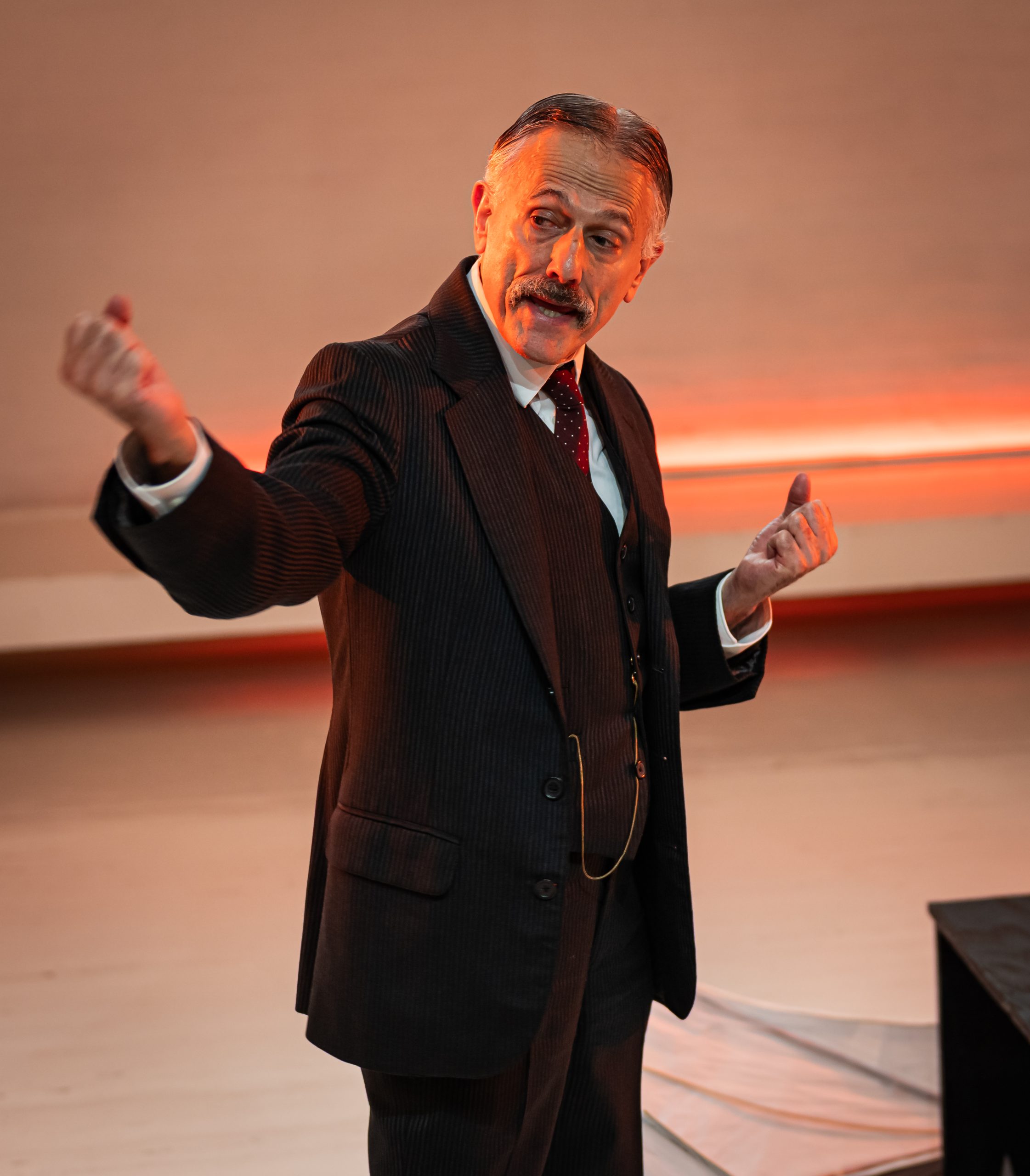

Let me say this right off the bat: if nothing else, I urge theater-lovers to see The Invention of Love just for David Greenspan’s brilliant performance. As the older A.E. Houseman, the role demands the actor to recite poetic passages in Latin with effortless adoration, as well as oscillate between uptight British manners and a wit sharp as a rapier, the distinct arrogance that often accompanies a brilliant mind, and the ability to vividly embody moments of longing, regret, and profound despair. Houseman must slip into these various states within a single scene, sometimes mid-thought or within a single sentence, creating a window into a man’s complex interiority. Greenspan fulfills these demands exquisitely, powerfully; Houseman’s monologue at the end of Act I exemplifies these different facets coming together. This is a role which excites the mind, stirs the emotions, and transports the spirit.
But Greenspan is not the only talented actor onstage in The MAP Theater’s intimate revival of Tom Stoppard’s play. I saw the 2001 Broadway production starring Richard Eastman and Robert Sean Leonard (which was exceptional), so was curious how the choice of a studio at TheaterLab with approximately 60 seats would fare. Director Zachary Elkind has wisely prioritized proximity with the actors and the story over grandeur or spectacle, letting the language of the text perform even more magic. Bridget Lindsay’s scenic design is minimal and clean–a few benches, some cricket bats, a small structure that implies a small sea vessel–and Alyssa Korol’s costumes portray enough period and place to gesture to each character’s singular essence. Every actor in The Invention of Love is well-cast, each savoring the demands of this particular playwright’s complexities.
Stoppard’s plays often delight in dramatizing intellectually dizzying ideas; past works include an absurdist retelling of a Shakespearean tragedy from the perspective of its most insignificant characters (“Rosencrantz and Guildenstern Are Dead”), while another imagines a meeting between Tristan Tzara and James Joyce (“Travesties”), and having his characters speak in the literary styles they pioneered, Dada and stream-of-consciousness. In The Invention of Love, people frequently quote Latin and ancient Greek, and the non-linear sequence of scenes take place not only during the late Victorian era but also in the infernal underworld. Within this theatrical reality, there are multiple times, more than one reality, and their currents travel according to their own logic.
In the opening scene, Greenspan sits in a boat slowly meandering down the river Styx, ferried by Charon (Annabel Capper). Houseman is haunted by memories of the past, primarily from his student days at Oxford, when he first awakened to his deep love for classmate Moses Jackson (Jose Espinosa), a man as handsome as his younger self (Yoran Lotan) is awkward. As the young Houseman, Lotan captures the exquisite angst of the wallflower, the intellectual who cannot express his feelings for the athletic object of his adoration. Their scenes are tragic as well as identifiable, a condition that will eventually result in a calcification of Houseman’s demeanor, causing a cataract to form over his ability to show any emotion.
Of course, Stoppard scaffolds The Invention of Love with structures of irony, tension, and contradiction. While Houseman secretly pines for Jackson, he spends his time at Oxford studying Catullus and other Roman poets from antiquity who “invented the language of love,” eventually becoming an expert on the subject professionally. Plus, running parallel to Houseman’s closeted homosexuality is Oscar Wilde (Sam Bolen), a peer and distant acquaintance at the university who is causing a stir with his flamboyant dress and open acceptance of his queerness. These two historical figures serve as contrasts to one another on “the love that dare not speak its name,” as they make different choices within their repressive era. While Wilde faced imprisonment for gross indecency and the criminalization of his desire, he also created a model of how to be a modern queer individual who is unafraid of being different. Houseman, instead, has built his own prison out of ancient texts, which he pores over and discusses within his classroom with fervor, because the placement of a comma “can separate truth from falsehood.”
While most of the events inside Stoppard’s play occur 150 years ago, its themes feel timeless. Can one truly understand love, if one has never directly experienced it? Which is the more important path–the safe and scholarly study of the past, or the risks of forging something new as the poet? A key scene between the two Housemans highlights the mixture of reflection and regret permeating the play, as Greenspan gently speculates in front of Lotan if he has made the right choices in his life. But as with everything in Stoppard, such answers are never that black or white. In The Invention of Love, there is a price for every choice that we make, and especially when it comes to affairs of the heart, pain is unavoidable. Perhaps the question is more about how much suffering we are willing to bear, in order to accept who we are and who we are?
This revival is a tremendous production of a richly textured play, interpreted by an excellent ensemble, and featuring an exceptional actor in its leading role. Don’t miss it.
The Invention of Love
Starring David Greenspan and directed by Zachary Elkind
The MAP Theater at TheaterLab
September 17 – October 3, 2026
Leave a Reply