
Big tech is extracting our humanity. Data centers to power more LLMs are draining our water supply and forcing our electricity bills to skyrocket. The statistical probability that artificial intelligence will cause human extinction or the severe, irreversible disempowerment of humanity–”P(doom),” for short–is no longer just a story arc from The Terminator franchise. The robots are coming.
So why are more people not freaking out?

Maybe because, like climate change, imagining how AI will change our lives is too vast to fully grasp. Alongside the numerous reports outlining the dangers this new unregulated technology poses to all of humanity, millions of people continue to voluntarily use AI every day, and often for banal personal use. Under such circumstances, as we blithely use ChatGPT or Claude to write our emails or doctor some videos, are we becoming co-conspirators with our own demise?
Playwright Kate Vozella invites audiences to keep these questions in mind while watching her new play Machine Learning. On the one hand, AI-ambivalence permeates the work, especially in framing the scenes and themes which unfold over 90 minutes. At the same time, the story left me feeling pretty grim about humanity’s prospects to prevent self-extinction. People are just too self-involved, Vozella seems to be saying, too distracted by petty disputes and our own personal traumas.
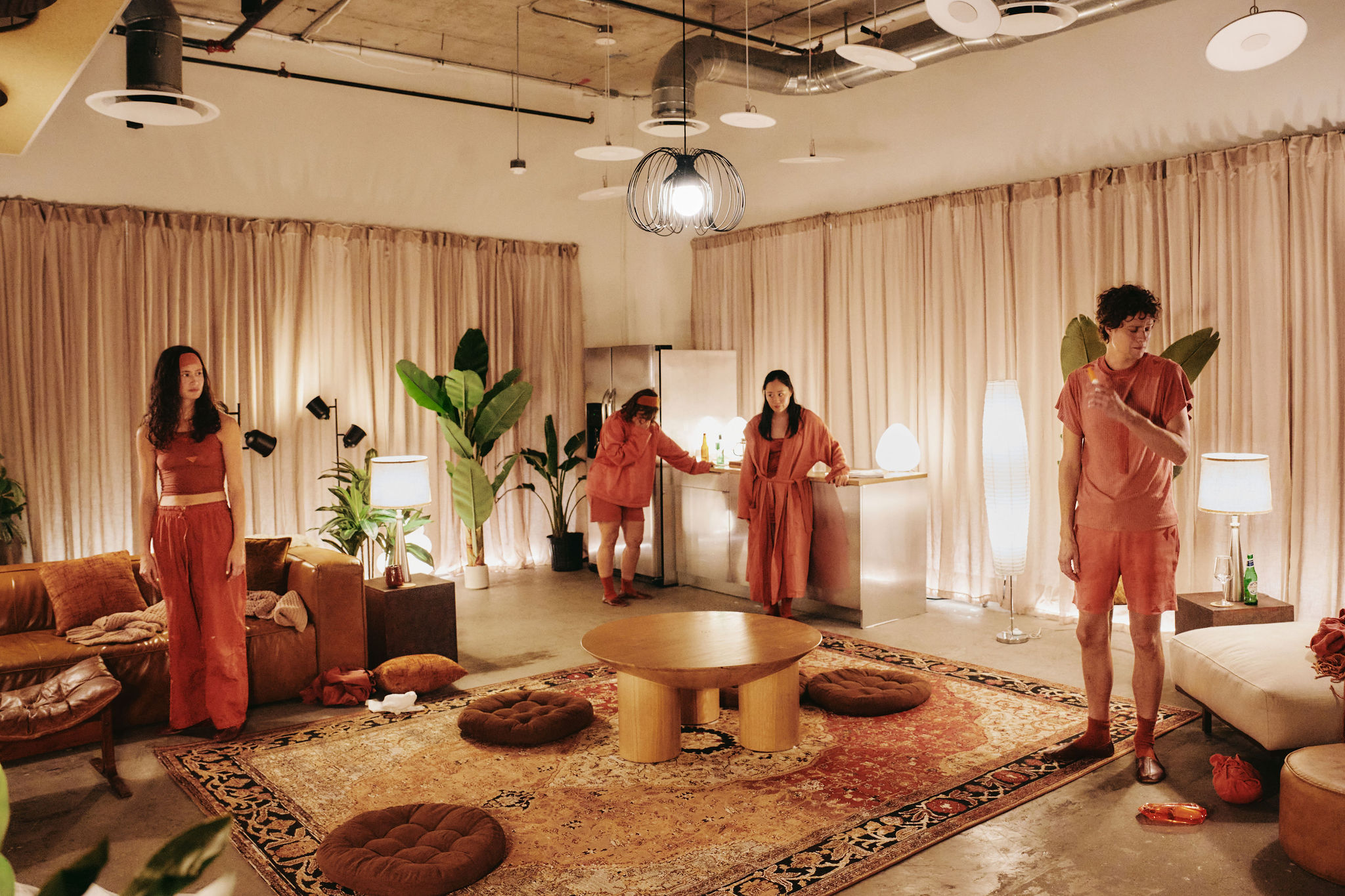
Four people sign up to live in a house for weeks under a particular kind of observation. As one character wryly observes, the living room “looks like a showroom from IKEA,” comfortable yet generic, the boogie objects all various shades of earth tone. The color palette of Karen Boyer’s costume design matches that of Tyler Herald’s set, perhaps suggesting that these men and women are interchangeable with the furniture. But why are these people volunteering to be part of this unusual experiment? Details are scarce and purposefully vague. Is this a contest? Will they be getting paid? Initially, audiences may associate this set-up with HouseGuests from “Big Brother” reality TV, or even Sartre’s infamous play “No Exit.”
As it turns out, this foursome are helping to train a new generation of AI models by giving them 24/7 access to their lives. There is gay couple Willa (a fine Michelle Selene Ang) and Lucia (an emotionally raw Emma Ramos), whose unspoken tensions are evident as soon as they enter the space. Lucia, a writer who doesn’t like the label “lesbian,” is stuck on completing the manuscript for her second novel. Her wife Willa is unemployed for reasons we will discover later, and both have a complicated relationship to motherhood that will come to a head before Machine Learning is over.
When the two return from dinner, they discover a second couple in their space–in the middle of having some unconventional sex, as a matter of fact. Charlie (a sensitive Douglas Smith) is a visual artist trying to build his own body work, and maybe drinks too much. His partner Georgia (the absolutely hilarious Delaney Rowe) is a psychotherapist who often undermines his self-confidence, and cannot resist analyzing everyone around her, often with malicious intent.
Performed without intermission, Machine Learning is a series of episodes that span a number of weeks, showing these vulnerable characters in various states of conflict. They frequently interrupt one another, leading to misunderstandings and hurt feelings, and their base-line present-day identities seem to be characterized by past traumas and pain, which they willingly use to their advantage whenever necessary. Is this who we are? Vozella’s view of humanity is rather grim, and often darkly comic.
Only Georgia seems consistently impervious to attack. We discover the reason why eventually, why she seems so strong and unaffected while the others are so broken and needy. If Machine Learning is about teaching AI how to be “authentic,” the sum of these interactions would conclude that humans are essentially selfish, manipulative, and afraid. And yet, despite all of the conflict, these four find a way to get along, much like humans do. Is that part of the point of the play? Are humans kind of like ChatGPT, possessing a limited memory that can simply be “refreshed” day to day?
For me, Rowe steals the show as Georgia. She cracks the most jokes, and takes considerable delight in being an agent of chaos. Ramos, too, has a number of emotionally risky scenes in the play, particularly towards the end with her wife Willa. Each of these actors has a moment in Machine Learning–a confession that invites the audience to feel empathy towards them and their plight. But such sympathy is tempered by Vozella’s setting within this larger dystopian environment. For these four, technology is not just a tool, but an extension of their personal needs; AI is merely a servant that will assist each of them to continue their vapid lives with less and less friction. Rarely do they interrogate why they are training AI to replace humanity in the first place. Is it because they don’t believe their own humanity has much value in the first place? Vozella lets those questions linger in the air, a fog that each audience member has to wade through on their own.
Colm Summers directs this ensemble in a style of relaxed naturalism, wisely leaving the darker and more dystopian thematic undercurrents to Vozella’s script to be felt subconsciously. By the end of Machine Learning, the characters are left wondering who or what is “real,” broadening this into a dialogue of superficiality/authenticity that continues after the play concludes. Through dark humor and a sinister premise, Vozella’s new play leaves the audience with many questions to ponder.
Machine Learning
Little Engine Theater at Manhattan Neighborhood Network
October 6-30, 2026
Leave a Reply