
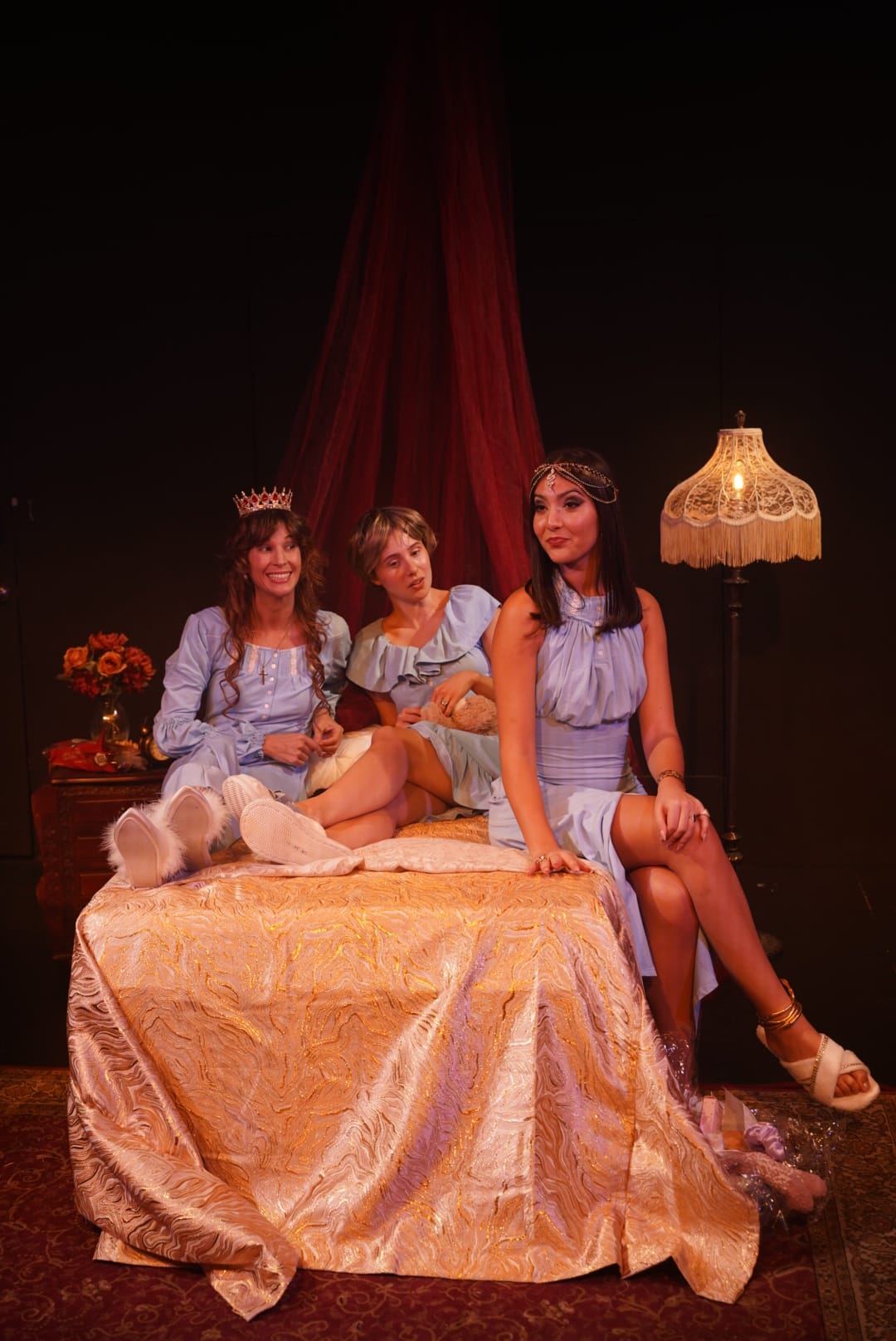
Night. A young woman sits in a room containing a bed, flanked by a small settee with a chessboard, and a vanity table cluttered with bottles of perfume. Candy wrappers and empty boxes of chocolates litter the floor.
The time is July 28, 1981. On her wedding day tomorrow, this woman will wed Prince Charles III. Diane Spencer will become Princess Di.
What is going through her mind on the eve of this momentous occasion that will change her life forever? What reservations does she have about transforming into a British royal? What opportunities will her new title afford her, and what will be her legacy in Thatcherite England?
These are some of the questions posed by The Queen Club, a new play written by Stella Steinheim and directed by Rosie Corr. Unfolding over the course of a single evening, the events take place in the intimate space of the NuBox Theater, creating a sense of intimacy and claustrophobia.
At first, we glimpse Diana (played by Steinheim) attempting to push down her anxiety by eating junk food. Later, she will retreat to a bathroom upstage to purge. Steinheim, though Norwegian by birth, captures the British accent and frail sensitivity of her historical counterpart. She appears lost and lonely in her dark little room, resolved to her fate.
Suddenly, in a theatrical move reminiscent of Dickens’ “A Christmas Carol,” Diana is visited by the spirits of two queens. The first is Isabel (Irene Aguilar), who initially frightens and confuses her. Why does the apparition from the 15th century who unified Spain want to see her? Then Cleopatra (Aurelie Drago) waltzes in, and young Di discovers that they are there to mentor, and to welcome her into a timeless sorority of women royals.
The three actors converse with youthful abandon, the no-nonsense dialogue of these once and future queens accessible and contemporary. One aim of The Queen Club seems to be highlighting the accomplishments of these historical figures, and to recognize that some challenges that women face remain unchanged across time.
Steinheim’s script is a feminist tract told through drama. As their conversation unspools through the night, Diana interrogates personal agency and gender-based privilege, questions which are universal concerns for women seeking to live in an equitable society. One major dilemma for Di is if she even loves Charles, and if that question should even be a concern. Should she be more strategic and simply “use” her entry into the British royal family to pursue her own ambitions for public good–such as calling for the removal of landmines in Africa, and using her public power to show compassion to people living with AIDS during the epidemic of the 1980s.
Her spectral girlfriends don’t always see eye to eye, though, highlighting how feminism is not monolithic and everyone ultimately needs to make their own choices. Of the two, Cleopatra is the more pragmatic, prioritizing personal pleasure and the acquisition of power. Drago’s interpretation of the last pharaoh of Egypt is often sassy and sensual, and she consistently lands her comedic dialogue with a breezy delivery. Isabel is more sympathetic to Diana’s doubts, and encourages a more traditional view (perhaps based on the queen’s Catholicism?). She shares her belief that not loving one’s husband is actually quite normal, in the beginning, because one “grows to love” one’s spouse over the course of a marriage. In The Queen Club, tradition frequently presses up against modernism. Which elements of the past be upheld, and which jettisoned forever?
Corr directs this tiny ensemble loosely. The gestures of Steinheim, Aguilar, and Drago appear almost improvised, as if they are choosing where to go and what to do on the spot. Sometimes their blocking feels a bit too constrained by the crowded set pieces (also designed by Corr), the small black box space confining. Other times, their physical limitation feels like a thematic choice: Diana, the fragile bird, seeks freedom from her gilded cage.
I am old enough to remember when Princess Di died (or was killed by paparazzi, depending on who you ask) in 1997, so my read of The Queen Club might be different than some younger audiences. Whenever the three royals speculate about her future, it’s hard to share their optimism. Whatever happiness Diana will be able to wrest from her new life will be short-lived. For all of her royal power and noble beliefs, she will still perish at the age of 36 in a Parisian tunnel.
But that doesn’t seem to be the message of this production. The Queen Club encourages everyone, no matter what their station, to do as much good as you can, with whatever time you are given, and with whatever resources available to you. And in 2026, that’s a idea worth repeating.

The Queen Club
The NuBox Theater
October 22-25, 2026
Leave a Reply