
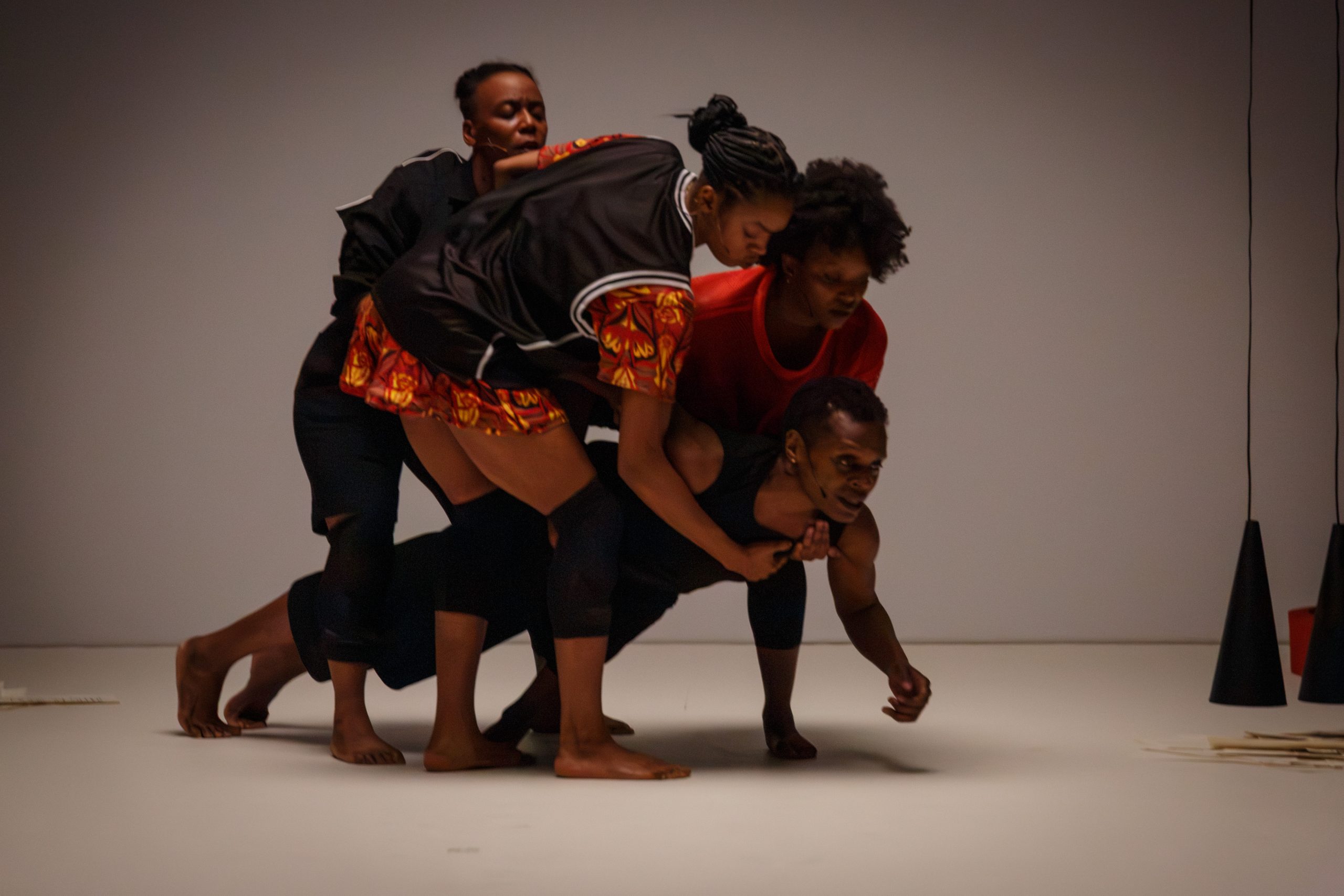
Okwui Okpokwasili’s long body is already twisting and contorting into unusual shapes as the audience enters, her movements following some hidden tempo. Above her, projected ocean waves rush to the shore over and over again, while around the edges of the space are low sinuous structures, a red border suggesting geologic pathways. Gentle light pours out of lamps just above the floor, suspended by long cords attached to the ceiling. Scattered throughout the space are three others (Bria Bacon, audrey elaine hailes, and AJ Wilmore), sitting at ease, bearing witness to Okpokwasili as her disquieting solo continues. The mood is mysterious, punctuated by a performer’s visceral gasps or grunts. Facing this landscape of light, form, and shadowy bodies feels as if we are peering into another world.

adaku, part 2: she shivers with it is the latest created by sweat variant, a vehicle for the artistic collaborations between Okpokwasili (who wrote the piece) and Peter Born (who served as its director and production designer). The piece defies clear categorization, as 90-minute performance includes not only movement, but original recorded sound, live vocalizations, and spoken text. Regardless of how one labels it, adaku is unmistakably powerful, even gut-wrenching.
The movement language embodied by these performers is an expressive chaos, with each one appearing to willingly step into states of structured risk. When Okpokwasili “finishes” her opening solo by leaning into Bacon, she then sits so that this new woman can interpret this frenzied state of moving in her own kinetic way. Later, Wilmore and hailes will surrender their bodies to gravity, allowing their weight to completely fall towards the floor before the others catch them at the very last moment. Movements, and later sounds and words, are frequently shared in adaku, forming potent images of trust and letting go, and highlighting the web of connections between individuality and lineage. Who are we, except the latest iteration of everyone who has come before us?
After the opening canon of movement is complete, the four performers huddle in a group crouch to vocalize in the downstage corner. Their voices rise and lower, sharing pitches and creating passages of harmony and friction. The sounds could be interpreted as “singing,” at least in the beginning, but as their voices continue to vibrate, their emotional qualities push the sound into other realms of expression: shouts, howls, wails, screams. And still the performers go on, their voices soaring to surprising depths, revealing tracks of tears streaming down their cheeks. This isn’t a song. This is a plea, a demand to witness.
When adaku shifts into a quieter tone, we see the toll that has been taken on them as they begin to slowly rise back onto their feet. Okpokwasili is the first to stand. She comes to the edge of the space, pausing long enough to make eye contact with various members of the audience before moving on to a new spot. She wants to see us, but also to remind us that she knows we are watching her and the others–an act that invites a more intimate level of connection. Others begin to join her, watching and being watched, and all of them begin to repeat a few words: “okay” and “just breathe,” using repetition to give them slightly different interpretations, implying different stories but also sounding a bit like music.
The final section of adaku is a kind of extended choral reading of an original text. The story, spoken by a single narrator but in the voices of all four performers simultaneously, begins with a hungry woman detailing an experience of casual racism at a restaurant. But the narrative slips into other moments of time and reality to include the narrator’s mother, their own birth, visions of an afterlife, and more. Okpokwasili’s writing is riveting, and its telling is further haunted by the precision with which all four of them coordinate not only their speaking, but their movements. The performers take one step forward, or shift their weight to one side, or turn their heads. Meanwhile, the text describes the narrator’s own birth shooting out of her mother’s vagina at a man on the streets of New York, as well as describing how her mother was not in fact dead, and how her reappearance at the funeral caused a mixture of surprise, dismay, and disappointment.
Trauma and resilience are presented throughout this piece without explanation and without apology, and with as little filter as possible. In adaku, concepts of marginalization are destabilized, and part of the work sweat variant aims to produce involves placing Black identity and experience at the center of the art. Spawned from a collaborative partnership that is personal as well as professional, Okpokwasili and Born infuse this performance with added layers of vulnerability rarely experienced in the theater. This is an exceptionally raw and visceral piece of performance, wrought by a fearless artistic team which will haunt one’s memory long after the piece concludes.
adaku, part 2: she shivers with it
Created by sweat variant–Okwui Okpokwasili and Peter Born
BAM in association with L’Alliance New York’s Crossing The Line Festival
November 11-15, 2026
Leave a Reply